Perform RK4 between 2 Clusters in Magnetic Field

Join the discussion
Ask a follow-up here, or get your own question answered by working scientists, mathematicians and engineers — people, not an autocomplete.
Real named experts · corrections over time · the nuance an AI answer skips
12 replies · 2K views
harryharns
Messages
6
Reaction score
0
TL;DR
I have a simulated data of charged particles in a magnetic field. I have selected clusters, each cluster contains a set of points(x,z) and I want to perform RK4 between the first and second clusters and fill the positions in a histogram.

I have selected the clusters with the initial conditions(positions and velocity). but the thing is I have performed the rk4 but it is not behaving like I want and I am not able to perform the rk4 between the two clusters. Here is my code:
C++:
 firstCluster = hitClusterArray->at(0);
    secondCluster = hitClusterArray->at(1);
    firstPosition = firstCluster.GetPosition();
    secondPosition = secondCluster.GetPosition();
 
    Double_t iniPx, iniPy, iniPz;
    Double_t iniVx1, iniVy1, iniVz1;

    Double_t secPosX,secPosY,secPosZ;
    Double_t iniPosX,iniPosY,iniPosZ;

    secPosX = secondPosition.X();
    secPosY = secondPosition.Y();
    secPosZ = secondPosition.Z();
    iniPosX = firstPosition.X();
    iniPosY = firstPosition.Y();
    iniPosZ = firstPosition.Z();

    phi = TMath::ATan2(secPosY- iniPosY, secPosX - iniPosX);
    Double_t phiDeg;
    if (phi < 0){
    phiDeg = 360+ phi*TMath::RadToDeg();
    }  else {
    phiDeg = phi*TMath::RadToDeg();
    }

    iniPx = p * TMath::Cos(phiDeg*TMath::DegToRad()) * TMath::Sin(theta);        // in MeV/c
    iniPy = p * TMath::Sin(phiDeg*TMath::DegToRad()) * TMath::Sin(theta);              // in MeV/c
    iniPz = p * TMath::Cos(theta);                                              // in MeV/c    iniVx1 = (iniPx * 5.344286e-22)/m; //meter per second [m/s]
    iniVy1 = (iniPy * 5.344286e-22)/m;
    iniVz1 = (iniPz * 5.344286e-22)/m;
    int clusterCount = 0;
    for (auto iCluster = 0; iCluster < hitClusterArray->size(); ++iCluster) {
    auto cluster = hitClusterArray->at(iCluster);
    auto pos = cluster.GetPosition();

    Double_t clusterPosX = pos.X();
    Double_t clusterPosY = pos.Y();
    Double_t clusterPosZ = pos.Z();

    //std::count<<iniPosX << " " << iniPosY << " "<< iniPosZ <<endl << endl;
    for (pp =  0; pp< 100; pp++){

    l1x[pp] = fx(t1,iniPx1);
    l1y[pp] = fy(t1,iniPy1);
    l1z[pp] = fz(t1,iniPz1);

    l1vx[pp] = dxdt(t1,iniPx1,iniPy1,iniPz1);
    l1vy[pp] = dydt(t1,iniPx1,iniPy1,iniPz1);
    l1vz[pp] = dzdt(t1,iniPx1,iniPy1,iniPz1);

    l2x[pp] = fx(t1+h*0.5,iniPx1+0.5*h*l1x[pp]);
    l2y[pp] = fy(t1+h*0.5,iniPy1+0.5*h*l1y[pp]);
    l2z[pp] = fz(t1+h*0.5,iniPz1+0.5*h*l1z[pp]);

    l2vx[pp] =dxdt(t1+h*0.5,iniPx1+l1vx[pp]*0.5*h,iniPy1+l1vy[pp]*h*0.5,iniPz1+l1vz[pp]*h*0.5);
    l2vy[pp] =dydt(t1+h*0.5,iniPx1+l1vx[pp]*h*0.5,iniPy1+l1vy[pp]*h*0.5,iniPz1+l1vz[pp]*h*0.5);
    l2vz[pp] =dzdt(t1+h*0.5,iniPx1+l1vx[pp]*h*0.5,iniPy1+l1vy[pp]*h*0.5,iniPz1+l1vz[pp]*h*0.5);

    l3x[pp] = fx(t1+h*0.5,iniPx1+0.5*h*l2x[pp]);
       l3y[pp] = fy(t1+h*0.5,iniPy1+0.5*h*l2y[pp]);
       l3z[pp] = fz(t1+h*0.5,iniPz1+0.5*h*l2z[pp]);
       l3vx[pp] =dxdt(t1+h*0.5,iniPx1+l2vx[pp]*0.5*h,iniPy1+l2vy[pp]*h*0.5,iniPz1+l2vz[pp]*h*0.5);
       l3vy[pp] =dydt(t1+h*0.5,iniPx1+l2vx[pp]*h*0.5,iniPy1+l2vy[pp]*h*0.5,iniPz1+l2vz[pp]*h*0.5);
       l3vz[pp] =dzdt(t1+h*0.5,iniPx1+l2vx[pp]*h*0.5,iniPy1+l2vy[pp]*h*0.5,iniPz1+l2vz[pp]*h*0.5);

       l4x[pp] = fx(t1+h,iniPx1+l3x[pp]*h);
       l4y[pp] = fy(t1+h,iniPy1+l3y[pp]*h);
       l4z[pp] = fz(t1+h,iniPz1+l3z[pp]*h);

       l4vx[pp] = dxdt(t1+h,iniPx1+l3vx[pp]*h,iniPy1+l3vy[pp]*h,iniPz1+l3vz[pp]*h);
       l4vy[pp] = dydt(t1+h,iniPx1+l3vx[pp]*h,iniPy1+l3vy[pp]*h,iniPz1+l3vz[pp]*h);
       l4vz[pp] = dzdt(t1+h,iniPx1+l3vx[pp]*h,iniPy1+l3vy[pp]*h,iniPz1+l3vz[pp]*h);      iniPx1 = iniPx1 + h/6 *( l1vx[pp] + 2*l2vx[pp] + 2*l3vx[pp] + l4vx[pp]);
      iniPy1  = iniPy1 + h/6 *(l1vy[pp] + 2*l2vy[pp] + 2*l3vy[pp] + l4vy[pp]);
      iniPz1  = iniPz1 + h/6 *(l1vz[pp] + 2*l2vz[pp] + 2*l3vz[pp] + l4vz[pp]);

      iniPosX = iniPosX + h/6 *( l1x[pp]  + 2*l2x[pp] + 2*l3x[pp] + l4x[pp]);
      iniPosY  = iniPosY + h/6 *( l1y[pp] + 2*l2y[pp] + 2*l3y[pp] + l4y[pp]);
      iniPosZ  = iniPosZ + h/6 *( l1z[pp] + 2*l2z[pp] + 2*l3z[pp] + l4z[pp]);
                                  
    
         kx_vs_ky->Fill(iniPosX, iniPosY);

      }

       //Update the initial conditions for the next cluster
         iniPosX = clusterPosX;
         iniPosY = clusterPosY;
         iniPosZ = clusterPosZ;
                               
          ++clusterCount;
       if (clusterCount > 2) {
           break; // stop iterating over clusters after the second one
           }
    }
<Moderator's note: Please use code tags when posting code>
 
Last edited by a moderator:
Physics news on Phys.org
harryharns said:
but the thing is I have performed the rk4 but it is not behaving like I want and I am not able to perform the rk4 between the two clusters.
For useful advice from us you need to provide more detail on what "not behaving like I want" means.

Also, there are several function calls (?) to functions that aren't shown in your code: dxdt(), fx(), fy(), fz(). I assume these are function calls. If they aren't coded correctly, that will affect the code you've shown.

Are you using a debugger? If not, why not? Can you hand-simulate a simple data set to do some calculations, and compare your results to what your program produces?

In addition, there are a whole bunch of what seem like arrays that don't have declarations.
 
I have the functions declared from the equation of motions. No I am not using a debugger as I am new to c++ and I do not know what a debugger is. can you advice me on the best debugger to use? and all the arrays are declared I didnt show the whole code as it is long. I have used a simple calculation for the rk4 but not simulated data. the problem is that between cluster 1 and cluster 2 there should be the rk4 points.
 
harryharns said:
No I am not using a debugger as I am new to c++ and I do not know what a debugger is. can you advice me on the best debugger to use?
A debugger is software that lets you insert breakpoints in your code to allow you to single-step through it. Most debuggers have a lot of features besides this, including inspecting variables, looking at memory, and many other options. Most C++ compilers come with a set of tools, such as a debugger, profiler, and other software.

Before I can advise you on which debugger to use, I need to know which compiler are you using?
 
harryharns said:
I want to perform RK4 between the first and second clusters and fill the positions in a histogram.
I can't make any sense of this. Could you please elaborate on what you want to solve?
 
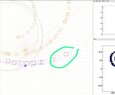
this is what I want to solve. In the image, the cubes (circled in green)are the clusters with positions (x,y,z). I want to calculate the small points between cluster 1 and cluster 2 using the rk4 method.
 

Attachments

  • WhatsApp Image 2023-05-10 at 12.04.39 PM.jpeg
    WhatsApp Image 2023-05-10 at 12.04.39 PM.jpeg
    37.5 KB · Views: 163
harryharns said:
this is what I want to solve. In the image, the cubes (circled in green)are the clusters with positions (x,y,z). I want to calculate the small points between cluster 1 and cluster 2 using the rk4 method.
I'm sorry, but this is not helpful at all. What differential equations are you solving?
 
Charge particles in magnetic and electric field. this is the functions.
C++:
Double_t  dxdt(double t,double vx, double vy, Double_t vz){

        Double_t Energy = GetEnergy(vx, vy, vz);
        Double_t st = StoppingPower(Energy);
        Double_t Ex,Ey,Ez,f1;                   //Electric field in V/m. 
        Double_t Bx,By,Bz;              // magnetic field in Tesla
        Double_t rr,az,po;
        Double_t q = 1.6022*TMath::Power(10,-19);       //charge of the particle(proton) in (C)
        Double_t m = 1.6726*TMath::Power(10,-27);       // mass of the particle in kg
        Double_t B= -3.0;                 // Applied magnetic field (T).
        Double_t E=TMath::Cos((q*B)/m) * 500;   // Applied Electric field(V/m).
        Bx = 0;
        By = 0;                 // magnetic field in x and y  direction in Tesla.
        Bz = B;          // magnetic field in the z direction in Tesla.
        Ex = 0;
        Ey = 0;                 // Electric field in the x and  direction in V/m.
        Ez = -E;                        // Electric field in the z direction.         rr = TMath::Sqrt(TMath::Power(vx,2)+TMath::Power(vy,2)+TMath::Power(vz,2));
        az = TMath::ATan2(vy,vx);
        po = TMath::ACos(vz/rr);

        f1 =  q/m * (Ex + vy*Bz-vz*By) - st*TMath::Sin(po)*TMath::Cos(az); //-s*TMath::Sin(po)*TMath::Cos(az) ;                                    //dxdt with energyloss compensation.

        double bro = Bz * rr / TMath::Sin(po)/ 1000.0;
//count<<Energy<<endl;
//count<<bro<<endl;
        //std::count<<Ex <<" "<< vy<<" "<<vz << " " <<By<< " "<< f1<<std::endl; 
        return f1;

        }

double  dydt(double t,double vx, double vy, Double_t vz){
Double_t Energy = GetEnergy(vx, vy, vz);
        Double_t st = StoppingPower(Energy);
        Double_t Ex,Ey,Ez,f2;              //Electric field in V/m. 
        Double_t Bx,By,Bz;              // magnetic field in Tesla
        Double_t q = 1.6022*TMath::Power(10,-19);   //charge of the particle in C
        Double_t B= -3.0;                 // Applied magnetic field.
        Double_t rr,az,po;
        Double_t m = 1.6726*TMath::Power(10,-27);  // mass of the particle in kg
        Double_t E = TMath::Cos((q*B)/m) * 500 ;
        Bx = 0;                      // magnetic field in x and y  direction in Tesla.
        By = 0;
        Bz = B;          // magnetic field in the z direction in Tesla.
        Ex = 0;                      // Electric field in the x and  direction in V/m.
        Ey = 0;
        Ez = -E;                        // Electric field in the z direction.

        rr = TMath::Sqrt(TMath::Power(vx,2)+TMath::Power(vy,2)+TMath::Power(vz,2));
        az = TMath::ATan(vy/vx);
        po = TMath::ACos(vz/rr);       f2 =  q/m * (Ey + vz*Bx - vx*Bz) - st*TMath::Sin(po)*TMath::Sin(az); 

        double bro = Bz * rr / TMath::Sin(po)/ 1000.0;
//count<<bro<<endl;
//count<<Energy<<endl;
        //std::count<<f2<<std::endl;
        return f2;
        }

double  dzdt(double t,double vx, double vy,Double_t vz){
Double_t Energy = GetEnergy(vx, vy, vz);
        Double_t st = StoppingPower(Energy);
        Double_t Ex,Ey,Ez,f3;              //Electric field in V/m. 
        Double_t Bx,By,Bz;              // magnetic field in Tesla
        Double_t q = 1.6022*pow(10,-19);   //charge of the particle in eV
        Double_t B= -3.0;                 // Applied magnetic field.
        Double_t rr,az,po;
        Double_t m = 1.6726*TMath::Power(10,-27);  // mass of the particle in kg
        Double_t E = TMath::Cos((q*B)/m) * 500 ; 
        Bx = 0;                      // magnetic field in x and y  direction in Tesla.
        By = 0;
        Bz = B;          // magnetic field in the z direction in Tesla.
        Ex = 0;                      // Electric field in the x and  direction in V/m. 
        Ey = 0;
        Ez = -E;                        // Electric field in the z direction.

        rr = TMath::Sqrt(TMath::Power(vx,2)+TMath::Power(vy,2)+TMath::Power(vz,2));
        az = TMath::ATan(vy/vx);
        //std::count<<az<<endl;
        po = TMath::ACos(vz/rr);        f3 =  q/m * (Ez + vx*By - vy*Bx)- st*TMath::Cos(po);
        double bro = Bz * rr / TMath::Sin(po)/ 1000.0;
//count<<bro<<endl;
//count<<Energy<<endl<<endl;
        //std::count <<r<< " " << TMath::Power(vy,2) + TMath::Power(vx,2) + TMath::Power(vz,2)<< " " << TMath::Power(vz,2) <<  std::endl; 
        return f3;
        }

//  Functions for positions.

Double_t fx(Double_t t, Double_t vx){       Double_t f1x =  vx;
        return f1x;        }

Double_t fy(Double_t t,Double_t vy){        Double_t f2y = vy;
        return f2y;        }
Double_t fz(Double_t t,Double_t vz){

        Double_t f3z =  vz;
        return f3z;

        }
 
Last edited by a moderator:
harryharns said:
I am using the root for it
I don't know what this means in the context of C++ compilers. Are you possibly using gcc? I believe that's the compiler that comes with Linux distributions.
 
ROOT is a C++ based framework widely used in particle physics. It comes with a C++ interpreter.

There is a lot of weird stuff in the code that makes understanding it more difficult.
Code:
Double_t fx(Double_t t, Double_t vx){
       Double_t f1x =  vx;
        return f1x;
        }
This function does nothing besides returning its second parameter.
The comment is "Functions for positions." but it accepts a parameter vz, which would naturally be the name for a velocity. Equivalently for y and z.

Where is theta calculated? The code uses it.

dxdt, dydt, dzdt have a lot of redundant code and could be combined to a single function.