SUMMARY
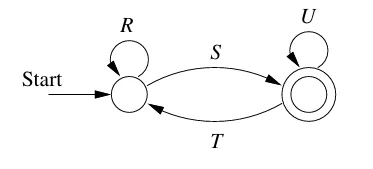
The discussion centers on proving the equivalence of two regular expressions derived from a finite automaton: R^*S(U+TR^*S)^* and (R+SU^*T)^*SU^*. Participants clarify that the plus symbol (+) denotes alternation (union) rather than Kleene plus, and emphasize the importance of correct Kleene star (*) usage for accurate language representation. The equivalence is established by recognizing both expressions describe the same language accepted by the automaton, supported by the R_{ij}^{(k)} method and standard regular expression algebraic transformations such as (a+b)^* = a^*(ba^*)^*. The discussion references "Introduction to Automata Theory, Languages, and Computation" (3rd edition, page 99) as the authoritative source.
PREREQUISITES
- Understanding of finite automata and their language acceptance
- Familiarity with regular expressions, including Kleene star (*) and alternation (+ or |)
- Knowledge of the
R_{ij}^{(k)} method for deriving regular expressions from automata
- Basic skills in regular expression algebraic transformations
NEXT STEPS
- Study algebraic equivalences of regular expressions, e.g.,
(a+b)^* = a^*(ba^*)^*
- Practice converting finite automata to regular expressions using the
R_{ij}^{(k)} method
- Explore the difference between Kleene star (*) and Kleene plus (+) in formal language theory
- Review "Introduction to Automata Theory, Languages, and Computation" (3rd edition, page 99) for detailed examples
USEFUL FOR
Students and researchers in formal language theory, automata theory, and computational linguistics; educators teaching regular expressions and finite automata; anyone seeking to rigorously prove equivalences between complex regular expressions derived from automata.