Physics Riddle: The Fate of the Balance

  • Thread starter Thread starter micromass
  • Start date Start date
  • Tags Tags
    Physics Riddle
Click For Summary
SUMMARY

The forum discussion centers around a physics riddle involving buoyancy and balance scales with two different balls: a steel ball and a ping pong ball. Participants conclude that the scale will tilt towards the ping pong ball due to the upward buoyant force acting on it, which counterbalances its weight and the string attached to it. The discussion highlights the importance of understanding buoyancy, as both balls displace the same volume of water, yet the forces acting on them differ based on their respective weights and the air inside the ping pong ball.

PREREQUISITES
  • Understanding of buoyancy principles
  • Familiarity with balance scales and their mechanics
  • Knowledge of fluid displacement concepts
  • Basic grasp of forces acting on submerged objects
NEXT STEPS
  • Research Archimedes' Principle and its applications in buoyancy
  • Explore the mechanics of balance scales and their sensitivity to weight changes
  • Study the effects of air pressure on buoyancy in different fluids
  • Investigate experiments demonstrating buoyancy with various objects
USEFUL FOR

Physics students, educators, and anyone interested in understanding buoyancy and its implications in real-world scenarios, particularly in experimental physics.

micromass
Staff Emeritus
Science Advisor
Homework Helper
Insights Author
Messages
22,170
Reaction score
3,327
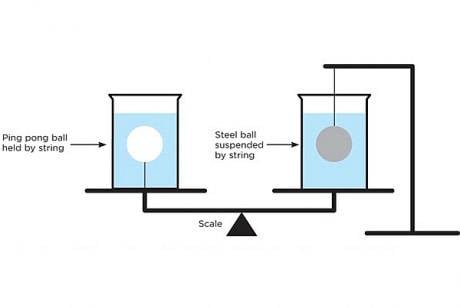
What will happen to the balance:
abq50dE_460s_v4.jpg
 
  • Like
Likes   Reactions: Richard Dean and Nathanael
Physics news on Phys.org
I assume the balls are equal volume?

I think the balance will tip to the right, only because the string on ping pong ball is pulling up on the container. If the ping pong ball were held in place (so it didn't float up) from the outside (like on the right side) then my answer would be that the scale will not move.

My reasoning is that the difference in weight (between the balls) is irrelevant because the excess weight of the steel ball is counteracted by the string holding it up. Both of the balls only push down on the water with the buoyant force proportional to their volume, so their mass is irrelevant.

But since there is a force of tension upwards on the left container, it must push down on the scale less, thus the scale tips to the right.
 
Ain't saying. :-p

(Good one, micro! :approve:)
 
micromass said:
What will happen

The steel ball will rust.
 
I'll give it a try. I'm not certain of my answer though. Assuming we're supposed to say what will happen after insertion of the balls: The scale will tilt down on the side of the ping pong ball. (I haven't read the spoiler)
 
The weight of both containers is the same. The depth of fluid in both containers is the same, so the hydrostatic pressure acting on both scale pans is the same. The only difference is the upwards force from the string on the left hand pan.
 
I forgot to give the reason for my answer.

The balance scale measures a difference in mass. After insertion of the balls, the mass on the left plate has changed but the mass on the right plate has not changed (the steel ball is supported by the external hanger). Buoyancy is irrelevant because it's the same for both.
 
At first I thought the scale tips to the left, but now I think it tips to the right. Assume the containers have the same mass so forget about them. Also assume the balls have the same volume. The plate on the left feels the weight of the ping pong ball plus the water. The plate on the right feels the weight of the water plus the buoyant force from the steel ball (the rest of the force is taken care of by the string so that it stays put in the water). The buoyant force from the steel ball is the weight of a ball of the same volume as the steel ball, but made of water. So since a ball made of water is heavier than the ping pong ball, the force on the right plate is greater, and the scale tips to the right.
 
Last edited:
  • Like
Likes   Reactions: 1 person
Way to go Zeta!

There apparently are a lot of people here who think they can pick themselves up by their bootstraps.
 
  • #10
D H said:
Way to go Zeta!

There apparently are a lot of people here who think they can pick themselves up by their bootstraps.


LOL ... I would have been another

instead I second the vote for V50's reply haha :wink:

Dave
 
  • #11
Good job, Zeta!
 
  • #12
It might have been interesting to also include a cup filled with water and no ball in it, then ask to compare the weights of all 3 cups, but that might have given away the answer. It could also be noted that the cup with the ping pong ball has lower average density, and no external forces (other than gravity) are exerted onto the ping pong ball.
 
  • #13
It boils down to this question: Does the upward force caused by the air inside the ping pong ball counterbalance the added weight of the ping pong ball itself and the string which holds it. Both balls displace the same amount of water (presumably) and the ball on the right adds no weight to the right side. I suspect the scale stays even, because the air lifts the ball and string - BUT the string is attached to the bottom of the glass, so I don't think it can lift the glass by its own bootstrap (string).
 
  • #14
Guess I don't understand how the steel ball contributes the weight of its volume in water to the weight on the right...
 
  • #15
BobKat said:
It boils down to this question: Does the upward force caused by the air inside the ping pong ball counterbalance the added weight of the ping pong ball itself and the string which holds it. Both balls displace the same amount of water (presumably) and the ball on the right adds no weight to the right side. I suspect the scale stays even, because the air lifts the ball and string - BUT the string is attached to the bottom of the glass, so I don't think it can lift the glass by its own bootstrap (string).

I just did the experiment. Zeta is correct. Although, I replaced the two balls with a plastic tool pick container, and the string with a rubber band. 9 oz vs 12 oz.

Buoyancy problems always have me scratching my head, and mopping up in the kitchen afterwards. :-p
 
  • #16
BobKat said:
Guess I don't understand how the steel ball contributes the weight of its volume in water to the weight on the right...

Replace the steel ball on the right, with a ping pong ball. Instead of a string, smoosh the ping pong ball down with your fingers. I actually did this, but my ping pong ball had too little volume to indicate a weight change on my cheesy little 16 ounce dollar store diet scale. Hence my toothpick container upgrade.
 
Last edited:
  • #17
BobKat said:
Guess I don't understand how the steel ball contributes the weight of its volume in water to the weight on the right...

Gravity exerts a downwards force onto the steel ball equal to the steel balls weight, which in turn exerts some of it's weight onto the water, and some onto the wire connected to the steel ball. This force is opposed by an upwards buoyant force exerted by what would the the weight of the water displaced by the steel ball. The remaining component of downwards force is opposed by the external (to the cup) upwards force from the wire connected to the steel ball. So the net downwards force exerted by the steel ball onto the water is equal in magnitude to the upwards buoyant force (Newton third law pair of forces), which is equal to what would be the weight of water displaced by the steel ball.
 
Last edited:
  • #18
you can think of it like a variation of energy problem, too.
If the right side moves down by ##\delta y## (i.e. positive ##\delta y## means right side goes down), then the change in GPE on the right is equal to ##- (V_{water} + V_{ball}) \rho_{water} g \delta y## This is because all the water moves down by ##\delta y## plus some small amount to account for the fact that the steel ball has moved upwards relative to it. The GPE of the steel ball itself does not change. Also, the left side will move upwards, so the change in GPE on the left side is: ##V_{water} \rho_{water} g \delta y + \rho_{pingpong} V_{ball} g \delta y## This is simply because everything on the left side moves upwards by ##\delta y## (including the ping pong ball). So, the total change in GPE is ##(\rho_{pingpong}-\rho_{water}) V_{ball} g \delta y## Which is negative, since the density of the ping pong ball is less than that of water, so in conclusion, if the right side moves down and left moves up, the total GPE will decrease, so that is what will happen.
 
  • #19
For those still struggling:
If the string pulling up on the steel ball supported the full weight of the ball, then both sides would be balanced. But it doesn't. (The buoyant force partially supports the ball.) Thus the right side is heavier.
 
  • #20
I think it is easiest to think of it in terms of external forces on the containers, since their weights are the same. The pressure of the water depends only the the height of the water level, which is the same for both of them, but the left container has an additional string pulling it up.
I think we have to be careful not to say that the steel ball's weight somehow channels through the water, because the water pressure is the same in both containers.
 
  • #21
chingel said:
I think it is easiest to think of it in terms of external forces on the containers, since their weights are the same. The pressure of the water depends only the the height of the water level, which is the same for both of them, but the left container has an additional string pulling it up.
I think we have to be careful not to say that the steel ball's weight somehow channels through the water, because the water pressure is the same in both containers.
"easiest to think of it..."? I did not understand one word of what you said. And their weights (including the balls in them) are not the same.
 
  • #22
Gerinski said:
"easiest to think of it..."? I did not understand one word of what you said. And their weights (including the balls in them) are not the same.

View the container itself as a system, viewing everything inside and outside of it as external. The containers themselves are the same, they weigh the same. Water pressure on both of the containers is exactly the same everywhere, but the left container has an extra string attached to it pulling it up, therefore it will go up.
 
  • #23
that is a nice way to think about it. Maybe not very intuitive though.

edit: It is probably the most inventive, of the ones I've seen so far :)
 
  • #24
I still don't get it:
Why does the steel ball have buoyancy and the ping pong one doesn't? is it because the steel one is more massive than the other?

(BTW I though than the balance would lean to the left due to the extra weight of the ping pong ball)
 
  • #25
derek10 said:
I still don't get it:
Why does the steel ball have buoyancy and the ping pong one doesn't? is it because the steel one is more massive than the other?

(BTW I though than the balance would lean to the left due to the extra weight of the ping pong ball)
The buoyant force on each ball is the same. Buoyant force depends only on the volume of fluid displaced, not the mass of the ball itself.

Extra weight of the ping pong ball? :confused:
 
  • #26
Doc Al said:
The buoyant force on each ball is the same. Buoyant force depends only on the volume of fluid displaced, not the mass of the ball itself.

Extra weight of the ping pong ball? :confused:

Yeah because if I interpreted the OP diagram properly it is tied into the container right? so it has a extra weight exerted into the container even if it's floating while the steel one is hanged so it doesn't weight anymore (only displaces water?)

What I don't understand is why does the steel ball exert a weight equivalent to a water ball of the same size but the ping pong doesn't (per Zeta's explanation, if I understood it well)
 
Last edited:
  • #27
chingel said:
Water pressure on both of the containers is exactly the same everywhere, but the left container has an extra string attached to it pulling it up, therefore it will go up.
That was my first idea too. And it seems like the simplest argument so far to me.
 
  • #28
Here is a similar one:

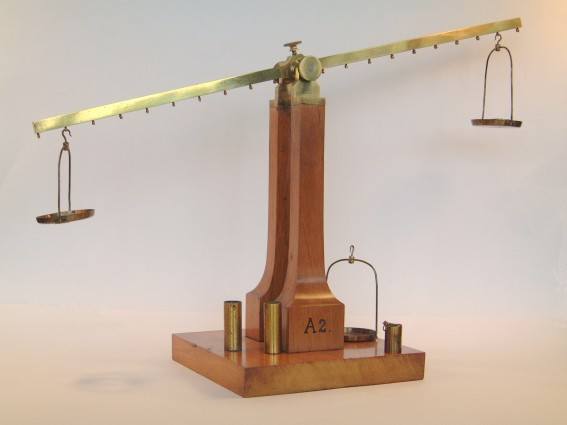
You have two identical steel balls hanging on opposite sides of a scale like this:
waage_f1c.jpg


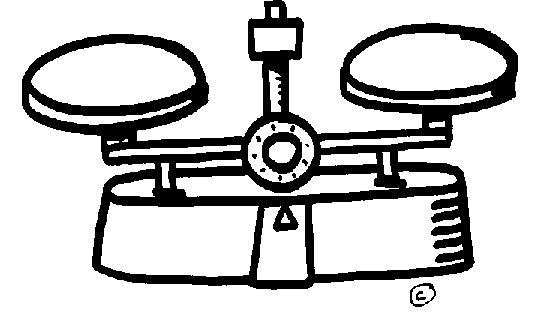
You have two buckets, one with water and one with glycerin, standing on opposite sides of a scale like this:
scale.gif


Both scales are initially balanced. Then you fully submerge the balls into the buckets without touching the walls.

Does the balance of the scales change? If yes, how?
 
  • #29
A.T. said:
Here is a similar one:

No it won't change, both sides of the scale have the same mass/weight

Thats the first thing I thought so I'm pretty sure I'm wrong :-p
 
  • #30
chingel said:
View the container itself as a system, viewing everything inside and outside of it as external. The containers themselves are the same, they weigh the same. Water pressure on both of the containers is exactly the same everywhere, but the left container has an extra string attached to it pulling it up, therefore it will go up.
I don't thing that's correct, the string in the left container is not pulling it up, as someone said "nobody can lift himself by pulling his bootstraps".

I see the buoyancy argument but as Derek I do not see why only the right side should have the weight of the steel ball's buoyancy and not the left side the same buoyancy by the volume of water displaced by the ping-pong ball.
 

Similar threads

  • · Replies 16 ·
Replies
16
Views
5K
  • · Replies 3 ·
Replies
3
Views
3K
  • · Replies 16 ·
Replies
16
Views
2K
Replies
2
Views
3K
  • · Replies 4 ·
Replies
4
Views
1K
  • · Replies 4 ·
Replies
4
Views
2K
  • · Replies 10 ·
Replies
10
Views
2K
  • · Replies 1 ·
Replies
1
Views
306
  • · Replies 3 ·
Replies
3
Views
2K
  • · Replies 6 ·
Replies
6
Views
2K