Undergrad Interpreting Copper & Argon Emission Spectral Lines with Plasma Spectroscopy

Click For Summary
SUMMARY

This discussion focuses on interpreting emission spectral lines from copper and argon in MPD thruster experiments. Users are advised to utilize the NIST Atomic Spectra Database for identifying spectral lines, particularly between 400 and 700 nm. The importance of calibrating the spectrometer for accurate wavelength measurements is emphasized, as uncalibrated images provide limited interpretative value. Participants suggest comparing relative intensities from the NIST database with pixel distances in the spectral images for better analysis.

PREREQUISITES
  • Understanding of MPD thrusters and their operation
  • Familiarity with plasma spectroscopy techniques
  • Knowledge of spectral line identification
  • Experience with spectral calibration methods
NEXT STEPS
  • Explore the NIST Atomic Spectra Database for copper and argon spectral lines
  • Learn about spectral calibration techniques for accurate wavelength measurement
  • Research methods for analyzing uncalibrated spectral images
  • Investigate the physical principles of emission spectroscopy in plasma environments
USEFUL FOR

Researchers and engineers working with MPD thrusters, plasma physicists, and anyone involved in emission spectroscopy and spectral line analysis.

jagadeeshr
Messages
11
Reaction score
0
Hi,

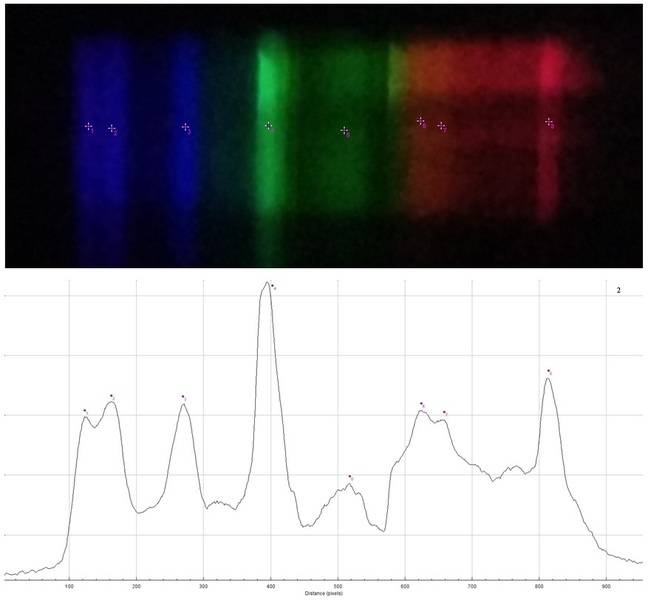
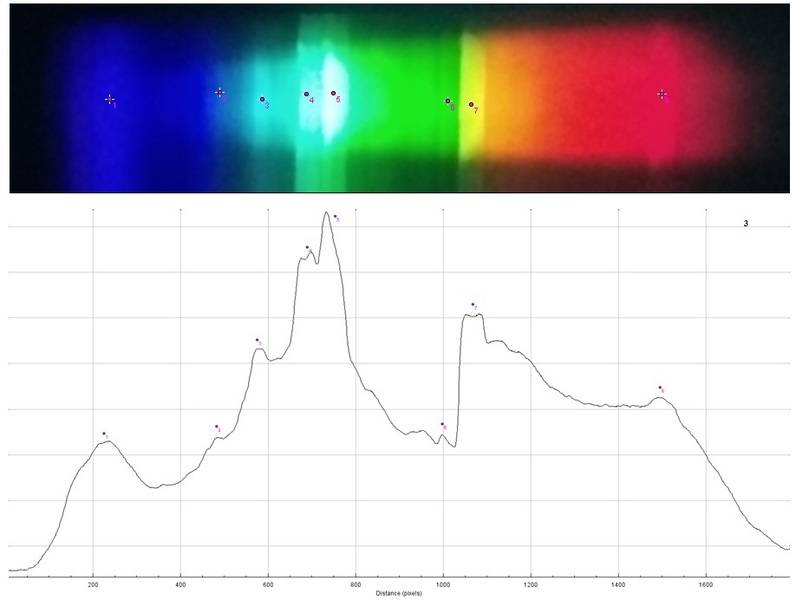
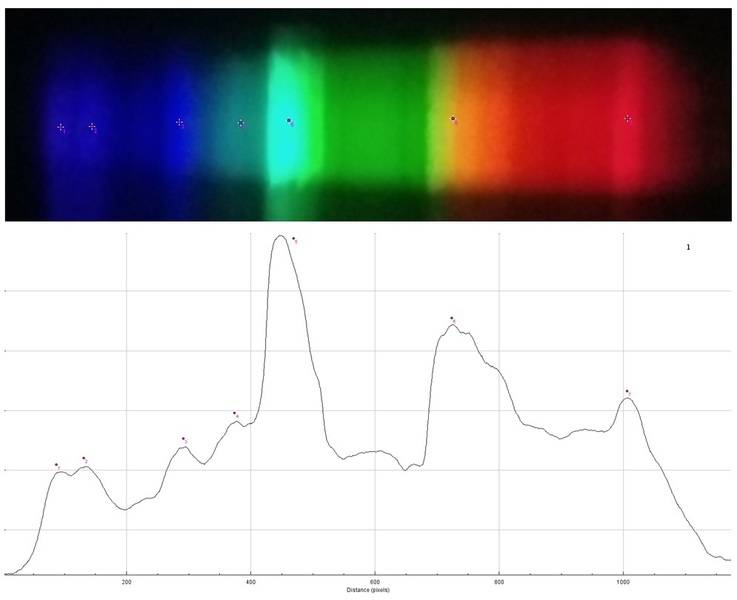
I recently started working on MPD Thrusters. During a recent experiment, spectral images (uncalibrated) were obtained.

The thruster is made of copper and the propellant is argon. These two elements will be the source of emission spectral lines.

I need help to interpret them. I have attached spectrums and profiles.

Thank you.

Spectrum 1
gogcQwM.jpg


Spectrum 2
r4jvzEX.jpg


Spectrum 3
W8R7G5s.jpg
 
Physics news on Phys.org
I'm not sure exactly what you mean by interpret but you may find this website (http://physics.nist.gov/PhysRefData/ASD/lines_form.html)really useful in determining where the lines are coming from if you ever manage to calibrate the spectrometer for the exact wavelengths. Even if you don't, I think you should be able to find the brightest lines from C and Ar between roughly 400 and 700nm and roughly compare these with the image? Other than that, from what I can see there isn't too much more you can get from an un-calibrated image, I may be wrong though.
 
Mzzed said:
I'm not sure exactly what you mean by interpret but you may find this website (http://physics.nist.gov/PhysRefData/ASD/lines_form.html)really useful in determining where the lines are coming from if you ever manage to calibrate the spectrometer for the exact wavelengths. Even if you don't, I think you should be able to find the brightest lines from C and Ar between roughly 400 and 700nm and roughly compare these with the image? Other than that, from what I can see there isn't too much more you can get from an un-calibrated image, I may be wrong though.
I would like to know the source of each line. Whether emitted by argon or copper?
 
jagadeeshr said:
I would like to know the source of each line. Whether emitted by argon or copper?
Try collecting the largest relative intensities (Rel. Int. column on the NIST website) from both the copper and Argon spectral line tables as I linked and compare the distances between them with the distances you obtained in pixels. This doesn't seem to be too accurate while it is un-calibrated so maybe even just do a quick google image search and match the brightest lines by eye?
 

Similar threads

Replies
7
Views
2K
  • · Replies 1 ·
Replies
1
Views
2K
  • · Replies 6 ·
Replies
6
Views
3K
  • · Replies 1 ·
Replies
1
Views
3K
  • · Replies 7 ·
Replies
7
Views
3K
  • · Replies 76 ·
3
Replies
76
Views
8K
  • · Replies 3 ·
Replies
3
Views
5K
  • · Replies 8 ·
Replies
8
Views
6K
  • · Replies 4 ·
Replies
4
Views
7K
  • · Replies 3 ·
Replies
3
Views
4K