Plastic Analysis: Upper Bound Theorem

Click For Summary
SUMMARY

The discussion centers on the Upper Bound Theorem in plastic analysis, specifically addressing the calculation of the collapse load factor, denoted as λ_c, which is determined to be 2.25. The conversation highlights the necessity of incorporating sway into the structural analysis, particularly the right side of the structure, to achieve accurate results. Participants emphasize the importance of understanding the centers of rotation in the sway diagram, particularly points A, B, and I, to properly analyze the mechanism and derive the correct load factor.

PREREQUISITES
  • Understanding of plastic analysis concepts, specifically the Upper Bound Theorem.
  • Familiarity with structural mechanics, including plastic hinges and redundancy.
  • Knowledge of sway diagrams and their application in structural analysis.
  • Proficiency in using equations related to plastic energy dissipation and load factors.
NEXT STEPS
  • Study the derivation and application of the Upper Bound Theorem in plastic analysis.
  • Learn how to construct sway diagrams for complex structures.
  • Explore the role of centers of rotation in structural mechanisms.
  • Investigate the calculation methods for collapse load factors in various structural scenarios.
USEFUL FOR

Structural engineers, civil engineering students, and professionals involved in plastic analysis and structural stability assessments will benefit from this discussion.

Master1022
Messages
590
Reaction score
116
Homework Statement
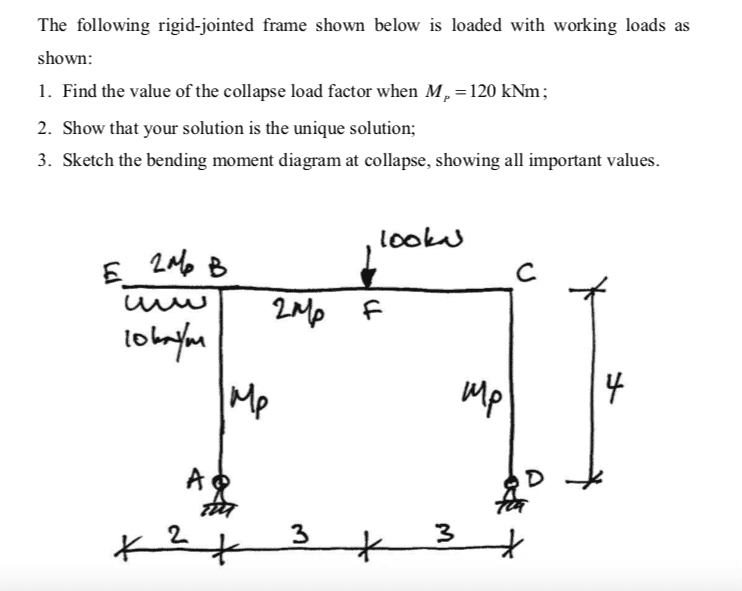
Find the value of the collapsed load factor when Mp = 120 kN/m
Relevant Equations
Plastic energy dissipated = work done by loads
Hi,

I have a quick question about part 1 of this upper bound theorem question (in the attached image). Answer says that \lambda_c = 2.25.
Screen Shot 2020-02-19 at 12.12.52 PM.png


First, we know that there is 1 redundancy and therefore there will be a maximum of 2 plastic hinges for failure.

I have found that there needs to be swaying to right of the right side of the structure (by an angle \theta), but I don't have any intuition for why that would be the case. Would someone be able to explain to me why there must be swaying in the structure for the mechanism illustrated? If I update my answer below to include this, then I get the correct answer.

(Initial drawing without the swaying)
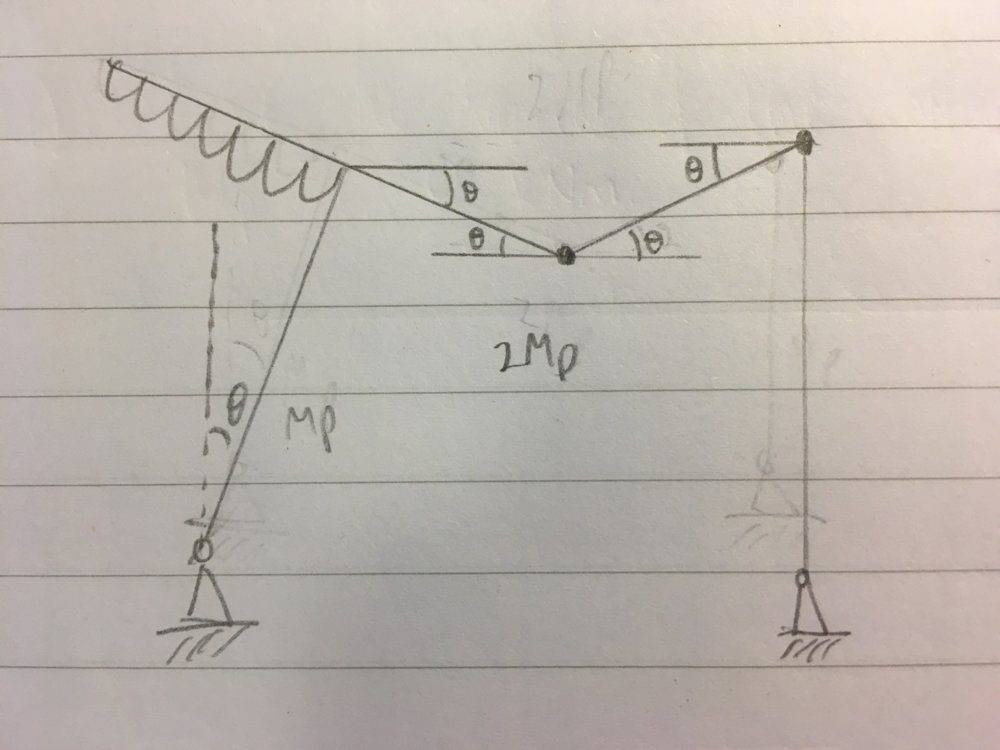
IMG_8744.jpg


Doing my original incorrect analysis yields:
M_p \left( \theta \right) + 2 M_p \left( 2 \theta \right) = 100 \lambda \left( 3 \theta \right) + w \lambda \left( \frac{1}{2} 2 \left( 2 \theta \right) \right)
Substituting in the values from the question, that will yield \lambda = \frac{600}{320} = 1.875, which isn't the correct answer.
 

Attachments

  • Screen Shot 2020-02-19 at 12.12.52 PM.png
    Screen Shot 2020-02-19 at 12.12.52 PM.png
    20.4 KB · Views: 273
Last edited:
Physics news on Phys.org
Master1022 said:
Homework Statement:: Find the value of the collapsed load factor when Mp = 120 kN/m
Relevant Equations:: Plastic energy dissipated = work done by loads

Hi,

I have a quick question about part 1 of this upper bound theorem question (in the attached image). Answer says that \lambda_c = 2.25. View attachment 257324

First, we know that there is 1 redundancy and therefore there will be a maximum of 2 plastic hinges for failure.

I have found that there needs to be swaying to right of the right side of the structure (by an angle \theta), but I don't have any intuition for why that would be the case. Would someone be able to explain to me why there must be swaying in the structure for the mechanism illustrated? If I update my answer below to include this, then I get the correct answer.

(Initial drawing without the swaying)
View attachment 257326

Doing my original incorrect analysis yields:
M_p \left( \theta \right) + 2 M_p \left( 2 \theta \right) = 100 \lambda \left( 3 \theta \right) + w \lambda \left( \frac{1}{2} 2 \left( 2 \theta \right) \right)
Substituting in the values from the question, that will yield \lambda = \frac{600}{320} = 1.875, which isn't the correct answer.
In your initial sketch, allegedly without sway, you have included some sway of the left hand column, but not of the right hand column. The line AF produced meets the line DC produced at a point 4 m above C. This is the instantaneous centre of rotation of the beam segment FC, say call it point I. When you draw your sway diagram, there are 3 parts, each with their own centre of rotation, namely A B and I. Apply a theta to A and draw the remaining mechanism to scale. Work from there.
 
pongo38 said:
When you draw your sway diagram, there are 3 parts, each with their own centre of rotation, namely A B and I. Apply a theta to A and draw the remaining mechanism to scale. Work from there.
Many thanks for your response. Can you explain how B is a centre of rotation, I am struggling to see how this is the case.

Otherwise, with regards to the extra angle \theta at D, is this a correct line of reasoning to follow?
So if we have applied some angle \theta to A in the CW direction, then we must have some angle \theta in the CCW direction at I (intersection of AF and DC) due to 5 \times \theta_{AF} = 5 \times \theta_{IF}. Thus, due to the CCW rotation at I, there will be a displacement at C with the size of = r_{IC} \theta. Due to the equivalence argument again, then we must have a CW angle of \theta at D.
 

Similar threads

  • · Replies 2 ·
Replies
2
Views
2K
  • · Replies 1 ·
Replies
1
Views
2K
  • · Replies 3 ·
Replies
3
Views
3K
Replies
3
Views
2K
  • · Replies 4 ·
Replies
4
Views
3K
  • · Replies 5 ·
Replies
5
Views
2K
  • · Replies 4 ·
Replies
4
Views
3K
Replies
6
Views
3K
  • · Replies 1 ·
Replies
1
Views
3K
  • · Replies 7 ·
Replies
7
Views
2K