Please explain the proofs for sin(90 - θ)

  • Thread starter Thread starter jayanthd
  • Start date Start date
  • Tags Tags
    Explain Proofs
Click For Summary
SUMMARY

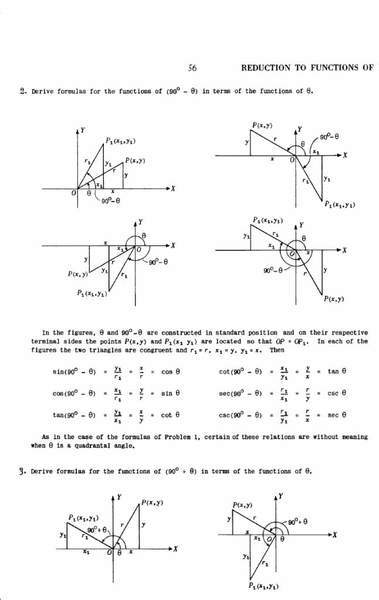
The discussion focuses on the proofs for the trigonometric identity sin(90 - θ) = cos(θ) as illustrated in the figures from "Theory and Problems of Plane and Spherical Trigonometry" by Frank Ayres. The user seeks clarification on how positive values for sin(90 - θ) are derived from the second, third, and fourth images, despite the negative coordinates in those figures. The key takeaway is that the identity holds true across different quadrants, with specific angles leading to positive or negative values based on their respective positions.

PREREQUISITES
  • Understanding of basic trigonometric identities
  • Familiarity with the unit circle and coordinate geometry
  • Knowledge of angle measures in different quadrants
  • Ability to interpret geometric figures in trigonometric proofs
NEXT STEPS
  • Study the derivation of trigonometric identities using the unit circle
  • Explore the properties of angles in different quadrants
  • Review proofs of trigonometric identities in "Theory and Problems of Plane and Spherical Trigonometry" by Frank Ayres
  • Learn about the implications of negative coordinates in trigonometric functions
USEFUL FOR

Students of trigonometry, educators teaching trigonometric identities, and anyone seeking to deepen their understanding of angle relationships in trigonometric functions.

jayanthd
Messages
16
Reaction score
0
Please see the attached image. There are 6 figures.

Please explain the proofs for sin(90 - θ) w.r.t the 2nd, 3rd and 4th images. I understand the proof w.r.t 1st image.

In the 2nd image y1 and x is negative. In 3rd image y, y1, x, x1 are all negative and in the 4th image y and x1 are negative. How he gets +ve value for sin(90 - θ) w.r.t 2nd, 3rd and 4th figures?

In the 3rd fig. -y1 = -x and -y = -x1.

-y1/r1 = -x/r = -cos(θ)
attachment.php?attachmentid=62294&d=1380475523.jpg
 

Attachments

  • trig.jpg
    trig.jpg
    19.8 KB · Views: 743
Physics news on Phys.org
I don't understand your question. If, as in #2, the top figure on the right, 90< \theta< 180, sin(90- \theta) is certainly negative. Where does he say that it is positive?
 
He is proving with the top four figures that sin(90 - θ ) = cos(θ). It is from the book "Theory and Problems of Plane and Spherical Trigonometry by Frank Ayres, Schaum's Outline Series"

The book is available here. http://archive.org/details/SchaumsTheoryProblemsOfTrigonometry

Please explain the proofs in page nos 56 and 57.

In the 2nd figure from top ∠AOP = (180 - θ). How does he say ∠BOP1 = (90 - θ)?

and ∠OAP and ∠OBP1 = 90.

attachment.php?attachmentid=62317&d=1380518060.jpg
 

Attachments

  • trig3.jpg
    trig3.jpg
    20.4 KB · Views: 575
Last edited:

Similar threads

Replies
11
Views
10K
  • · Replies 19 ·
Replies
19
Views
2K
Replies
8
Views
5K
  • · Replies 9 ·
Replies
9
Views
3K
  • · Replies 16 ·
Replies
16
Views
3K
Replies
3
Views
1K
  • · Replies 1 ·
Replies
1
Views
2K
  • · Replies 3 ·
Replies
3
Views
2K
Replies
9
Views
3K
  • · Replies 10 ·
Replies
10
Views
1K