Position vector question. Tough to solve.

Click For Summary
SUMMARY

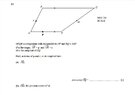
The discussion centers on solving position vector equations involving points P, Q, O, R, and M. The key equations provided are $\vec{PQ} = \vec{PO} + \vec{OR} + \vec{RQ}$ and $\vec{OM} = \vec{OP} + \frac{1}{2}\vec{PQ}$. Participants emphasize the importance of breaking down the vectors into their components and applying vector addition principles to derive the final expressions. The conversation concludes with a clear method for manipulating these vectors to achieve the desired results.

PREREQUISITES
  • Understanding of vector notation and operations
  • Familiarity with position vectors in geometry
  • Knowledge of vector addition and decomposition
  • Basic skills in algebraic manipulation of equations
NEXT STEPS
  • Study vector decomposition techniques in geometry
  • Learn about vector addition and its applications in physics
  • Explore advanced topics in vector calculus
  • Practice solving complex vector problems using real-world scenarios
USEFUL FOR

Students and educators in mathematics and physics, particularly those focusing on vector analysis and geometric interpretations of position vectors.
drsundeep
Messages
1
Reaction score
0

Attachments

  • 1.jpg
    1.jpg
    22.2 KB · Views: 116
Mathematics news on Phys.org
Hints:

1. $\displaystyle \begin{align*} \vec{PQ} = \vec{PO} + \vec{OR} + \vec{RQ} \end{align*}$. Finish it.

2. $\displaystyle \begin{align*} \vec{OM} = \vec{OP} + \vec{PM} = \vec{OP} + \frac{1}{2}\vec{PQ} \end{align*}$. Finish it.
 

Similar threads

  • · Replies 11 ·
Replies
11
Views
3K
  • · Replies 7 ·
Replies
7
Views
3K
  • · Replies 8 ·
Replies
8
Views
3K
  • · Replies 2 ·
Replies
2
Views
2K
  • · Replies 8 ·
Replies
8
Views
5K
  • · Replies 1 ·
Replies
1
Views
2K
  • · Replies 1 ·
Replies
1
Views
2K
  • · Replies 9 ·
Replies
9
Views
2K
  • · Replies 9 ·
Replies
9
Views
3K
  • · Replies 3 ·
Replies
3
Views
1K