Potential energy and turning points

Click For Summary
SUMMARY

The minimum height required for a block to successfully navigate a frictionless loop-the-loop is determined to be (5/2)R, where R is the radius of the loop. The discussion highlights two approaches to solving the problem using the conservation of energy principle, represented by the equations U0 + K0 = K + U and m * g * h >= (1/2) * m * v^2 + m * g * 2 * R. The correct analysis involves ensuring that the normal force at the top of the loop is zero, which leads to the conclusion that a height of 2R is insufficient for the block to maintain motion without falling off.

PREREQUISITES
  • Understanding of potential energy and kinetic energy concepts
  • Familiarity with the conservation of mechanical energy principle
  • Basic knowledge of forces acting on objects in circular motion
  • Ability to manipulate algebraic equations and solve for variables
NEXT STEPS
  • Study the derivation of the centripetal force requirement for objects in circular motion
  • Learn about energy conservation in non-conservative systems
  • Explore the implications of normal force in circular motion scenarios
  • Investigate real-world applications of potential and kinetic energy in engineering
USEFUL FOR

Students studying physics, particularly those focusing on mechanics, as well as educators looking for examples of energy conservation in action.

nightshade123
Messages
82
Reaction score
0
[SOLVED] potential energy and turning points

Homework Statement


A block slides on the frictionless loop the lopp track shown in this img, what is the min height at which it can start from rest and still make it around the loop
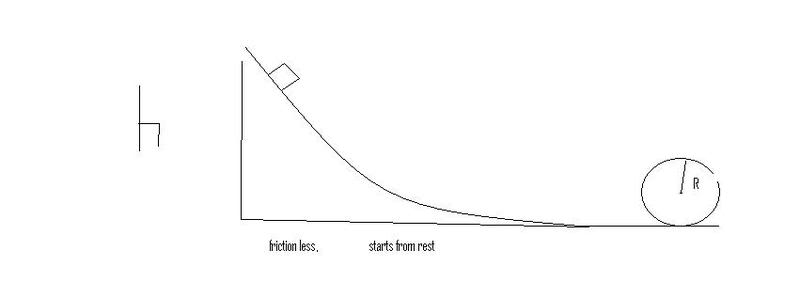
46.jpg


The Attempt at a Solution


I haev solved this problem TWO ways, and i can't decide which way is correct

the eqn...

U0+K0 = K+U
where U = potential energy and K = kinetic energy
first

m * g * h + (1/2) * m * v^2 >= m * g * 2 * R

final answer = h = 2R
the other way is

m * g * h >= (1/2) * m * v^2 + m * g * 2 * R

final answer is h = (5*R) / 2??
 
Last edited:
Physics news on Phys.org
if i am way off let me kno, thx
 
Last edited:
What are you assuming v to be? 0?

I don't think the answer is just 2R. You have to do some analysis on the forces, since at the top, the normal force should be zero, and you find the velocity for which that is required. If velocity were zero at the top, it wouldn't make it around the loop, just fall off.

The 5/2 R answer looks correct.
 
Last edited:
you can solve the problem for velocity and plug the velocity function in and solve for h, and that is how you derive the formula, and for the 2R velocity cancels out so that wouldn't make sense, thanks
 
can someone else sovle the two equations i listed at the top of the page and tell me if they got the same thing, i keep solving the 2nd one and getting h=h-2R+2R which is saying the min height is the min height of the radius...
 
Last edited:
well you are starting from rest with U_i so it makes sense to me that what ever happens after would only be distributions of the energy between kintetic and potential so I would set the equation to what I am starting with
 
Last edited:
i just did this exact problem in my homework and got the correct answer but i don't kno how to help without breaking a forum rule and giving u the answer
 
dont worry about it i got it already, had to open a diffrent thread because the titel was wrong
 

Similar threads

Replies
6
Views
1K
Replies
1
Views
1K
Replies
7
Views
1K
Replies
13
Views
3K
  • · Replies 2 ·
Replies
2
Views
1K
  • · Replies 17 ·
Replies
17
Views
2K
  • · Replies 8 ·
Replies
8
Views
2K
Replies
4
Views
1K
  • · Replies 7 ·
Replies
7
Views
3K
  • · Replies 5 ·
Replies
5
Views
2K