Power and Efficiency without mass?

Join the discussion
Ask a follow-up here, or get your own question answered by working scientists, mathematicians and engineers — people, not an autocomplete.
Real named experts · corrections over time · the nuance an AI answer skips
4 replies · 1K views
sbrads87
Messages
1
Reaction score
0
Homework Statement
Possible error in text (has happened before.)
A basketball loses 35% of its kinetic energy when it hits the floor. Initially dropped from a height of 1.2m. How much time will it be in the air between 3rd and 4th bounces?
Relevant Equations
Ek = Eg = mgh = m(9.81)(1.2)

s = v2t-1/2at^2
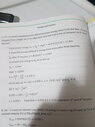
Really perplexed me as the answer provided does not solve for mass ... seemingly wants to use mass as a unit of height? Or perhaps I'm off base ... really just curious if this is even correct or possible?

Thanks in advance
 

Attachments

  • 20230303_225314.jpg
    20230303_225314.jpg
    32.8 KB · Views: 142
Physics news on Phys.org
Sounds okay. Is the answer going to be different depending on the mass of the b-ball ?
 
It is correct. The solution shows that the answer is independent of the mass. Look at it this way. If you drop a mass from height ##h_0##, its mechanical energy before the bounce is ##E_0=mgh_0##. If it loses 35% of that during the bounce, it will have ##KE_1=0.65mgh_0## left in the form of kinetic energy.

Question: To what maximum height ##h_1## will the ball rise?
Answer: $$mgh_1=KE_1=0.65mgh_0\implies h_1=0.65h_0.$$Note that the answer is independent of the mass. If you drop two unequal masses, they will hit the floor at the same time; if in addition they lose the same fraction of energy after the bounce, they will rise to the same maximum height.
 
Reply
  • Like
Likes   Reactions: Lnewqban
The textbook solution is poor in several ways.

1. It plugs in numbers without units. E.g. we read "##mgh=11.8m##" instead of "##mgh=m\cdot 11.8m^2/s^2##". That may be why you thought it was turning mass into a distance.

2. It plugs in numbers too soon. By leaving g as g it would have cancelled out in the first part, as @kuruman shows in post #4. That makes for less work and greater accuracy.

3. It was never necessary to find an energy. Since after three bounces it will only have ##0.65^3## of its initial energy, we know it will rise to a height of ##1.2\cdot 0.65^3=0.33##m. After that, it is just a matter of finding how long it takes to fall to the ground from that height and doubling it.