Press Tonnage (No Flywheel)

  • Thread starter Thread starter Bob Warren
  • Start date Start date
  • Tags Tags
    Flywheel
Join the discussion
Ask a follow-up here, or get your own question answered by working scientists, mathematicians and engineers — people, not an autocomplete.
Real named experts · corrections over time · the nuance an AI answer skips
6 replies · 2K views
Bob Warren
Messages
2
Reaction score
0
TL;DR
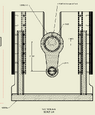
Looking for the resulting tonnage of press ram.
1726677110851.png


2.00" of Stroke and 300 strokes per minute.
 

Attachments

  • Screenshot 2024-09-18 113355.png
    Screenshot 2024-09-18 113355.png
    8.7 KB · Views: 74
Physics news on Phys.org
Is this homework? If so, we can move it.

To calculate forces, you start with a free body diagram (search the term). Every calculation in this problem requires getting the free body diagram correct. There are other considerations that will enter the problem at a later stage, but nothing will make sense until the free body diagram is correct. So start there, and we will assist as needed.
 
Reply
  • Like
Likes   Reactions: berkeman
Since you specify torque as inch pounds, and the crank radius conveniently as one inch, I assume you are using US customary units, so want an answer in short tons.
The crank torque of 24,000 pound⋅inch = 12 ton⋅inch.
My estimate is; 12 / Sin( Acos( -31/32 ) ) = 48.37 ton(short).
But I certainly would not trust it without a diagram.
 
Ranger Mike said:
Define the problem. You offer no specs on the ram. No data.
What more do you need that is not provided in the diagram or text ?
 
Ranger Mike said:
ram, dimensions, die opening width, material thickness, type of material, bending rate to name a few
Ram dimensions: determine pressure, not total tonnage.
Die opening width: As above, irrelevant, the throw on the crank is ±1", so the opening will be a maximum of 2" high.
Material thickness: is not important as; 1/32" above BDC has been specified.
Type of material: Bending rate: Irrelevant.

The torque of 24,000 pound·inch is 12.0 short ton·inch.
The crank throw is 2” total, so the crank follows; y = 1” * Cos(theta) .
TDC will be at 0°, with BDC at 180° .
The work will first be done at; y = 1/32” above BDC, then ;
Theta = Acos( -31/32 ) = Acos( -0.96875 ) = 165.638°.
Mechanical advantage is the reciprocal of the slope of the Cos() function, = Sin() ;
1 / Sin( theta ) = 1 / 0.248 = 4.0316 advantage.
So the ram force will be 12 * 4.0316 = 48.38 ton(short).

That ignores the connecting rod diagonal length of 13” when offset 0.248” which will lower the tonnage slightly. A crude estimate is; (13” - 1/32”) / 13” = 99.76% .
So the; 48.38 becomes 48.25 ton(short).

The die, below the work, should be sprung to protect the crank and bearings. That cushion must begin to compress before 48.25 ton, which will set the actual limit to the press tonnage applied to the work.
 
Reply
  • Like
Likes   Reactions: Tom.G