Prim's algorithm-Minimum Spanning Tree

  • Context: MHB 
  • Thread starter Thread starter evinda
  • Start date Start date
  • Tags Tags
    Tree
Click For Summary
SUMMARY

This discussion focuses on Prim's algorithm for finding the Minimum Spanning Tree (MST) of a graph. The algorithm initializes keys for each vertex, tracks the minimum weights of edges, and utilizes a priority queue for efficient extraction of the minimum. Participants confirm the correctness of the algorithm's application to a specific graph and discuss the importance of tracking the predecessor array, p[v], to reconstruct the MST. The conversation concludes with insights on the uniqueness of the MST based on edge weights.

PREREQUISITES
  • Understanding of Prim's algorithm and its implementation
  • Familiarity with graph theory concepts, including vertices and edges
  • Knowledge of priority queues and their role in algorithm efficiency
  • Ability to interpret and manipulate adjacency lists or matrices
NEXT STEPS
  • Implement Prim's algorithm in Python using libraries like NetworkX
  • Explore the differences between Prim's algorithm and Kruskal's algorithm for MST
  • Study the time complexity of Prim's algorithm in various implementations
  • Analyze real-world applications of Minimum Spanning Trees in network design
USEFUL FOR

Computer scientists, software engineers, and students studying algorithms and data structures, particularly those interested in graph theory and optimization techniques.

evinda
Gold Member
MHB
Messages
3,741
Reaction score
0
Hi! (Mmm)

I am looking at Prim's algorithm:

Code:
Prim(G,w,v)

 for each u  ϵ V
      key[u]<-oo // the minimum of the weights of the edges,
                           that connect the vertex u with an other 
                           vertex of the tree
      p[u]<-∅
 key[v]<-0
 Q<-V // priority queue,the vertices are sorted,with respect to key[u]
 while Q≠∅
     u<-Εxtraction_of_minimum(Q)
     for each v ϵ adj[u]
          if v ϵ Q and w(u,v)<key[v] then
             p[v]<-u
             key[v]<-w(u,v)

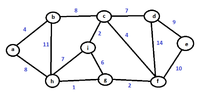
and..I want to apply it at this graph:

View attachment 3111

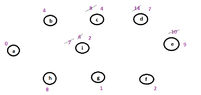
These are the keys that I found:

View attachment 3112

Is it right,or have I done something wrong? (Thinking)

Which vertices do I have to connect now,to get a minimum spanning tree? (Thinking)
 

Attachments

  • prim.png
    prim.png
    5.7 KB · Views: 137
  • prim.png
    prim.png
    3.8 KB · Views: 145
Physics news on Phys.org
Hey! (Smile)

evinda said:
Is it right,or have I done something wrong? (Thinking)

It is right! (Nod)
Which vertices do I have to connect now,to get a minimum spanning tree? (Thinking)

Well, you were also supposed to track p[v] for every step.
p[v] identifies the node you were coming from when assigning the minimum weight.

Did you track p[v]? (Wondering)
Or can you otherwise still figure out what each p[v] should be? (Wondering)
 
evinda said:
Hi! (Mmm)

I am looking at Prim's algorithm:

Code:
Prim(G,w,v)

 for each u  ϵ V
      key[u]<-oo // the minimum of the weights of the edges,
                           that connect the vertex u with an other 
                           vertex of the tree
      p[u]<-∅
 key[v]<-0
 Q<-V // priority queue,the vertices are sorted,with respect to key[u]
 while Q≠∅
     u<-Εxtraction_of_minimum(Q)
     for each v ϵ adj[u]
          if v ϵ Q and w(u,v)<key[v] then
             p[v]<-u
             key[v]<-w(u,v)

and..I want to apply it at this graph:

https://www.physicsforums.com/attachments/3111

These are the keys that I found:

https://www.physicsforums.com/attachments/3112

Is it right,or have I done something wrong? (Thinking)

Which vertices do I have to connect now,to get a minimum spanning tree? (Thinking)
This problem is easy enough to do by hand. To find the minimal spanning tree, the process is always to find the minimum sized edge connecting a node that isn't already connected to the tree, until all the nodes are connected. Just keep a mental track of everything that is now connected.

So looking at the graph, the minimal node is 1, between "g" and "h".

The next minimal node is 2, between "g" and "f". Now f, g, h are connected.

The next minimal node is 2, between "c" and "i". Now f, g, h are connected, and c, i are connected.

The next minimal node is 4, connecting "c" with "f". Now c, f, g, h, i are connected.

The next minimal node is 4, connecting "a" with "b". Now c, f, g, h, i are connected, and a, b are connected.

The next minimal node is 7, connecting "c" with "d". Now c, d, f, g, h, i are connected, and a, b are connected. Notice we didn't use the 6, because g and i are already connected in the tree.

The next minimal node is 8, connecting "a" with "h". Now a, b, c, d, f, g, h, i are connected.

The next minimal node is 9, connecting "d" with "e". Now a, b, c, d, e, f, g, h, i are connected.

Now that everything is connected we have our minimal spanning tree (I'll leave you to draw it and to evaluate the minimal distance).
 
I like Serena said:
Well, you were also supposed to track p[v] for every step.
p[v] identifies the node you were coming from when assigning the minimum weight.

Did you track p[v]? (Wondering)
Or can you otherwise still figure out what each p[v] should be? (Wondering)

I found the following:

$$p[e]=d$$
$$p[h]=g$$
$$p[g]=f$$
$$p[d]=c$$
$$p[f]=c$$
$$p=c$$
$$p[c]=b$$
$$p=a$$

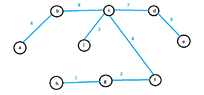
So..applying the algorithm,do we get this minimum spanning tree? (Thinking)

View attachment 3119
 

Attachments

  • spanning.png
    spanning.png
    4.3 KB · Views: 136
evinda said:
So..applying the algorithm,do we get this minimum spanning tree? (Thinking)

Yep! (Happy)

Did you notice that the number you had for each node, was actually the weight of edge that led to that node?
So you could construct the minimum spanning tree like that as well.

Would that always work? (Wondering)
 
I like Serena said:
Yep! (Happy)

Since I found these:

$$p[e]=d$$
$$p[h]=g$$
$$p[g]=f$$
$$p[d]=c$$
$$p[f]=c$$
$$p=c$$
$$p[c]=b$$
$$p=a$$

does this mean that this minimum spanning tree is the only one? (Thinking)
I like Serena said:
Did you notice that the number you had for each node, was actually the weight of edge that led to that node?
So you could construct the minimum spanning tree like that as well.

Would that always work? (Wondering)

So,if we have , for example, a node $u$ and the edges $(u,v)$, $(u,w)$ and $(u,r)$ and $w(u,v)< w(u,w)<w(u,r)$,then do we connect $u$ with $v$? (Thinking)
 
evinda said:
does this mean that this minimum spanning tree is the only one? (Thinking)

Why do you think so? (Wasntme)
So,if we have , for example, a node $u$ and the edges $(u,v)$, $(u,w)$ and $(u,r)$ and $w(u,v)< w(u,w)<w(u,r)$,then do we connect $u$ with $v$? (Thinking)

Yes.

Now suppose $w(u,v)= w(u,w)$, doesn't that give you 2 choices leading to different trees? (Wondering)
 
I like Serena said:
Why do you think so? (Wasntme)

I thought so,because I found specific $p[v], \forall v \in V$..So,could I also find other ones? (Thinking)
I like Serena said:
Yes.

Now suppose $w(u,v)= w(u,w)$, doesn't that give you 2 choice leading to different trees? (Wondering)

Yes! (Nod)
 
evinda said:
I thought so,because I found specific $p[v], \forall v \in V$..So,could I also find other ones? (Thinking)

Generally, yes, because $p[v]$ is selected to be the first neighbor with lowest weight. There might be other neighbors with the same weight.

In this particular example, there are no other ones though. (Wink)
 

Similar threads

  • · Replies 13 ·
Replies
13
Views
4K
  • · Replies 11 ·
Replies
11
Views
3K
  • · Replies 6 ·
Replies
6
Views
2K
  • · Replies 1 ·
Replies
1
Views
2K
Replies
2
Views
2K
  • · Replies 22 ·
Replies
22
Views
2K
  • · Replies 2 ·
Replies
2
Views
1K
  • · Replies 2 ·
Replies
2
Views
2K
  • · Replies 6 ·
Replies
6
Views
2K
Replies
8
Views
1K