Brooklyn
- 2
- 0
- TL;DR
- Probability of a Union using Indicator Functions
"Prove Theorem 7.1 about the probability of a union, using the 12.3 proof (see section 12.2) that involves indicator variables. Do not write the proof in full generality, only for three events. You should not use the product notation; you should write out all factors of the product."
I'm taking a calculus-based intro to probability and stats course that's not intended for math majors. I have a professor who is terrible at teaching and expects that students should easily be able to do the proof. I asked for help and he told me that it'd make sense if I worked out an example. I'm not sure how to work out an example if I don't understand the proof. None of the students in the class understand the proof.
During class, he reads from his notes (excerpts below) and doesn't work out examples. A month into the course, he says we need more theory before he supposedly gets to examples. I found nothing on the net to explain the proof. Any help would be greatly appreciated and I'd pass it on to the rest of the class which is also lost.
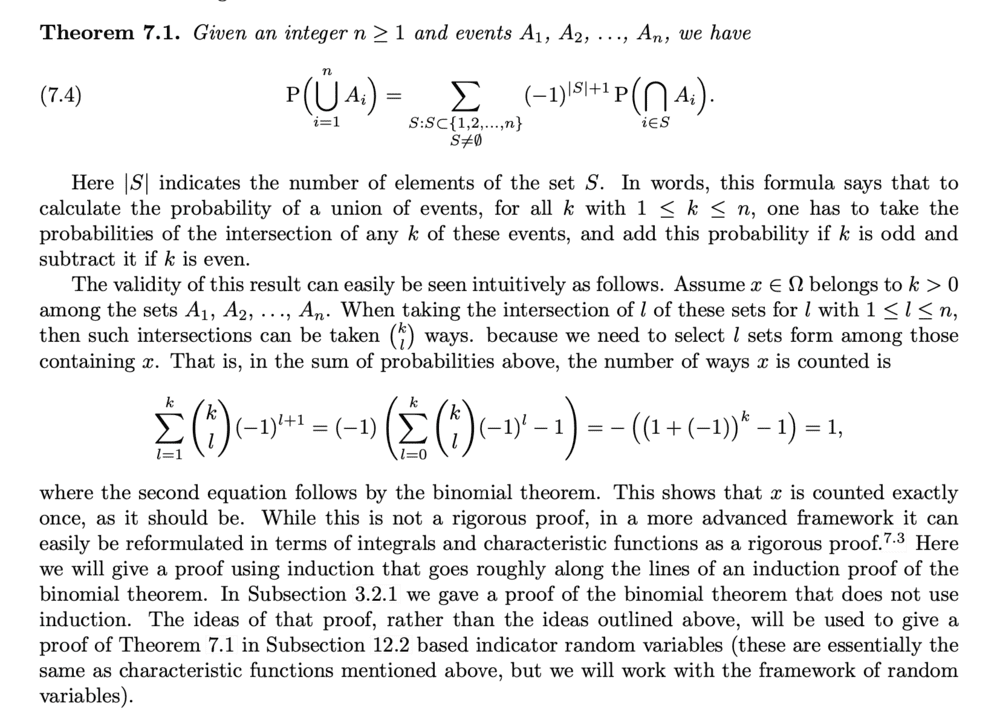
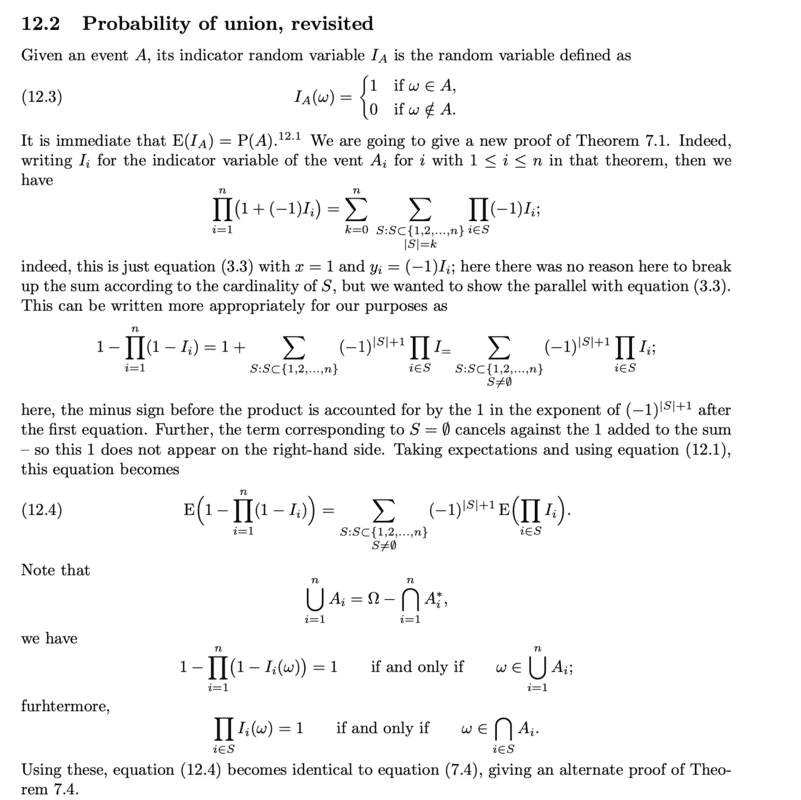
I'm taking a calculus-based intro to probability and stats course that's not intended for math majors. I have a professor who is terrible at teaching and expects that students should easily be able to do the proof. I asked for help and he told me that it'd make sense if I worked out an example. I'm not sure how to work out an example if I don't understand the proof. None of the students in the class understand the proof.
During class, he reads from his notes (excerpts below) and doesn't work out examples. A month into the course, he says we need more theory before he supposedly gets to examples. I found nothing on the net to explain the proof. Any help would be greatly appreciated and I'd pass it on to the rest of the class which is also lost.