Probability-To-Exceed (PTE) and Chi^2 distribution

Click For Summary
SUMMARY

The discussion centers on the differences between the Chi-squared (##\chi^{2}##) distribution and the Probability-To-Exceed (PTE) in the context of comparing two data sets, A and B. The user seeks clarification on the mathematical relationships, particularly the integration of the exponential function in the Chi-squared distribution and its connection to the PTE. The user also questions the statistical independence and consistency of the parameters estimated from both data sets, referencing the article on dark energy survey results for context.

PREREQUISITES
  • Understanding of Chi-squared distribution with k=2 degrees of freedom
  • Familiarity with confidence levels (CL) in statistical analysis
  • Knowledge of statistical independence and parameter estimation
  • Basic comprehension of Gaussian and exponential functions in statistics
NEXT STEPS
  • Study the mathematical derivation of the Chi-squared distribution and its applications
  • Explore the concept of Probability-To-Exceed (PTE) and its statistical implications
  • Investigate methods for comparing data sets using statistical tests
  • Learn about the role of Gaussian functions in statistical modeling and hypothesis testing
USEFUL FOR

Statisticians, data analysts, researchers comparing experimental data sets, and anyone interested in advanced statistical methods for hypothesis testing.

fab13
Messages
300
Reaction score
7
I would like to know the difference between the ##\chi^{2}## distribution and the PTE (Probability-To-Exceed) ?

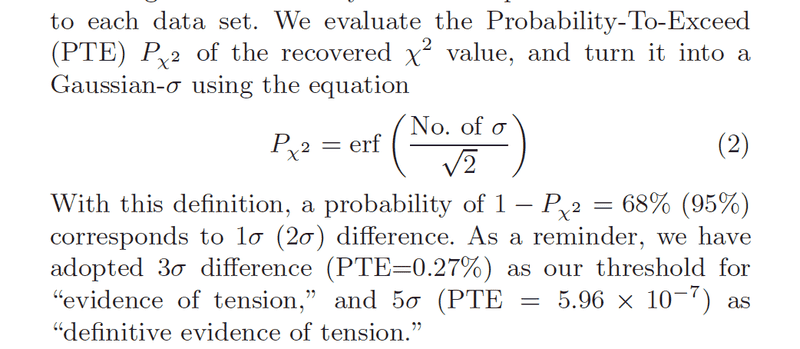
I must compare 2 data sets A and B and in the article I am reading, they talk about this PTE :
Y5WOSqP.png


For the moment, I only know the ##\chi^{2}## distribution with ##k=2## degrees of freedom :

##f(\Delta\chi^{2})=\dfrac{1}{2}\,e^{-\dfrac{\Delta\chi^{2}}{2}}\quad(1)##

and the relation with confidence level :

##1-CL={\large\int}_{\Delta\chi^{2}_{CL}}^{+\infty}\,\dfrac{1}{2}\,e^{-\dfrac{\Delta\chi^{2}}{2}}\,d\,\chi^{2}=e^{-\dfrac{\Delta\chi_{CL}^{2}}{2}}\quad(2)##

I don't know how to make the link with the image and text above. Indeed, in the article, they make appear the integral of gaussian whereas in ##(2)##, I can only make appear a simple integration of exponential (I mean, there is no "##\text{erf}##" function appearing unlike into the article).

If someone could explain the difference between ##\chi^{2}## distribution and ##P_{\chi^2}## PTE ?

Thanks
 

Attachments

  • Y5WOSqP.png
    Y5WOSqP.png
    39.5 KB · Views: 1,396
Physics news on Phys.org
Even the additional information given on stackexchange https://stats.stackexchange.com/que...obability-to-exceed-pte-and-chi2-distribution doesn't clarify the situation. Questions about statistics involve what statistic is involved not merely what distribution is involved. To understand a statistic, one must know the data and how the statistic is computed from the data. In this example, it isn't clear what the data is. The stackexchange information seems to treat the "model parameters" as random variables. How does that work?
 
@Stephen Tashi

My main issue is to understand the method used in this article to be able to compare 2 data set and see if threre are :

1) there are Consistent since I have to extimate in both data sets the parameters contained into ##p_{A}## and ##p_{B}## vectors (parameters are shared into 2 experiments A and B)
2) there are independent from a statistical point of view
3) Give consistent estimation of parameters with A and B experiments (roughly equal)

I would like to get more informations about the using of the Probability-To-Exceed ##Pr_{\chi^2}## in this topic. Up to now, I know classical relation between condifence level (CL) and the ##\chi^2 ## distribution with given number of degrees of freedom (with n.o.f = 2, the ##\chi^2## distribution has an exponential density function, and not gaussian like it seems to be the case here). So the relation I know is : ##1 - CL = Pr(d(\chi^2)) > d(\chi^2_CL))##. Must I consider the P-T-E as a similar principle of ##\chi^2## distribution but with a different density function (in this case here, density function of PTE is maybe gaussian) ?

By the way, if I take a large number of sigma in this PTE, then, I have a small value for PTE and then a high C.L (confidence level) : it is the expected result, right ? since the probability to exceed a value far away from the ##\chi^2_min## is small. Thanks for your explanations and help.
 
Anyone could understand my issue ? or maybe Is my question bad formulated.

I just want to get some advices about the notion of consistency or the general method to compare and do cross-correlations between 2 data set like it is performed in article cited above.
In the case of this article, I would like to understand f someone could explain the difference between ##\chi^{2}## distribution and ##P_{\chi^{2}}## Probability To Exceed (PTE) ?
 

Similar threads

  • · Replies 6 ·
Replies
6
Views
1K
  • · Replies 4 ·
Replies
4
Views
3K
  • · Replies 8 ·
Replies
8
Views
2K
  • · Replies 20 ·
Replies
20
Views
4K
Replies
13
Views
2K
  • · Replies 4 ·
Replies
4
Views
3K
  • · Replies 2 ·
Replies
2
Views
2K
  • · Replies 2 ·
Replies
2
Views
3K
  • · Replies 4 ·
Replies
4
Views
4K
  • · Replies 12 ·
Replies
12
Views
2K