Problem ODE from mechanics equation

2 replies · 1K views · last reply
Another
Messages
104
Reaction score
5
The particles are moving under force F = rK
when r = 1/u and u = 1/r

I tried to solve the problem by defining a variable v = u4 and u = v1/2

But I can not divide variable v out of variable u

I want to find r (Radius) of orbit
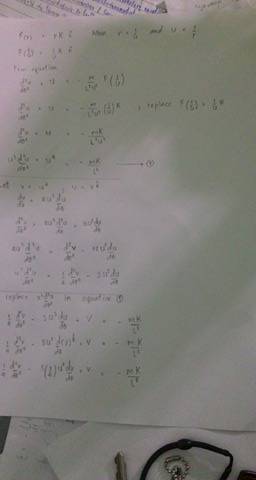
Handwritten derivation on lined paper: a central-force orbit problem with F = rK, substitution u = 1/r, and changes of variable using chain rule for d²u/dθ², ending in a final equation with terms in u and d²u/dθ².
 
Attachments
  • Handwritten derivation on lined paper: a central-force orbit problem with F = rK, substitution u = 1/r, and changes of variable using chain rule for d²u/dθ², ending in a final equation with terms in u and d²u/dθ².
    22883103_1504763529604934_1105646521_n.jpg
    8.7 KB · Views: 788
Another said:
The particles are moving under force F = rK
when r = 1/u and u = 1/r

I tried to solve the problem by defining a variable v = u4 and u = v1/2

But I can not divide variable v out of variable u

I want to find r (Radius) of orbit

View attachment 213844
Handwritten derivation of a central-force orbit equation: F(r) = rK r-hat with r = 1/u, F(1/u) = (1/u)K, then d2u/dtheta2 + u = -(m/(L2u2)) F(1/u), leading to d2u/dtheta2 + u = -(mK/(L2u2))(1/u), and finally u2 d2u/dtheta2 + u4 = -mK/L2 labelled equation 1; a substitution v = u4 is noted at the bottom.


Handwritten derivation on lined paper: u^2 d^2u/dθ^2 + u^4 = -mK/l^2 (equation 1), then substitution v = u^2 and dv/dθ = 2u^3 du/dθ, leading to replacing u^3 d^2u/dθ^2 in equation 1.


Handwritten derivation on lined paper: substitution of u^3 d^2u/dθ^2 into an equation, with terms involving d^2v/dθ^2, du/dθ, and -mK/L^2 across successive lines.
 
Attachments
  • Handwritten derivation of a central-force orbit equation: F(r) = rK r-hat with r = 1/u, F(1/u) = (1/u)K, then d2u/dtheta2 + u = -(m/(L2u2)) F(1/u), leading to d2u/dtheta2 + u = -(mK/(L2u2))(1/u), and finally u2 d2u/dtheta2 + u4 = -mK/L2 labelled equation 1; a substitution v = u4 is noted at the bottom.
    22834733_1504774389603848_295760871_n.jpg
    8 KB · Views: 349
  • Handwritten derivation on lined paper: u^2 d^2u/dθ^2 + u^4 = -mK/l^2 (equation 1), then substitution v = u^2 and dv/dθ = 2u^3 du/dθ, leading to replacing u^3 d^2u/dθ^2 in equation 1.
    22854884_1504774392937181_1917239542_n.jpg
    8.7 KB · Views: 335
  • Handwritten derivation on lined paper: substitution of u^3 d^2u/dθ^2 into an equation, with terms involving d^2v/dθ^2, du/dθ, and -mK/L^2 across successive lines.
    22835385_1504774409603846_1871424257_n.jpg
    8.1 KB · Views: 410
Another said:
The particles are moving under force F = rK
when r = 1/u and u = 1/r
I cannot make sense of the question. What do r, K and u represent? Which way does the force act?
Please state the entire question exactly as given to you. If it is a translation, try to be as complete and accurate as you can.

The ability to post images is really for diagrams and textbook extracts. Please take the trouble to type in your equations. The first image you posted was unreadabe.