Problems with Runge-Kutta method

Click For Summary
The discussion centers on a programming challenge involving the implementation of the Runge-Kutta 4th order method to solve Kepler's problem in a Cartesian coordinate system. The original poster is struggling with errors in their code, particularly with force calculations returning zero and the program crashing at certain iterations. Key issues identified include the incorrect use of array indexing, as C-style arrays start at zero rather than one, leading to out-of-bounds errors. Additionally, the implementation of the Runge-Kutta method is flawed; the poster is advised to follow a more structured approach to the RK4 algorithm, which involves calculating intermediate values for position and velocity in a specific order. Ultimately, the poster acknowledges that the issue was computational rather than mathematical, indicating a resolution was found through community feedback and corrections.
Leonardo Machado
Messages
56
Reaction score
2
I'm writing a program to compute an ODE solution of the Kepler's problem based on Runge-Kutta 4th order method and today I've past the whole day trying to made it work, but I've failed, maybe you could help me to kill the problem ?
The solutions is cartesian.
Code:
int main(){
  
    int n;
  
    double tau, x[4][200], xk[4], f[4][200], GM, PI = 3.14159265;
  
    double f1[4], f2[4], f3[4], f4[4] ;
  
    GM = 4 * pow ( PI, 2);
  
    x[2][1]= 0;
  
    x[3][1]= 0;
  
    cout << "Insert the inicial distance ( AU): " ;
    cin >> x[1][1];
  
    cout << "Choose tau ( Years): " ;
    cin >> tau;
  
    //Circular mov condition
  
    x[4][1]= sqrt ( GM / sqrt ( pow ( x[1][1], 2) + pow ( x[2][1], 2)));
 

    for ( n=1 ; n <= 199 ; n++) {
      
        // Definitions of runge-kutta parametres F1, F2, F3 e F4
      
        xk[1]=0;
        xk[2]=0;
        xk[3]=0;
        xk[4]=0;
      
        f[1][n]= x[3][n] + xk[3];
      
        f[2][n]= x[4][n] + xk[4];
      
        f[3][n]= -GM * (x[1][n] + xk[1]) / pow ( sqrt (  pow ( x[1][n] + xk[1], 2) + pow ( x[2][n] + xk[2], 2)), 3);
      
        f[4][n]= -GM * (x[2][n] + xk[2]) / pow ( sqrt (  pow ( x[1][n] + xk[1], 2) + pow ( x[2][n] + xk[2], 2)), 3);
     
      
        f1[1]= f[1][n];
        f1[2]= f[2][n];
        f1[3]= f[3][n];
        f1[4]= f[4][n];
      
      
        xk[1]=0.5*tau*f1[1];
        xk[2]=0.5*tau*f1[2]/2;
        xk[3]=0.5*f1[3];
        xk[4]=0.5*tau*f1[4];
      
        f2[1]= f[1][n];
        f2[2]= f[2][n];
        f2[3]= f[3][n];
        f2[4]= f[4][n];
      
        xk[1]=0.5*tau*f2[1];
        xk[2]=0.5*tau*f2[2];
        xk[3]=0.5*tau*f2[3];
        xk[4]=0.5*tau*f2[4];
     
        f3[1]= f[1][n];
        f3[2]= f[2][n];
        f3[3]= f[3][n];
        f3[4]= f[4][n];
      
        xk[1]=0.5*tau*f3[1];
        xk[2]=0.5*tau*f3[2];
        xk[3]=0.5*tau*f3[3];
        xk[4]=0.5*tau*f3[4];
           
        f4[1]= f[1][n];
        f4[2]= f[2][n];
        f4[3]= f[3][n];
        f4[4]= f[4][n];
      
        xk[1]=0;
        xk[2]=0;
        xk[3]=0;
        xk[4]=0;
      

        x[1][n+1]= x[1][n] + tau/6*(f1[1]+f4[1]+2*(f2[1]+f3[1]));
        x[2][n+1]= x[2][n] + tau/6*(f1[2]+f4[2]+2*(f2[2]+f3[2]));
        x[3][n+1]= x[3][n] + tau/6*(f1[3]+f4[3]+2*(f2[3]+f3[3]));
        x[4][n+1]= x[4][n] + tau/6*(f1[4]+f4[4]+2*(f2[4]+f3[4]));

        cout << endl
            << "t= " << setw (6) << tau*(n-1)
            << setw (10) << "x= " << setw (6) << x[1][n]
            << setw (10) << "y= " << setw (6) << x[2][n]
            << setw (10) << "vx= " << setw (6) << f[1][n]
            << setw (10) << "vy= " << setw (6) << f[2][n]
            << setw (10) << "fx= " << setw (6) << f[3][n]
            << setw (10) << "fy= " << setw (6) << f[4][n];
          
      
      }
}

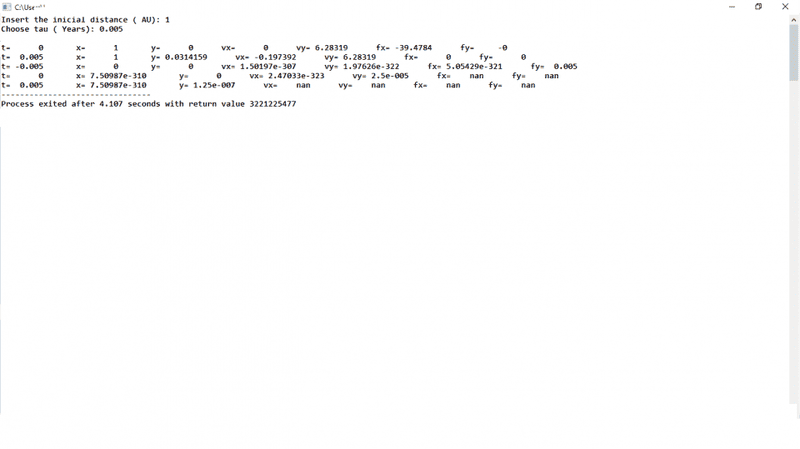
Erro para o forum.png

Look like when it takes n=1 there is some error that make the force in x and y equals 0, as you can see in this print screen, also it crashes on n=5 :c

I would be gratefull if you help me.
 
Last edited by a moderator:
Technology news on Phys.org
@Leonardo Machado, I fixed your post to use code tags rather than a bold font.

Your problem is simple: Arrays in the C family of languages start at zero rather than one.
 
D H said:
@Leonardo Machado, I fixed your post to use code tags rather than a bold font.

Your problem is simple: Arrays in the C family of languages start at zero rather than one.

Thanks, I'm newbie in here, sorry about the wrong format.
Dont know if i got it , but when you say it starts at zero you meant for example:

double x[4] = x[0] , x[1], x[2], x[3] and x[4], right ??

Case yes, there should not have any problem, cause I'm using n starting at 1 in the loop, these coordinates still exist.
 
Leonardo Machado said:
Dont know if i got it , but when you say it starts at zero you meant for example:

double x[4] = x[0] , x[1], x[2], x[3] and x[4], right ??
That is not right. What double x[4] does do is to declare x as an array with four elements, accessed as x[0], x[1], x[2], and x[3]. The element x[4] does not exist.

Your code is incorrect in a number of other ways. You are not implementing RK4 correctly.
 
Example pseudo code RK4 step, p = position, v = velocity, a = acceleration. p[] and v[] don't have to be arrays, just using the syntax of [ i ] as a step indicator. In this case (Kepler), acceleration is a function of position (the velocity parameter is not needed).

p1 = p[ i ]
v1 = v[ i ]
a1 = f(v1, p1)

p2 = p[ i ] + 1/2 Δt v1
v2 = v[ i ] + 1/2 Δt a1
a2 = f(v2, p2)

p3 = p[ i ] + 1/2 Δt v2
v3 = v[ i ] + 1/2 Δt a2
a3 = f(v3, p3)

p4 = p[ i ] + Δt v3
v4 = v[ i ] + Δt a3
a4 = f(v4, p4)

p[ i+1 ] = p[ i ] + 1/6 Δt (v1 + 2 v2 + 2 v3 + v4)
v[ i+1 ] = v[ i ] + 1/6 Δt (a1 + 2 a2 + 2 a3 + a4)
i = i + 1
 
I've fixed it, thanks all of you for the contribution and ideas.

In the end, the mistake was computational, not mathematical, was something about the order that the function was presented.
 
Learn If you want to write code for Python Machine learning, AI Statistics/data analysis Scientific research Web application servers Some microcontrollers JavaScript/Node JS/TypeScript Web sites Web application servers C# Games (Unity) Consumer applications (Windows) Business applications C++ Games (Unreal Engine) Operating systems, device drivers Microcontrollers/embedded systems Consumer applications (Linux) Some more tips: Do not learn C++ (or any other dialect of C) as a...

Similar threads

  • · Replies 15 ·
Replies
15
Views
3K
  • · Replies 4 ·
Replies
4
Views
2K
  • · Replies 2 ·
Replies
2
Views
2K
Replies
10
Views
2K
  • · Replies 12 ·
Replies
12
Views
3K
Replies
1
Views
2K
Replies
10
Views
2K
  • · Replies 66 ·
3
Replies
66
Views
6K
  • · Replies 7 ·
Replies
7
Views
2K
  • · Replies 4 ·
Replies
4
Views
2K