Proof concerning the Four Fundamental Spaces

Click For Summary

Discussion Overview

The discussion revolves around the orthogonality of the four fundamental spaces associated with a matrix, specifically the row space to the null space and the column space to the left null space. Participants explore proofs and definitions related to these concepts, including the use of dot products and matrix representations.

Discussion Character

  • Technical explanation
  • Mathematical reasoning
  • Debate/contested

Main Points Raised

  • One participant presents a matrix proof for the orthogonality of the row space to the null space, arguing that the dot product of the row space vectors with any vector from the null space must be zero.
  • Another participant suggests that if \(Ax = 0\), then the first entry of \(Ax\) being zero implies orthogonality, extending this reasoning to all rows of \(A\).
  • A question is raised about the proof concerning the left null space and column space, specifically how to argue using the dot product.
  • Definitions of the left null space are discussed, with one participant stating it as \(y \in N(A^T)\) and relating it to the column space of matrix \(A\).
  • Participants discuss the implications of the relationship between the rows of \(A^T\) and the columns of \(A\) in the context of orthogonality.
  • One participant expresses interest in a different proof that derives the orthogonality from the statement \(A^Ty = 0\) and seeks clarification on the steps involved in this proof.
  • Another participant clarifies that multiplying the equation from the left means applying \(x^T\) to both sides, leading to the conclusion that \(y^TAx = 0\).
  • A more conceptual approach to linear algebra is presented, discussing the relationship between linear maps and their kernels and images, emphasizing the orthogonality of associated subspaces.

Areas of Agreement / Disagreement

Participants express various viewpoints and approaches to the proofs and definitions discussed, with some agreeing on the correctness of certain proofs while others raise questions or propose alternative methods. The discussion remains unresolved regarding the clarity of certain steps in the proofs and the definitions used.

Contextual Notes

Some participants note the need for clarity in definitions and the steps of proofs, particularly regarding the left null space and its relationship to the column space. There is also mention of the graphical representation of these concepts, which may depend on specific bases chosen for the vector spaces involved.

Peter_Newman
Messages
155
Reaction score
11
Hello all,

I am currently working on the four fundamental spaces of a matrix. I have a question about the orthogonality of the
  1. row space to the null space
  2. column space to the left null space
------------------------------------------------

In the book of G. Strang there is this nice picture of the matrices that clarifies the orthogonality. This is what I mean:
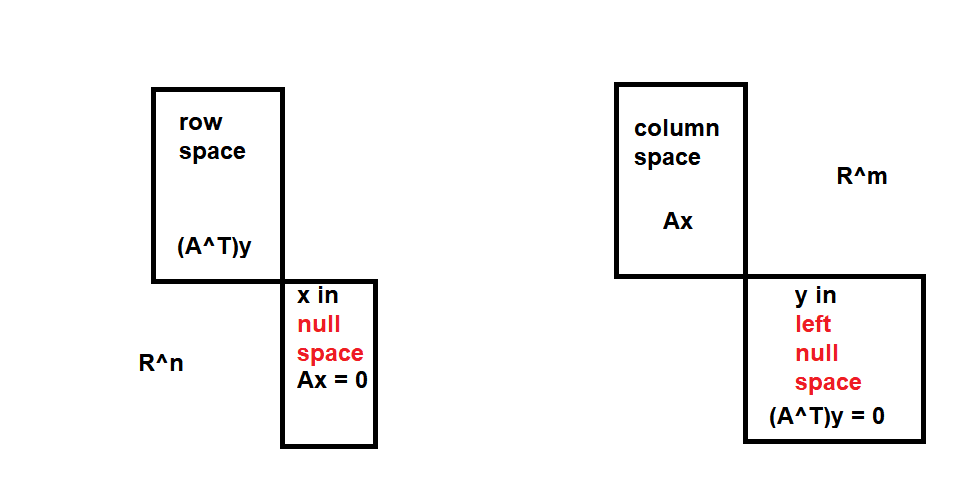
FundamentalSpaces.png

With the help of these expressions, this is then argued:

$$Ax = \begin{pmatrix}\text{row 1} \\ ... \\ \text{row m}\end{pmatrix}\begin{pmatrix} \vdots \\ x \\ \vdots \end{pmatrix} = 0$$
$$A^Ty = \begin{pmatrix}\text{transposed column 1 of A} \\ ... \\ \text{transposed column n of A}\end{pmatrix}\begin{pmatrix} \vdots \\ y \\ \vdots \end{pmatrix} = 0$$

------------------------------------------------

There is also a matrix proof, and this is what I am very interested in. You can read my thoughts about it in the explanations below.

I have shown the whole thing as a picture. Using this picture I try to show the matrix proof.

1. proof for the orthogonality of the row space to the null space:
  • The row space vectors are combinations ##A^Ty## of the rows, therefore the dot product of ##A^Ty## with any ##x## of the null space must be zero:

$$\langle\,A^Ty,x\rangle = x^T(A^Ty) = (Ax)^Ty = 0^Ty = 0$$

2. proof of the orthogonality of the column space to the left null space:
  • The column space vectors are combinations ##Ax## of the columns, therefore the dot product of ##Ax## with any ##y## of the left null space must be zero:

$$\langle\, Ax, y\rangle = (Ax)^Ty = x^T(A^Ty) = x^T0 = 0$$

I think that is correct so far, but I am not quite sure. Therefore I would be very happy about a confirmation or contra position :)

Note 1: I would like to be honest enough to say that I have also asked this question to others HERE. However, I did not receive an answer there, but I would like to refer to this fact. If Someone here gives an answer, I would like to refer to it. I hope that's ok, because I can no longer delete my question in the other forum, but here I promise myself more adequate help (At least this was always so in the past :) )...

Note 2: This is not a homework assignment. I'm just reading the book in parallel and am interested in this question.
 
Physics news on Phys.org
I think the easiest way to see the null space is orthogonal to the row space is to just noticed that if ##A x = 0##, then the first entry of ##Ax## is the dot product of ##x## and the first row of ##A##, and it must be zero. Similar to the other rows of ##A##.
 
  • Like
Likes   Reactions: Peter_Newman
Hello and thank you for your answer. Yes, it is similar to that in Strang's book (see matrix part between the dashed lines in my first post). ##Ax = 0## is almost the definition from which this comes out. But how do you argue regarding the Left Nullspace and the Column Space?

I am especially interested in the proof with the help of the dot product.
 
What is your definition of left null space?
 
It is ##y \in N(A^T)## and ##Ax## is in the column space of Matrix ##A##. The definition for the left null space is ##A^Ty = 0##
 
The picture looks as a graphic formulation, that every short exact sequence in ##\operatorname{Vec}## splits. In other words, we can find a basis of the kernel (or the image) and extend it to a basis of the entire spaces. Matrices require some bases anyway, so why not choose one which makes the matrices especially easy?
 
  • Like
Likes   Reactions: Peter_Newman
Peter, ##A^t y =0## looks a lot like the ##Ax=0## formula we used to show the null space was orthogonal to the row space. What are the rows of ##A^t##?
 
  • Like
Likes   Reactions: Peter_Newman
@Office_Shredder, the rows of ##A^T## are the columns of ##A##, I guess. With this you probably want to point out that this behaves almost like ##Ax = 0## (which we know is orthogonal. But only "rotated")?.

@fresh_42, the picture more or less summarizes the "action" of a matrix. This is in my opinion a nice way to visualize it (Strang's idea :) )
-----
What I want to point out:

This ##Ax = \begin{pmatrix}\text{row 1} \\ ... \\ \text{row m}\end{pmatrix}\begin{pmatrix} \vdots \\ x \\ \vdots \end{pmatrix} = 0## ist clear for me. I understand that the dot product is zero, means they are orthogonal.

This ##A^Ty = \begin{pmatrix}\text{transposed column 1 of A} \\ ... \\ \text{transposed column n of A}\end{pmatrix}\begin{pmatrix} \vdots \\ y \\ \vdots \end{pmatrix} = 0## is also understandable.

BUT:

I'am interested if this is right:
Let ##y \in N(A^T)## and ##Ax## is in the column space of Matrix ##A##. I want to prove that every vector ##y## is orthogonal to ##Ax##. Then ##\langle\, Ax, y\rangle = (Ax)^Ty = x^T(A^Ty) = x^T0 = 0##
 
Last edited:
I think that your proof is correct at the end of your post.
 
  • Like
Likes   Reactions: Peter_Newman
  • #10
@Office_Shredder, thanks a lot!

I have one last question:

I have seen another prove (which comes not from me but is also interesting:) ) that derives this fact by starting from this statement ##A^Ty = 0##. I want to quote the steps to derive the orthogonality ##y^T\cdot Ax = 0##, to show what is unclear to me...

Step 1: ##A^Ty = 0##
Step 2: ##A^Ty = 0|x## multiply equation from left
Step 3: ##x^TA^Ty = 0|^T## transpose equation
Step 4: ##y^TAx = 0##

In this prove the step from 2 to 3 is unclear for me. What does "multiply equation from left" mean? Personally I like my prove more than this but, this prove here is in the meaning the same as my but in the derivation different.
 
  • #11
I think it's saying multiply both sides on the left by ##x^T##, and then obviously ##x^T 0= 0## so they don't even write the x on the right hand side I think.
 
  • Like
Likes   Reactions: Peter_Newman
  • #12
Thanks for your answer! I also see it that way, correctly it should then be called as follows in step 2:
Step 2: ##A^Ty = 0\quad|\cdot x^T##, multiply ##x^T## from left, (##x^TA^Ty = x^T0 = 0##)
 
  • #13
Peter_Newman said:
Thanks for your answer! I also see it that way, correctly it should then be called as follows in step 2:
Step 2: ##A^Ty = 0\quad|\cdot x^T##, multiply ##x^T## from left, (##x^TA^Ty = x^T0 = 0##)
If you are so picky, then you must write: ##A^Ty = 0\quad| x^T\cdot ##
 
  • Haha
Likes   Reactions: Peter_Newman
  • #14
If you like conceptual linear algebra you might think about this formulation:

If A:V-->W is a linear map from one vector space V to another W, and f:W-->k is a linear "functional" on W, i.e. a linear map to the scalars, then their composition fA = A*(f):V-->k is a linear functional on V. Thus a linear map A from V to W yields by composition a linear map A* in the other direction, i.e. from functionals on W to functionals on V.

The obvious subspaces associated to A are its kernel in V and its image in W. Then we can also ask for the kernel and image of A*. As to the kernel, i.e. what functionals f map to zero under A*, we ask when is fA = 0? This happens when f vanishes on the image of A, so the kernel of A* is orthogonal to the image of A.

As to the image of A*, we ask what functionals g on V have the form g = fA for some f on W? I.e. which functionals on V factor through A? This happens exactly when g vanishes on the kernel of A, (note at least if Ax=0, then certainly gx = fAx = 0). Thus the image of A* is orthogonal to the kernel of A.

The connection with your version is that the matrix of A* is the transpose of the matrix of A. Note e.g. that the ith row of A defines the scalar valued map fiA on V, which equals the composition of A followed by the scalar valued map fi on W which is projection on the ith "axis" in W defined by the given basis of W. Thus the rows of A span the image of A*, just as the columns of A span the image of A.

This may seem lengthy when written out, but it is all summarized in the diagram fA:V-->W-->k, preferably drawn as a triangle with sides A:V-->W, f:W-->k, fA:V-->k. Then you just look at it and ask yourself, given A, for which f is fA = 0, and which maps V-->k can occur as fA for some f? The answers almost force themselves on you.
 
  • Informative
Likes   Reactions: Peter_Newman
  • #15
Thanks for the good and helpful answers here. I think my question is now well answered!

@mathwonk, thank you for this other perspective about the things!
 

Similar threads

  • · Replies 8 ·
Replies
8
Views
3K
  • · Replies 15 ·
Replies
15
Views
2K
  • · Replies 52 ·
2
Replies
52
Views
4K
  • · Replies 8 ·
Replies
8
Views
3K
  • · Replies 7 ·
Replies
7
Views
3K
  • · Replies 3 ·
Replies
3
Views
3K
  • · Replies 16 ·
Replies
16
Views
2K
  • · Replies 9 ·
Replies
9
Views
2K
  • · Replies 23 ·
Replies
23
Views
2K
  • · Replies 4 ·
Replies
4
Views
3K