bargaj
- 2
- 0
Hello!
Lately, I've been struggling with this assignment. (angle brackets represent closed interval)
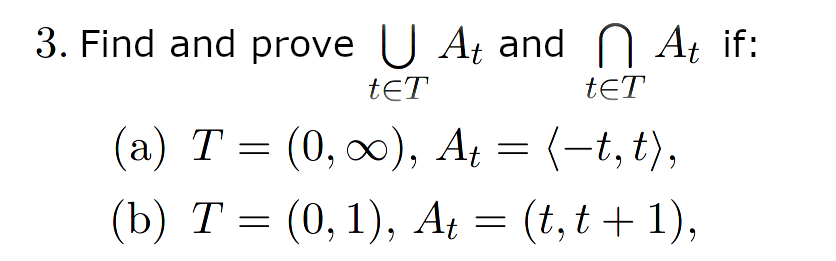
I figured out that:
a)
union = R
intersection = {0}
b)
union = (0, 2)
intersection = {1}
I asked my prof about this and she explained to me that it should be shown that if a set is an intersection of sets, then it belongs to each of those sets and, conversely, nothing else belongs to the intersection, so every other element does not belong to at least one of those sets. But I don't really know how to interpret this or where to even start. (normally, when proving the equality of two sets, I would try to prove that A⊆B and B⊆A, but I don't see how that's applicable here).
Thank you for your help!
Lately, I've been struggling with this assignment. (angle brackets represent closed interval)
I figured out that:
a)
union = R
intersection = {0}
b)
union = (0, 2)
intersection = {1}
I asked my prof about this and she explained to me that it should be shown that if a set is an intersection of sets, then it belongs to each of those sets and, conversely, nothing else belongs to the intersection, so every other element does not belong to at least one of those sets. But I don't really know how to interpret this or where to even start. (normally, when proving the equality of two sets, I would try to prove that A⊆B and B⊆A, but I don't see how that's applicable here).
Thank you for your help!