Discussion Overview
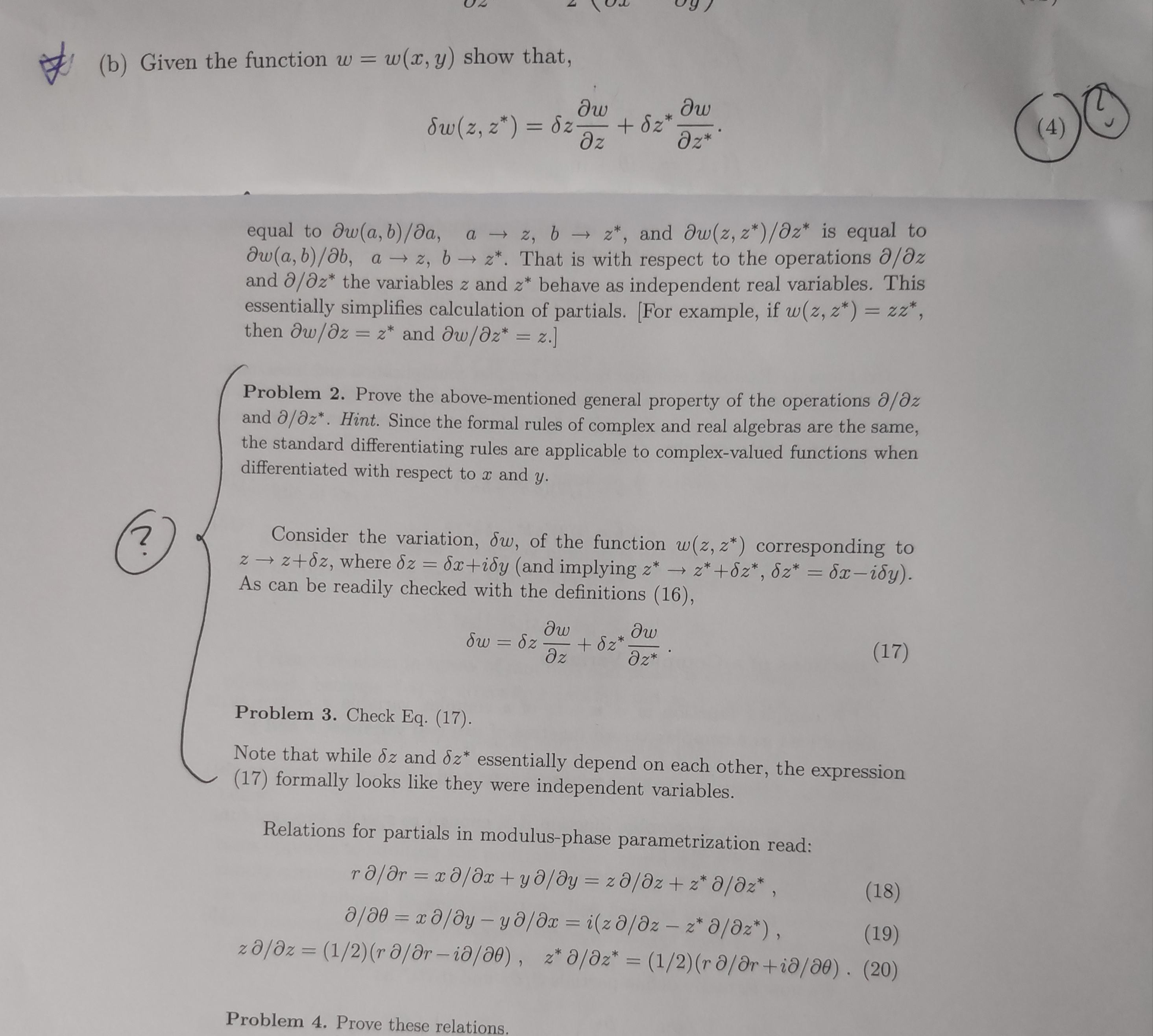
The discussion revolves around understanding the expression for delta*w(z, z) in the context of complex numbers, specifically in relation to a problem involving a proof and an equation labeled (17). Participants explore the meaning of delta in this context and how it relates to changes in complex functions.
Discussion Character
- Exploratory
- Technical explanation
- Mathematical reasoning
Main Points Raised
- One participant expresses confusion about the term delta*w(z, z) and seeks clarification on its meaning.
- Another participant asserts that there is no delta*w(z, z) and suggests that the correct term is delta w(z, z*), which represents the change in w when z and its conjugate z* change slightly.
- A participant acknowledges understanding what "delta" means but struggles to prove equation (17).
- One suggestion involves using the mean value theorem to express delta w in terms of changes in x, y, and z.
- A participant presents a series of equations attempting to relate changes in w to changes in its real and imaginary components, but questions whether this approach is correct.
Areas of Agreement / Disagreement
Participants do not appear to reach a consensus on the correct interpretation of delta*w(z, z) or the validity of the proposed solutions. Multiple competing views and interpretations remain present in the discussion.
Contextual Notes
There are unresolved assumptions regarding the definitions of the variables involved and the specific context of equation (17). The discussion reflects varying levels of understanding and interpretation of complex functions and their derivatives.
Who May Find This Useful
This discussion may be useful for students or individuals studying complex analysis, particularly those interested in the nuances of derivatives and changes in complex functions.