Proof of ##F## is an orthogonal projection if and only if symmetric

Click For Summary

Discussion Overview

The discussion revolves around the conditions under which a linear transformation ##F## on an inner product space ##V## is considered an orthogonal projection, specifically focusing on the relationship between symmetry and projection properties.

Discussion Character

  • Technical explanation
  • Debate/contested

Main Points Raised

  • Some participants reference the definition of a symmetric linear transformation, stating that ##\langle F(\textbf{u}), \textbf{v} \rangle = \langle \textbf{u}, F(\textbf{v}) \rangle## for ##\textbf{u},\textbf{v}\in V##.
  • There is a question regarding the justification of the equality ##\langle F(\textbf{v}), F(\textbf{v}) \rangle = \langle \textbf{v}, F(F(\textbf{v})) \rangle##, particularly in the context of projections and the condition ##F=F^2##.
  • One participant suggests that for vectors in the orthogonal complement of the image of ##F##, denoted as ##(\text{im} \ F)^{\perp}##, it is unclear why ##F(\textbf{v})=\textbf{v}## holds.
  • Another participant points out that the equality ##||F(v)||^2 = ## follows from the symmetry of ##F## and notes that this equals zero for vectors in ##Im(F)^{\perp}##.
  • There is a suggestion to apply the definition of ##F## with specific substitutions, indicating that ##u=v## and ##v=F(v)## are not direct equations but rather replacements.

Areas of Agreement / Disagreement

Participants express differing views on the justification of certain equalities and the implications of symmetry in relation to projections. The discussion remains unresolved regarding the specific conditions under which the properties of ##F## hold.

Contextual Notes

Participants have not reached a consensus on the implications of symmetry for the behavior of the transformation ##F##, particularly in relation to vectors in the orthogonal complement of its image.

schniefen
Messages
177
Reaction score
4
TL;DR
This is a proof of a linear transformation ##F## on an inner product space ##V## being an orthogonal projection if and only if ##F## is a projection and symmetric.
The given definition of a linear transformation ##F## being symmetric on an inner product space ##V## is

##\langle F(\textbf{u}), \textbf{v} \rangle = \langle \textbf{u}, F(\textbf{v}) \rangle## where ##\textbf{u},\textbf{v}\in V##.​

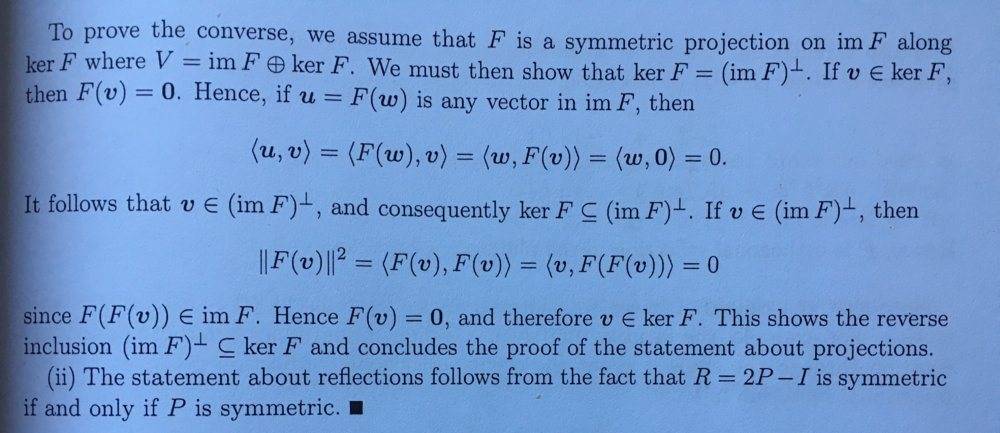
In the attached image, second equation, how is the second equality justified? That is, ##\langle F(\textbf{v}), F(\textbf{v}) \rangle = \langle \textbf{v}, F(F(\textbf{v})) \rangle##. For projections in general, ##F=F^2##, but why does ##F(\textbf{v})=\textbf{v}## for ##\textbf{v} \in (\text{im} \ F)^{\perp}##
IMG_3099.jpg
 
Physics news on Phys.org
schniefen said:
Summary: This is a proof of a linear transformation ##F## on an inner product space ##V## being an orthogonal projection if and only if ##F## is a projection and symmetric.

The given definition of a linear transformation ##F## being symmetric on an inner product space ##V## is

##\langle F(\textbf{u}), \textbf{v} \rangle = \langle \textbf{u}, F(\textbf{v}) \rangle## where ##\textbf{u},\textbf{v}\in V##.​

In the attached image, second equation, how is the second equality justified? That is, ##\langle F(\textbf{v}), F(\textbf{v}) \rangle = \langle \textbf{v}, F(F(\textbf{v})) \rangle##. For projections in general, ##F=F^2##, but why does ##F(\textbf{v})=\textbf{v}## for ##\textbf{v} \in (\text{im} \ F)^{\perp}##View attachment 250815

Apply the definition of symmetric linear map you quoted.
 
  • Like
Likes   Reactions: schniefen
Hi, for the second equality you've got : ##||F(v)||^2 = <v, F(F(v))>## (because ##F## is symmetric) and this equate ##0## since ##v \in Im(F)^{\perp}## and ##F(F(v)) \in Im(F)##. Where is the problem?

Perhaps I didn't understand the question.
 
Apply the definition of F you quoted for ##u=v##, ##v=F(v)## (those are replacement equations, not direct equations, i.e ##v## isn't something special such that ##v=F(v)##.
 

Similar threads

  • · Replies 25 ·
Replies
25
Views
4K
  • · Replies 10 ·
Replies
10
Views
2K
  • · Replies 4 ·
Replies
4
Views
2K
  • · Replies 0 ·
Replies
0
Views
2K
  • · Replies 3 ·
Replies
3
Views
4K
  • · Replies 2 ·
Replies
2
Views
2K
  • · Replies 1 ·
Replies
1
Views
2K
  • · Replies 3 ·
Replies
3
Views
4K
  • · Replies 7 ·
Replies
7
Views
2K
  • · Replies 7 ·
Replies
7
Views
2K