woundedtiger4
- 188
- 0
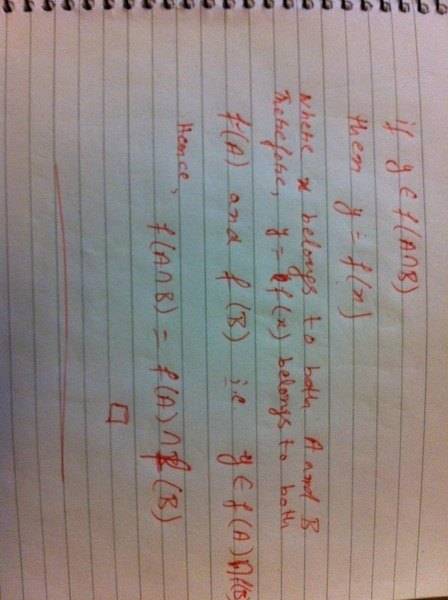
I know that f(A∩B) is not equal to f(A) ∩ f(B) but i don't know that where am i wrong in the following proof...:( can someone please give me an intuitive example?
The discussion centers on the mathematical proof that f(A∩B) is not equal to f(A) ∩ f(B). Participants emphasize that to establish this inequality, one must demonstrate that f(A) ∩ f(B) is not a subset of f(A∩B). A counterexample is suggested, involving a function f and distinct elements p and q from sets A and B, respectively, where f(p) equals f(q). This highlights the necessity of proving both inclusions to validate the inequality.
PREREQUISITESMathematicians, students studying abstract algebra or set theory, and anyone interested in understanding the nuances of function properties and proof techniques.
Thank you sir.HallsofIvy said:In order to prove "[itex]X= Y[/itex]" you must prove both "[itex]X\subseteq Y[/itex]" and [itex]Y\subseteq X[/itex].
You want to prove that [itex]f(A\cap B)[/itex] is not equal to [itex]f(A)\cap f(B)[/itex] and your give proof shows only that [itex]f(A\cap B)\subseteq f(A)\cap f(B)[/itex].
So look for a counter example in which [itex]f(A)\cap f(B)[/itex] is NOT a subset of [itex]f(A\cap B)[/itex].
That is, find a function f and values p and q, p in A, q in B such that f(p)= f(q).