Prove Bisecting Angle Theorem - 5 Min Exercise

  • Context: High School 
  • Thread starter Thread starter Qemikal
  • Start date Start date
  • Tags Tags
    Angle Proof
Click For Summary

Discussion Overview

The discussion revolves around the Bisecting Angle Theorem, specifically a proposed exercise involving the relationship between angles in a triangle. Participants are asked to prove a specific equation related to angle bisectors.

Discussion Character

  • Debate/contested

Main Points Raised

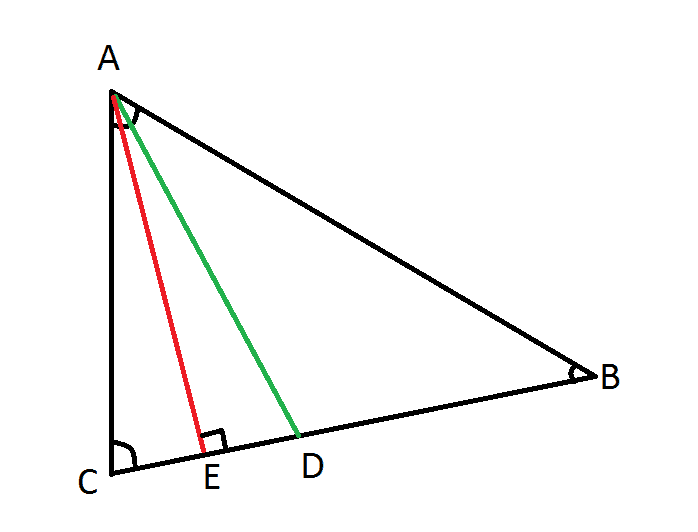
  • One participant presents an exercise stating that m(∠EAD) = [m(∠ABC) - m(∠ACB)]/2, claiming it is a result of angle AD bisecting angle A.
  • Another participant argues that the proposed statement cannot be proven as it is generally not true, pointing out that varying the position of point D along line BC results in different values for angle EAD, while the right side of the equation remains fixed.
  • A later reply reiterates the same concern about the inability to prove the statement without additional conditions on point D.
  • The original poster acknowledges a missing detail, emphasizing that AD splits the angle into two equal angles, but does not clarify how this affects the proof.

Areas of Agreement / Disagreement

Participants express disagreement regarding the validity of the proposed exercise, with at least one participant asserting that it cannot be proven without further conditions on point D.

Contextual Notes

The discussion lacks clarity on the specific conditions required for point D and how they might affect the validity of the proposed equation.

Qemikal
Messages
14
Reaction score
2
Hi, guys, i made an exercise, can you prove this?
xybn6vc.png

m(∠EAD)=[m(∠ABC)-m(∠ACB)]/2
If you have 5 free minutes, try it, i hope you'll like it!
It's my first own exercise, so I would like some feedback, too.
AD= bisecting(splits angle in 2 equal sides)
 
Last edited:
Mathematics news on Phys.org
You can't prove this, it is, generally, not true. By choosing D at different places along BC, angle EAD can take on many different values while the right side, not depending on D, is fixed. Was there some other condition on D you did not give?
 
HallsofIvy said:
You can't prove this, it is, generally, not true. By choosing D at different places along BC, angle EAD can take on many different values while the right side, not depending on D, is fixed. Was there some other condition on D you did not give?
My bad, I forgot to add that AD splits the angle in 2 equal sides(angles).
 
Thread closed for moderation.
 

Similar threads

  • · Replies 2 ·
Replies
2
Views
3K
  • · Replies 13 ·
Replies
13
Views
3K
  • · Replies 2 ·
Replies
2
Views
3K
  • · Replies 1 ·
Replies
1
Views
6K
  • · Replies 12 ·
Replies
12
Views
3K
  • · Replies 2 ·
Replies
2
Views
2K
  • · Replies 17 ·
Replies
17
Views
11K
  • · Replies 5 ·
Replies
5
Views
3K
  • · Replies 4 ·
Replies
4
Views
4K
  • · Replies 5 ·
Replies
5
Views
3K