Prove the time evolution operator is unitary

Click For Summary
SUMMARY

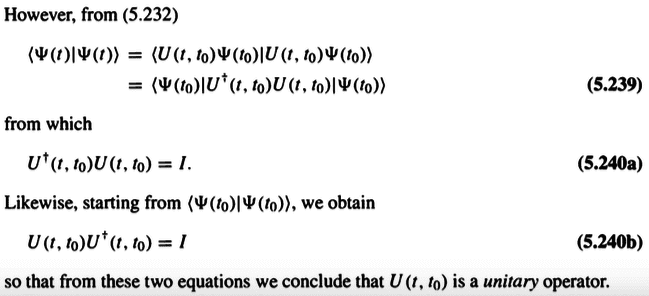
The discussion focuses on proving the unitarity of the time evolution operator, specifically addressing the derivation of equations (5.240a) and (5.240b). Participants clarify that the relationship <\psi(t_0)\,|\,\psi(t_0)>=<\psi(t_0)\,|\,U^\dagger(t, t_0)\,U(t, t_0)\,|\,\psi(t_0)> holds for any state \psi(t_0). The conclusion emphasizes that multiplying both sides by the appropriate matrices leads to the desired results, confirming the unitarity of the operator.

PREREQUISITES
  • Understanding of quantum mechanics principles, particularly the role of the time evolution operator.
  • Familiarity with bra-ket notation and inner product calculations.
  • Knowledge of unitary operators and their properties in quantum systems.
  • Experience with mathematical manipulation of operators in quantum mechanics.
NEXT STEPS
  • Study the derivation of the time evolution operator in quantum mechanics.
  • Learn about the implications of unitarity in quantum systems.
  • Research the mathematical foundations of bra-ket notation and inner products.
  • Explore advanced topics in quantum mechanics, such as the Schrödinger equation and its solutions.
USEFUL FOR

This discussion is beneficial for quantum mechanics students, physicists, and researchers interested in the mathematical foundations of quantum theory and the properties of time evolution operators.

Happiness
Messages
686
Reaction score
30
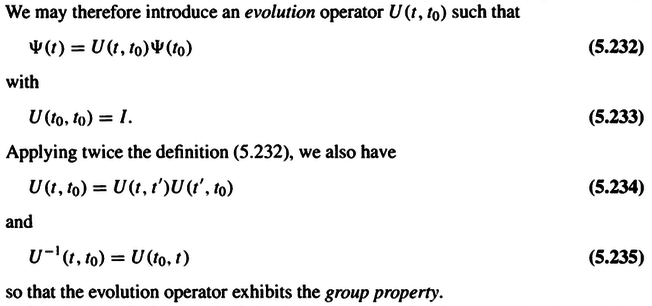
How is (5.240b) derived? I get {U^{-1}}^\dagger(t, t_0)\,U^{-1}(t, t_0)=I instead.

My steps:
\begin{align}&lt;\psi(t_0)\,|\,\psi(t_0)&gt;&amp;=\,&lt;U(t_0, t)\,\psi(t)\,|\,U(t_0, t)\,\psi(t)&gt;\\<br /> &amp;=\,&lt;U^{-1}(t, t_0)\,\psi(t)\,|\,U^{-1}(t, t_0)\,\psi(t)&gt;\\<br /> &amp;=\,&lt;\psi(t)\,|\,{U^{-1}}^\dagger(t, t_0)\,U^{-1}(t, t_0)\,|\,\psi(t)&gt;\end{align}

Screen Shot 2015-12-27 at 7.00.38 am.png

Screen Shot 2015-12-27 at 7.01.28 am.png

Screen Shot 2015-12-27 at 7.01.39 am.png


Also, to get (5.240a), do we use the fact that &lt;\psi(t_0)\,|\,\psi(t_0)&gt;\,=\,&lt;\psi(t_0)\,|\,U^\dagger(t, t_0)\,U(t, t_0)\,|\,\psi(t_0)&gt;is true for any \psi(t_0)?
 
  • Like
Likes Clausia
Physics news on Phys.org
Happiness said:
How is (5.240b) derived? I get {U^{-1}}^\dagger(t, t_0)\,U^{-1}(t, t_0)=I instead.
Multiply both sides by appropriate matrices and you should get the result you want.
Also, to get (5.240a), do we use the fact that &lt;\psi(t_0)\,|\,\psi(t_0)&gt;\,=\,&lt;\psi(t_0)\,|\,U^\dagger(t, t_0)\,U(t, t_0)\,|\,\psi(t_0)&gt;is true for any \psi(t_0)?
Right.
 
  • Like
Likes Clausia and Happiness
Time reversal invariant Hamiltonians must satisfy ##[H,\Theta]=0## where ##\Theta## is time reversal operator. However, in some texts (for example see Many-body Quantum Theory in Condensed Matter Physics an introduction, HENRIK BRUUS and KARSTEN FLENSBERG, Corrected version: 14 January 2016, section 7.1.4) the time reversal invariant condition is introduced as ##H=H^*##. How these two conditions are identical?

Similar threads

  • · Replies 2 ·
Replies
2
Views
2K
  • · Replies 15 ·
Replies
15
Views
2K
  • · Replies 3 ·
Replies
3
Views
2K
  • · Replies 8 ·
Replies
8
Views
1K
  • · Replies 8 ·
Replies
8
Views
2K
  • · Replies 12 ·
Replies
12
Views
865
  • · Replies 15 ·
Replies
15
Views
3K
  • · Replies 14 ·
Replies
14
Views
2K
  • · Replies 4 ·
Replies
4
Views
1K
  • · Replies 19 ·
Replies
19
Views
5K