Proving Countability: Positive Rational Numbers & Union of Countable Sets

  • Context: MHB 
  • Thread starter Thread starter mathmari
  • Start date Start date
  • Tags Tags
    Sets
Click For Summary

Discussion Overview

The discussion revolves around proving the countability of the set of positive rational numbers and the union of countable sets. Participants explore various methods and approaches to demonstrate these concepts, including the use of mappings and sequences.

Discussion Character

  • Exploratory
  • Mathematical reasoning
  • Debate/contested

Main Points Raised

  • One participant suggests using a "swan walk" to enumerate positive rational numbers, providing a specific sequence as an example.
  • Another participant questions whether the positive rationals can be counted using the provided hint and seeks a formal proof beyond visual representation.
  • There is a discussion about defining a mapping from natural numbers to positive rationals to show countability.
  • Participants propose that the union of two countable sets can be shown to be countable through a surjective mapping.
  • Induction is suggested as a method to prove that the union of a countable number of countable sets is also countable, with a base case and inductive hypothesis outlined.
  • Some participants note that while the inductive approach is valid, a surjective mapping is necessary to fully establish the countability of the union of sets.
  • There is a clarification that mixing Cartesian products and unions in the context of countability may lead to confusion, and a swan walk can also be defined for unions.

Areas of Agreement / Disagreement

Participants generally agree on the use of mappings and sequences to demonstrate countability, but there is no consensus on the best method to prove the union of countable sets, with some advocating for induction and others emphasizing the need for surjective mappings.

Contextual Notes

Some participants express uncertainty about the necessity of justifying certain steps in their proofs, such as ensuring that all fractions appear after a finite number of terms. There is also a note that the discussion mixes concepts of Cartesian products and unions, which may require further clarification.

mathmari
Gold Member
MHB
Messages
4,984
Reaction score
7
Hey! :o

  1. Show that the set of all positive rational numbers is a countable set.
    (Hint: Consider all points in the first quadrant of the plane of which the coordinates x and y are integers.)
  2. Show that the union of a countable number of countable sets is a countable set.
I have done the following:
  1. Let $x,y>0$. We write a positive rational $\frac{x}{y}$ at the point (x, y) in the plane in the first quadrant. Now we have to count these points, or not?
  2. Do we have to use induction here?

(Wondering)
 
Physics news on Phys.org
Hey mathmari!

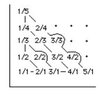
We should make a so called swan walk. That applies to both your problems.
The swan walk for the positive rationals is 1/1, 1/2, 2/1, 3/1, 2/2, 1/3, 1/4, ... (Thinking)
 
As an aside, see Chapter 1, exercise 4 (Examples I) of that PDF. I believe the general result implies countability.

You'll have to scroll down to see exercise 4; the link above is not direct.
 
Klaas van Aarsen said:
We should make a so called swan walk. That applies to both your problems.
The swan walk for the positive rationals is 1/1, 1/2, 2/1, 3/1, 2/2, 1/3, 1/4, ... (Thinking)

Does this mean that we correspond to these rationals the respective point and then we count them as follows?

View attachment 8481

(Wondering)

- - - Updated - - -

greg1313 said:
As an aside, see Chapter 1, exercise 4 (Examples I) of that PDF. I believe the general result implies countability.

You'll have to scroll down to see exercise 4; the link above is not direct.

So, do we have to write the positive rationals as a sequence? (Wondering)
 

Attachments

  • rationals.JPG
    rationals.JPG
    4.7 KB · Views: 138
mathmari said:
Does this mean that we correspond to these rationals the respective point and then we count them as follows?

So, do we have to write the positive rationals as a sequence? (Wondering)

Yes.
greg1313's reference shows a slightly different swan-walk, which boils down to the same thing.
We can write the positive rationals as a sequence, which means that we can 'count' them.
That is, we can define a mapping $\mathbb N \to \mathbb Q_{>0}$ that is surjective, which shows that the positive rationals are countable. (Thinking)
 
Klaas van Aarsen said:
Yes.
greg1313's reference shows a slightly different swan-walk, which boils down to the same thing.
We can write the positive rationals as sequence, which means that we can 'count' them.
That is, we can define a mapping $\mathbb N \to \mathbb Q_{>0}$ that is surjective, which shows that the positive rationals are countable. (Thinking)

Ah ok!

But using the given hint, do we 'count' the positive rationals as in the picture of #4 ? If yes, how could we prove that formally without just with the picture?

(Wondering)
 
mathmari said:
Ah ok!

But using the given hint, do we 'count' the positive rationals as in the picture of #4 ? If yes, how could we prove that formally without just with the picture?

Any positive rational can be written as $\frac p q$ where $p$ and $q$ are positive integers.
So each positive rational will show up in the sequence.
We might formalize the actual sequence a bit more, defining the actual mapping.
Did you try? Otherwise you can check out greg1313's reference. (Thinking)
 
Klaas van Aarsen said:
Any positive rational can be written as $\frac p q$ where $p$ and $q$ are positive integers.
So each positive rational will show up in the sequence.
We might formalize the actual sequence a bit more, defining the actual mapping.
Did you try?

1/1, 1/2, 2/1, 3/1, 2/2, 1/3, 1/4, ...

First we have all the fractions where the sum of numerator and denominator is equal to 2, then all the fractions where the sum of numerator and denominator is equal to 3, then all the fractions where the sum of numerator and denominator is equal to 4, etc.

The fraction p/q will appear if we write down all the fractions with sum of numerator and denominator equal to $p+q$.

Do we have to justify that we get this fraction after finite number of terms? Is everything correct? Or did you mean something else? (Wondering)
 
mathmari said:
1/1, 1/2, 2/1, 3/1, 2/2, 1/3, 1/4, ...

First we have all the fractions where the sum of numerator and denominator is equal to 2, then all the fractions where the sum of numerator and denominator is equal to 3, then all the fractions where the sum of numerator and denominator is equal to 4, etc.

The fraction p/q will appear if we write down all the fractions with sum of numerator and denominator equal to $p+q$.

Do we have to justify that we get this fraction after finite number of terms? Is everything correct? Or did you mean something else?

Yes. That is what I meant. And I believe it is sufficient for a proof. (Nod)
 
  • #10
Klaas van Aarsen said:
Yes. That is what I meant. And I believe it is sufficient for a proof. (Nod)

Ah ok! Great! (Nerd) What about the second question to show that the union of a countable number of countable sets is a countable set?
Do we have to show first that it holds for two sets and then we show the desired by induction?

Let $A=(a_1, a_2, \ldots )$, $B=(b_1, b_2, \ldots )$ be two countable sets. We define $f:\mathbb{N}\times\mathbb{N}\rightarrow A\times B$ with $f(n,m)=(a_n, b_m)$. This map is surjective, isn't it?
We have that $\mathbb{N}\times\mathbb{N}$ is counatble, right? Then it follows that $A\times B$ is also countable.

Is this part correct? (Wondering) Now we have to use the induction to show that $\displaystyle{\bigcup_{n\in \mathbb{N}}M_n}$ is countable:

Base case: For $n=1$ it holds since then we have just one set, which is countable.

Inductive Hypothesis: We suppose that the statement holds for $n=k$.

Inductive step: We want to show that it holds for $n=k+1$. We have that $\bigcup_{n=1}^{k+1}M_n=\bigcup_{n=1}^{k}M_n\cup M_{k+1}$. The first one $\bigcup_{n=1}^{k}M_n$ is countable from the inctuctive hypothesis and $M_{k+1}$ is also ccountable.
So we have a union of two countable sets, which is countable because of the above argument.

Is everything correct? (Wondering)
 
Last edited by a moderator:
  • #11
mathmari said:
Ah ok! Great! (Nerd) What about the second question to show that the union of a countable number of countable sets is a countable set?
Do we have to show first that it holds for two sets and then we show the desired by induction?

Let $A=(a_1, a_2, \ldots )$, $B=(b_1, b_2, \ldots )$ be two countable sets. We define $f:\mathbb{N}\times\mathbb{N}\rightarrow A\times B$ with $f(n,m)=(a_n, b_m)$. This map is surjective, isn't it?
We have that $\mathbb{N}\times\mathbb{N}$ is counatble, right? Then it follows that $A\times B$ is also countable.

Is this part correct?

It is correct, although you may want to explain why $\mathbb{N}\times\mathbb{N}$ is countable.
It is countable for the same reason as $\mathbb Q_{>0}$, which is because we can define a swan walk.
That is, we can define a surjective map $\mathbb N \to \mathbb N \times \mathbb N$, showing that it is countable.

mathmari said:
Now we have to use the induction to show that $\displaystyle{\bigcup_{n\in \mathbb{N}}M_n}$ is countable:

Base case: For $n=1$ it holds since then we have just one set, which is countable.

Inductive Hypothesis: We suppose that the statement holds for $n=k$.

Inductive step: We want to show that it holds for $n=k+1$. We have that $\bigcup_{n=1}^{k+1}M_n=\bigcup_{n=1}^{k}M_n\cup M_{k+1}$. The first one $\bigcup_{n=1}^{k}M_n$ is countable from the inctuctive hypothesis and $M_{k+1}$ is also ccountable.
So we have a union of two countable sets, which is countable because of the above argument.

Is everything correct?

I believe so yes.
EDIT: As Country Boy mentions below, induction is not good enough. We really need a surjective mapping of $\mathbb N$ to all elements.
Btw, we're mixing cartesian products and unions, which is strictly speaking not correct.Instead we can also define a swan walk through all the sets.
Let $a_{ij}$ be the $j$th element of the $i$th set.
Then $a_{11}, a_{12}, a_{21}, a_{13}, a_{22}, ...$ is a countable sequence that contains all elements in all sets. (Nerd)
 
  • #12
mathmari said:
Ah ok! Great! (Nerd) What about the second question to show that the union of a countable number of countable sets is a countable set?
Do we have to show first that it holds for two sets and then we show the desired by induction?
NO! "Induction" would show only that the union of any finite number of countable sets is countable.

Let $A=(a_1, a_2, \ldots )$, $B=(b_1, b_2, \ldots )$ be two countable sets. We define $f:\mathbb{N}\times\mathbb{N}\rightarrow A\times B$ with $f(n,m)=(a_n, b_m)$. This map is surjective, isn't it?
We have that $\mathbb{N}\times\mathbb{N}$ is counatble, right? Then it follows that $A\times B$ is also countable.

Is this part correct? (Wondering) Now we have to use the induction to show that $\displaystyle{\bigcup_{n\in \mathbb{N}}M_n}$ is countable:

Base case: For $n=1$ it holds since then we have just one set, which is countable.

Inductive Hypothesis: We suppose that the statement holds for $n=k$.

Inductive step: We want to show that it holds for $n=k+1$. We have that $\bigcup_{n=1}^{k+1}M_n=\bigcup_{n=1}^{k}M_n\cup M_{k+1}$. The first one $\bigcup_{n=1}^{k}M_n$ is countable from the inctuctive hypothesis and $M_{k+1}$ is also ccountable.
So we have a union of two countable sets, which is countable because of the above argument.

Is everything correct? (Wondering)
 

Similar threads

  • · Replies 18 ·
Replies
18
Views
3K
  • · Replies 7 ·
Replies
7
Views
2K
Replies
4
Views
2K
  • · Replies 1 ·
Replies
1
Views
3K
  • · Replies 16 ·
Replies
16
Views
2K
  • · Replies 1 ·
Replies
1
Views
2K
  • · Replies 1 ·
Replies
1
Views
2K
Replies
4
Views
2K
  • · Replies 55 ·
2
Replies
55
Views
9K
Replies
1
Views
2K