MHB Proving Subspace: Basic Proof for $V(A)$

  • Thread starter Thread starter nacho-man
  • Start date Start date
  • Tags Tags
    Proof Subspace
Click For Summary
The discussion centers on proving that the set \( V(A) \) is a subspace given that \( A \) is a subspace. The initial proof attempt incorrectly assumes closure under addition and scalar multiplication without properly justifying these properties. Participants emphasize the need to show that the limit of the sum of two sequences in \( V(A) \) remains in \( A \) and that scalar multiplication of a sequence in \( V(A) \) also results in a sequence in \( V(A) \). Clarifications are made regarding the definitions of the sequences and the need for precise language in mathematical proofs. Ultimately, the conclusion is that \( V(A) \) is a subspace if the necessary properties are adequately demonstrated.
nacho-man
Messages
166
Reaction score
0
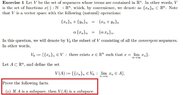
Hi everyone, would really appreciate if someone could help me with the
attached question (its the one in the red box).

View attachment 3826

My start:

Assume $A$ is a subspace. We need to show that
$V(A):= \{ \{x_n\}_n \in V_0 : \lim_{{n}\to{\infty}}x_n \in A \} $

By definition, a subspace is closed under scalar multiplication and addition, and also contains the $0 \in A$ in our case.

So my assumption is I would start off by proving each of these three properties takes place in $V(A)$.

For closure under addition:
Take $x_1, x_2 \in V_0$ then $x_1 + x_2 \in A \in V(A)$

For closure under scalar multiplication:
For any $x_n \in V_0$ and $\lambda \in \mathbb{R}$ it holds $x \lambda \in A \in V(A)$

Finally $\because A$ is a subspace, by definition $0 \in A \in V(A)$.
$\therefore V(A)$ is a subspace.

Would this be considered, by and large, a sufficient proof?
 

Attachments

  • linalgproof.jpg
    linalgproof.jpg
    48.3 KB · Views: 117
Physics news on Phys.org
nacho said:
By definition, a subspace is closed under scalar multiplication and addition, and also contains the $0 \in A$ in our case.
The fact that every subspace of a linear vector space contains 0 follows from the closure under scalar multiplication (multiply any vector by 0).

nacho said:
For closure under addition:
Take $x_1, x_2 \in V_0$ then $x_1 + x_2 \in A \in V(A)$
This does not make type sense. If $x_1,x_2\in V_0$, then $x_1,x_2\in(\Bbb R^n)^{\Bbb N}$ (the set of functions from $\Bbb N$ to $\Bbb R^n$), but $A\subseteq\Bbb R^n$. So, $x_i$ have a different type than elements of $A$. Also, $A$ cannot be an element of $V(A)$ since the latter set contains functions (from $\Bbb N$ to $\Bbb R^n$), not sets like $A$.

nacho said:
For closure under scalar multiplication:
For any $x_n \in V_0$ and $\lambda \in \mathbb{R}$ it holds $x \lambda \in A \in V(A)$
A similar remark applies.
 
thanks for your reply, I see exactly what you mean about where my proof didn't make sense.

So how exactly would I show that $V(A)$ is a subspace?

I don't see how working with the assumption that $A$ is a subspace is of any benefit to me?

If $A$ is a subspace, its closed under addition and scalar multiplication.

I have the definitions of $V$, $V_0$ and $V(A)$ at my disposal.

Logically, where would one go from here?
 
You assume that $\{x_n\}_n\in V(A)$ and $\{y_n\}_n\in V(A)$. You need to show that $\{x_n\}_n+\{y_n\}_n\in V(A)$. By definition, this means that there exists an $a\in A$ such that $\lim_{n\to\infty}(x_n+y_n)=a$. Can you use the definition of $V(A)$ and the fact that $\{x_n\}_n\in V(A)$ and $\{y_n\}_n\in V(A)$ to find such $a$?
 
So assume $A$ is a subspace.
we take $\{x_n\}_n + \{y_n\}_n \in V(A)$
$$\because \{x_n\}_n + \{y_n\}_n = x + y = a \in A$$
$$\therefore \{x_n\}_n + \{y_n\}_n \in V(A)$$ (not sure if I have sufficiently justified this)
Hence the set is closed under addition.

Then,
$$\forall \lambda \in \mathbb{R}^n $$
$\lambda V(A) \in \mathbb{R}^n$, $\therefore$ closed under scalar multiplication.

Hence the properties we need are satisfied, and $V(A)$ is a subspace if $A$ is a subspace.

Have I sufficiently proved this? How could I improve my reasoning and logic?
 
nacho said:
So assume $A$ is a subspace.
we take $\{x_n\}_n + \{y_n\}_n \in V(A)$
Not sure what you mean by "take", but you can't assume that $\{x_n\}_n + \{y_n\}_n \in V(A)$. This is what you need to prove.

nacho said:
$$\because \{x_n\}_n + \{y_n\}_n = x + y = a \in A$$
You have not properly introduced $x$ and $y$, so it's nor clear what can be said about them.

I personally think that using "because" and "therefore" in a row is potentially confusing and should be avoided when learning to write proofs. A proof should be a sequence of statements each of which follows from previous ones, together with an explanation why it follows.

nacho said:
$$\forall \lambda \in \mathbb{R}^n $$
I believe the vector space in this problem is over the field $\Bbb R$, not $\Bbb R^n$, so $\lambda\in\Bbb R$.

nacho said:
$\lambda V(A) \in \mathbb{R}^n$, $\therefore$ closed under scalar multiplication.
What do you mean by multiplying a real number $\lambda$ by a vector space $V(A)$?

You may need to review the definition and some examples of linear vector spaces.
 
Evgeny.Makarov said:
Not sure what you mean by "take", but you can't assume that $\{x_n\}_n + \{y_n\}_n \in V(A)$. This is what you need to prove.

You have not properly introduced $x$ and $y$, so it's nor clear what can be said about them.

I personally think that using "because" and "therefore" in a row is potentially confusing and should be avoided when learning to write proofs. A proof should be a sequence of statements each of which follows from previous ones, together with an explanation why it follows.

I believe the vector space in this problem is over the field $\Bbb R$, not $\Bbb R^n$, so $\lambda\in\Bbb R$.

What do you mean by multiplying a real number $\lambda$ by a vector space $V(A)$?

You may need to review the definition and some examples of linear vector spaces.

Sorry I could have worded my previous post a lot better, let me re-iterate what I was trying to say

When I say "take" I meant just select some $\{x_n\}_n$ and $\{y_n\}_n$ in $V(A)$ and add them together.

In regards to not properly introducing the $x$ and $y$ terms, I was just going off the definition given in the question. Is that considered sloppy when writing proofs?

Also I don't know why I wrote $\lambda * V(A)$ it should had been $\lambda * $ some $\{x_n\}_n \in V(A)$

I will re-read the definitions and post another attempt again. Thanks.

edit: My third attempt:

Our goal is to show that for $V(A)$ to be a subspace we require that:
$ \forall \{x_n\}_n, \{y_n\}_n \in V(A)$
$$ \{x_n\}_n + \{y_n\}_n \in V(A)$$
and also that it's closed under scalar multiplication

To do this, let's first assume that $A$ is a subspace, ie
$$ \forall u,v \in A, u+v \in A$$ and
$ \lambda \in \mathbb{R}$ and $u \in A$
$$\lambda \cdot u \in A$$

let $\\lim_{{n}\to{\infty}} x_n = x $ and $\\lim_{{n}\to{\infty}} y_n = y$
and let $\{x_n\}_n \{y_n\}_n$ be convergent sequences.

$V(A) := \{\{x_n\}_n \in V_0 : x \in A\}$

$\{x_n\}_n + \{y_n\}_n = \{x_n+y_n\}_n \in V(A)$ (I feel very unsure here, and in general how to convey/justify that two elements in $V(A)$ will remain in the space when summed.

And for the scalar multiplication, I would make a similar assertion as before.
 
Last edited:
nacho said:
In regards to not properly introducing the $x$ and $y$ terms, I was just going off the definition given in the question.
If by $x$ you mean the function from $\Bbb N$ to $\Bbb R^n$, i.e., $\{x_n\}_n$ itself, then that's OK. Sorry for not catching this the first time. But then you can't say that $x+y\in A$ because $x+y\in V(A)$. If you mean something else by $x$ and $y$, then I don't know what it is. Also, you did not introduce $a$. In my suggestion $a$ was an element of $A$ and the limit of $x_n+y_n$. The question was why such limit exists.
 

Similar threads

  • · Replies 3 ·
Replies
3
Views
2K
  • · Replies 19 ·
Replies
19
Views
5K
  • · Replies 7 ·
Replies
7
Views
2K
Replies
6
Views
2K
  • · Replies 5 ·
Replies
5
Views
2K
  • · Replies 3 ·
Replies
3
Views
3K
  • · Replies 2 ·
Replies
2
Views
2K
  • · Replies 3 ·
Replies
3
Views
2K
  • · Replies 6 ·
Replies
6
Views
1K
  • · Replies 4 ·
Replies
4
Views
2K