Math Amateur
Gold Member
MHB
- 3,920
- 48
- TL;DR
- I need help in order to prove a result stated by Willard linking the notions of interior and closure in a topological space ...
I am reading Stephen Willard: General Topology ... ... and am currently focused on Chapter 2: Topological Spaces and am currently focused on Section 3: Fundamental Concepts ... ...
I need help in order to fully understand a result or formula given by Willard concerning a link between closure and interior in a topological space ... ..The relevant text reads as follows:
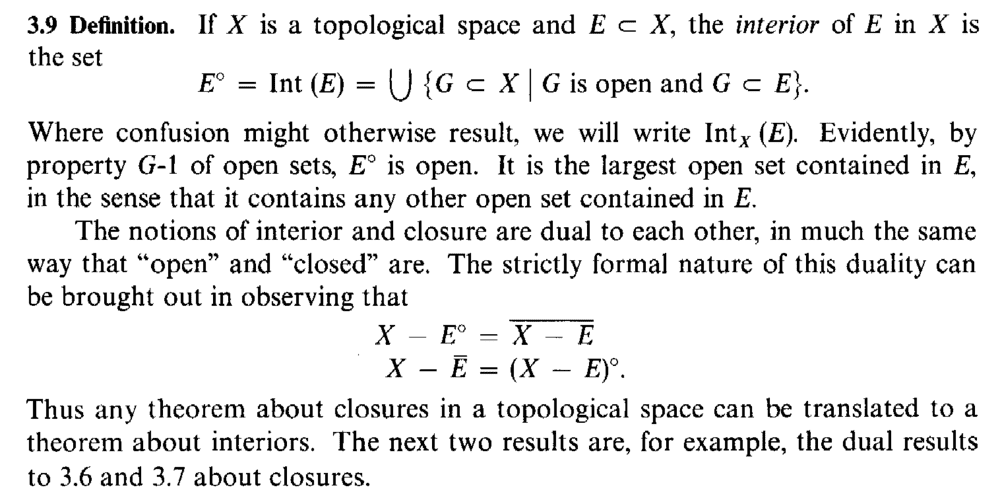
In the above text by Willard we read the following:
" ... ... The strictly formal nature of this duality can be brought out in observing that
##X - E^{ \circ } = \overline{ X - E }## ... ... "Can someone please demonstrate (formally and rigorously) that ... given the definitions and results regarding closure and interior used by Willard ... ##X - E^{ \circ } = \overline{ X - E }## ... ...The definitions and results regarding closure used by Willard are as follows:
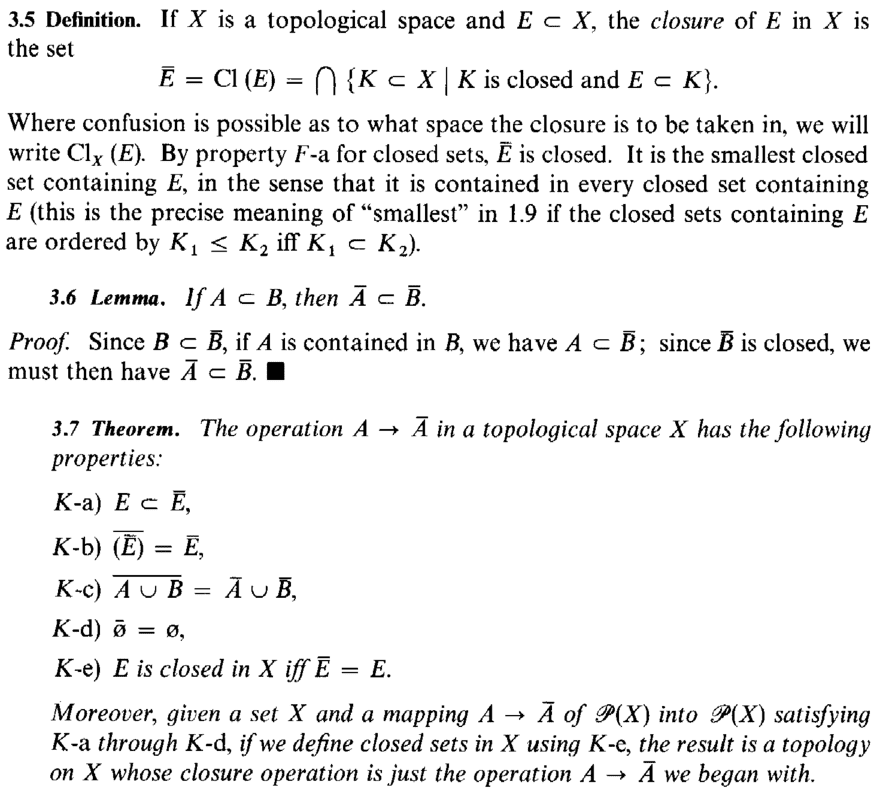
Help will be much appreciated ... ...
Peter
I need help in order to fully understand a result or formula given by Willard concerning a link between closure and interior in a topological space ... ..The relevant text reads as follows:
In the above text by Willard we read the following:
" ... ... The strictly formal nature of this duality can be brought out in observing that
##X - E^{ \circ } = \overline{ X - E }## ... ... "Can someone please demonstrate (formally and rigorously) that ... given the definitions and results regarding closure and interior used by Willard ... ##X - E^{ \circ } = \overline{ X - E }## ... ...The definitions and results regarding closure used by Willard are as follows:
Help will be much appreciated ... ...
Peter