Math Amateur
Gold Member
MHB
- 3,920
- 48
- TL;DR
- I am reading Stephen Willard: General Topology ... ... and am studying Chapter 2: Topological Spaces and am currently focused on Section 3: Fundamental Concepts ... ...
I need help in order to prove Theorem 3.11 Part 1-a using the duality relations between closure and interior ... ..
I am reading Stephen Willard: General Topology ... ... and am studying Chapter 2: Topological Spaces and am currently focused on Section 3: Fundamental Concepts ... ...
I need help in order to prove Theorem 3.11 Part 1-a using the duality relations between closure and interior ... ..The definition of interior and Theorem 3.11 read as follows:
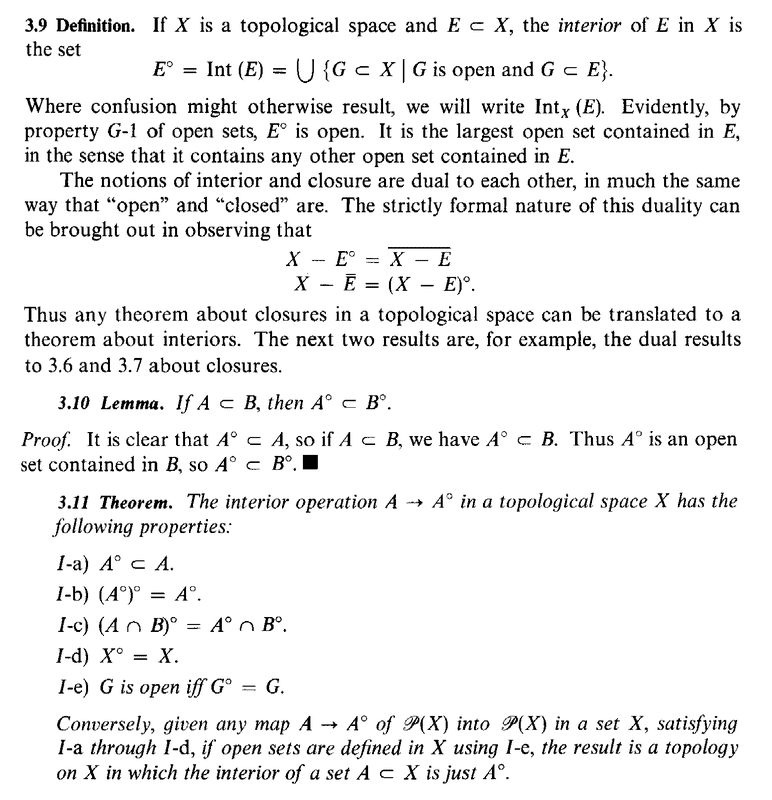 Readers of this post necessarily need access to the "dual" theorem ... namely Theorem 3.7 ...
Theorem 3.7 (together with Willard's definition of closure and a relevant lemma) reads as follows:
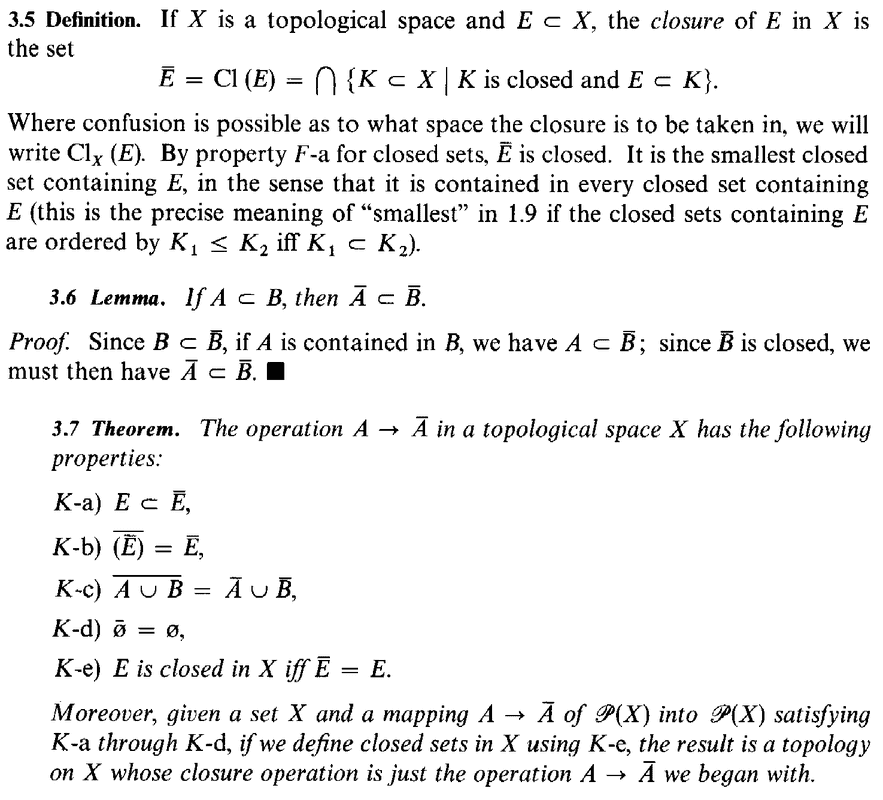 So ... I need help in order to prove Theorem 3.11 1-a assuming the dual result in Theorem 3.7 ( that is K-a or ##A \subset \overline{A}## ) using only the definitions of closure and interior and the dual relations: ##X - A^{ \circ } = \overline{ X - A }## and ##X - \overline{ A} = ( X - A)^{ \circ }## ...
My attempt so far is as follows:
To show ##A^{ \circ } \subset A## ...
Proof:
Assume ##A \subset \overline{ A}## ..
Now we have that ...
##A \subset \overline{ A}##
##\Longrightarrow X - \overline{ A} \subset X - A##
##\Longrightarrow (X - A)^{ \circ } \subset X - A## ...But how do I proceed from here ... ?Help will be much appreciated ... ...
Peter
I need help in order to prove Theorem 3.11 Part 1-a using the duality relations between closure and interior ... ..The definition of interior and Theorem 3.11 read as follows:
Theorem 3.7 (together with Willard's definition of closure and a relevant lemma) reads as follows:
My attempt so far is as follows:
To show ##A^{ \circ } \subset A## ...
Proof:
Assume ##A \subset \overline{ A}## ..
Now we have that ...
##A \subset \overline{ A}##
##\Longrightarrow X - \overline{ A} \subset X - A##
##\Longrightarrow (X - A)^{ \circ } \subset X - A## ...But how do I proceed from here ... ?Help will be much appreciated ... ...
Peter