Graduate Quantum Field Theory: 3-4 Equation Steps Explained

Click For Summary
SUMMARY

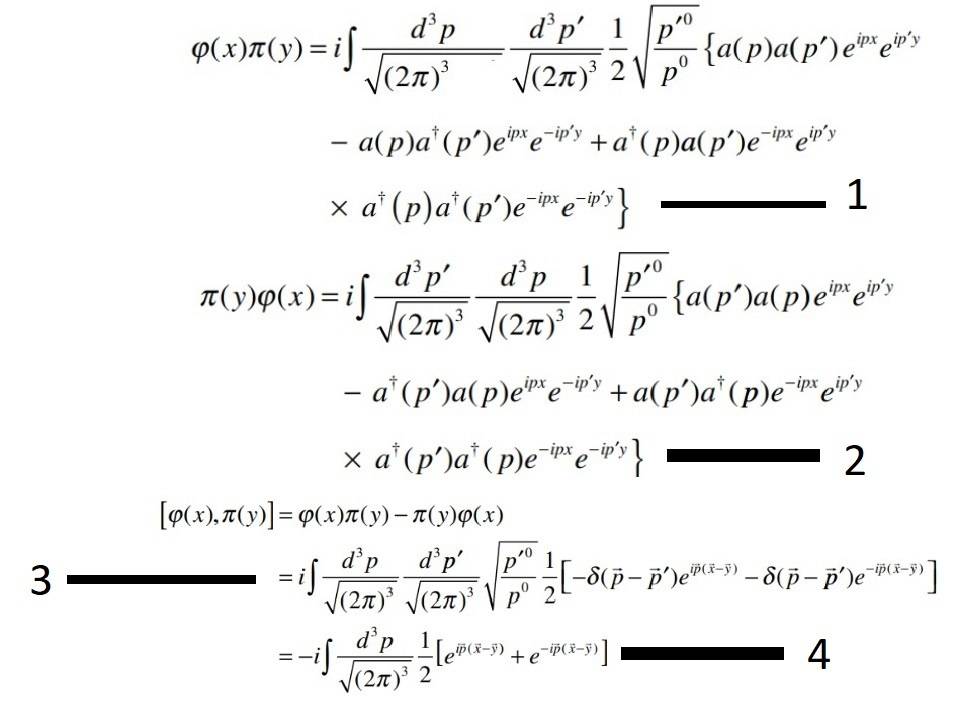
This discussion focuses on the transition from the third equation to the fourth equation in Quantum Field Theory, specifically addressing the application of the Dirac delta function, denoted as ##\delta(p-p')##. Participants emphasize the importance of understanding the double integral over ##p## and ##p'## in the third equation, which is crucial for correctly interpreting the equations. The conversation highlights the complexity of these equations and the necessity of using LaTeX for clarity in mathematical expressions.

PREREQUISITES
  • Understanding of Quantum Field Theory fundamentals
  • Familiarity with Dirac delta function notation and properties
  • Knowledge of double integrals in mathematical physics
  • Proficiency in LaTeX for formatting equations
NEXT STEPS
  • Study the properties and applications of the Dirac delta function in physics
  • Learn how to perform double integrals in Quantum Field Theory contexts
  • Explore the PF LaTeX Guide for effective equation formatting
  • Review examples of transitions between equations in Quantum Field Theory
USEFUL FOR

Students and researchers in theoretical physics, particularly those focusing on Quantum Field Theory and mathematical formulations of physical equations.
Adwit
Messages
15
Reaction score
2
TL;DR
I had been trying to understand second quantization for few months from an easy book "Quantum Field Theory Demystified". But couldn't succeed. So, I have posted my problem.
I understand how do 3 no. equation come from 1 & 2 no. equation. But I am struggling to understand how do 4 no. equation come from 3 no. equation. Will anyone do the steps between 3 no. equation and 4 no. equation, please ?
oOAfyizG.jpg
 
Physics news on Phys.org
@Adwit, we normally do not allow equations posted as images; that means they cannot be quoted usefully in responses. The PF LaTeX Guide (link at the bottom left of each post window) will help you to use LaTeX to format equations directly in your post.

That said, these equations are admittedly pretty gnarly so I can understand the temptation to use images.

Adwit said:
Will anyone do the steps between 3 no. equation and 4 no. equation, please ?

Look at the delta functions in the third equation. What do they tell you about the integral over ##p^\prime##? (Note that the integral in the third equation should really be a double integral; there is an integral over ##p## and an integral over ##p^\prime##.)
 
Ok, this is the last time I posted image of calculation. For now, I will write the calculation. Now, can you do the steps between 3 no. equation and 4 no. equation ?
 
Adwit said:
Ok, this is the last time I posted image of calculation. For now, I will write the calculation. Now, can you do the steps between 3 no. equation and 4 no. equation ?

Step 3 to step 4 is a "simple" application of the delta function. That is much simpler than understanding the equations that have gone before.

You must know what the Dirac delta function ##\delta(p-p')## is?
 
For what its worth, as far as I can tell there is indeed something funny going on with the factors of ##2\pi## here. If that is indeed the problem the best is probably if you show us what you got.
 
  • Like
Likes Demystifier and PeroK

Similar threads

  • · Replies 2 ·
Replies
2
Views
1K
  • · Replies 1 ·
Replies
1
Views
1K
  • · Replies 4 ·
Replies
4
Views
1K
  • · Replies 18 ·
Replies
18
Views
2K
  • · Replies 1 ·
Replies
1
Views
676
  • · Replies 3 ·
Replies
3
Views
629
  • · Replies 4 ·
Replies
4
Views
2K
  • · Replies 22 ·
Replies
22
Views
3K
  • · Replies 14 ·
Replies
14
Views
2K
  • · Replies 15 ·
Replies
15
Views
2K