[Quantum Optics] "quantumness"

  • Context: Graduate 
  • Thread starter Thread starter microsansfil
  • Start date Start date
  • Tags Tags
    Optics Quantum optics
Click For Summary

Discussion Overview

The discussion revolves around the nature of coherent states in quantum optics, particularly their classification as classical or quantum states. Participants explore the implications of coherent states having minimal quantum fluctuations and their role in quantum protocols like teleportation.

Discussion Character

  • Debate/contested
  • Conceptual clarification
  • Technical explanation

Main Points Raised

  • Some participants assert that coherent states are the most classical states due to their minimal quantum fluctuations and behavior resembling classical systems.
  • Others question the significance of presenting coherent states as a new discovery, suggesting that this information is well-established in introductory quantum optics literature.
  • There is a discussion about whether coherent states, despite being classical, can be entangled and thus exhibit quantum behavior, such as in quantum protocols like teleportation.
  • One participant raises a hypothetical analogy comparing the entanglement of classical entities, like trains, to the entanglement of coherent states.
  • Concerns are expressed regarding the definition of quantum states, particularly in relation to coherent states being pure states versus mixtures, referencing literature that suggests a distinction between coherent and squeezed states.

Areas of Agreement / Disagreement

Participants exhibit disagreement regarding the classification of coherent states as classical or quantum, with no consensus reached on the implications of their properties or the definitions involved.

Contextual Notes

There are unresolved questions about the definitions of classical and quantum states, particularly concerning the nature of coherent states and their mixtures. The discussion also highlights the complexity of entanglement and its implications for state classification.

microsansfil
Messages
325
Reaction score
43
TL;DR
Coherent states would be classic states according to the definition of "quantumness" !
Hi,

In this presentation slide 17 it is mentionned :
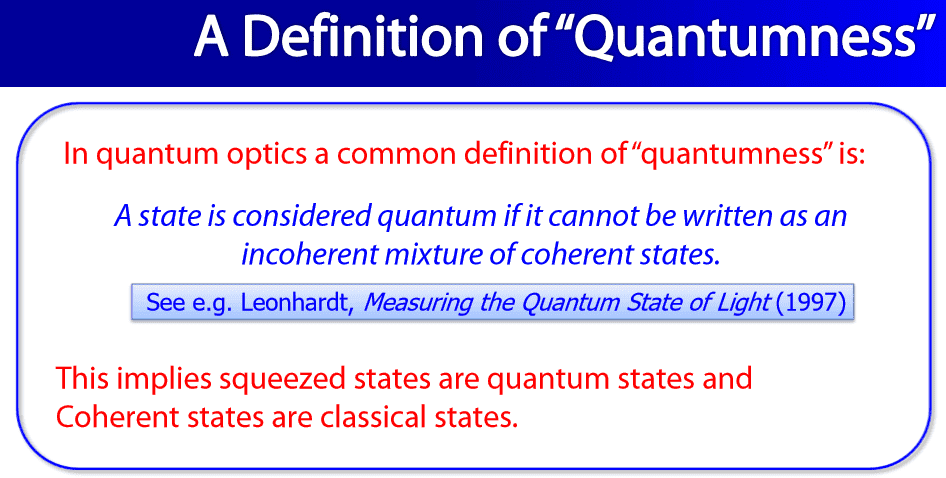
246408


Is there any confusion with the fact that coherent states are said to be semi-classical ?

http://lptms.u-psud.fr/ressources/publis/2010/Quantifying quantumness and the quest for Queens of Quantum.pdf

In physics there is a wide consensus that the “least quantum” (or “most classical”) pure states are coherent states. These are states which present the smallest possible amount of quantum fluctuations, as defined by a suitable Heisenberg uncertainty relation, evenly distributed over a pair of non-commuting variables.For example, in quantum optics, coherent states have that property of minimal and equal uncertainty for the field quadratures. Moreover, the dynamics of the latter is identical to that given by the classical equations of motion of the harmonic oscillator, and the property of minimal uncertainty is conserved during the time evolution created by the Hamiltonian of the electromagnetic field. The most classical mixed states possible can be obtained as a statistical mixture of coherent states.

/Patrick
 
Physics news on Phys.org
So what ?
Anyone can find this in any introductory quantum optics book or course from decades ago.
Why announce it as if some great discovery has been made.:smile:
 
Last edited:
  • Like
Likes   Reactions: vanhees71
Mentz114 said:
So what ?
Anyone can find this in any introductory quantum optics book or course from decades ago.
Why announce it as if some great discovery has been made.:smile:
Where did you read that I announced a great discovery ! ? It's just a question I'm asking.

Do the coherent states that have the property of minimal and equal uncertainty for the field quadratures are classical states and not quantum states?

/Patrick
 
  • Like
Likes   Reactions: Mentz114
Sure, coherent states of the light field are the most classical states you can get.
You can see this easily from the fact that they are eigenstates of the photon annihilation operator, which means that if you subtract a photon from a light field the photon number distribution of the photon-subtracted light field will have the same mean photon number as the light field before photon subtraction.
More formally speaking the correlation function factorizes.

This is the closest thing to the concept of a classical measurement (where measurements are considered non-invasive) that you can get for light fields.
 
Coherent states can be defined as describing electromagnetic fields that are produced by a classical charge-current distribution (the cocalled "hemi-classical approximation" to distinguish it from the "semi-classical approximation", where the matter is quantized and the em. field kept classical). In this sense they come closest to classical electromagnetic waves.
 
Thank for the answers.

Even if the coherent states of the light field are the most classical states you can get, it seem that you can entangled them together to implement quantum protocol like teleportation. And so behaves like quantum states.

/Patrick
 
Last edited:
Sure, but that applies to everything. To use a very exaggerated example: Trains are very classical entities. If you somehow managed to entangle trains, this entangled two-train state would be a quantum state as well.
 
  • Like
Likes   Reactions: Mentz114, microsansfil and vanhees71
Cthugha said:
Sure, but that applies to everything. To use a very exaggerated example: Trains are very classical entities. If you somehow managed to entangle trains, this entangled two-train state would be a quantum state as well.
Yes, indeed, it is. Polarization of light is classical state. Entangled two-photon with degree of polarization freedom would be a quantum state as well.

What is meant by "A state is considered quantum if it cannot be written as an incoherent mixture of coherent states" ? A coherent state can be written as an incoherent mixture of coherent states !

/Patrick
 
A coherent state is a pure state, not a mixture, or what do mean?
 
  • #10
vanhees71 said:
A coherent state is a pure state, not a mixture, or what do mean?
Yes. Why Michael R. Vanner write :

A state is considered quantum if it cannot be written as an incoherent mixture of coherent states.
See e.g. Leonhardt, Measuring the Quantum State of Light(1997)

This implies squeezed states are quantum states and Coherent states are classical states

/Patrick
 

Similar threads

  • · Replies 8 ·
Replies
8
Views
1K
  • · Replies 5 ·
Replies
5
Views
421
  • · Replies 37 ·
2
Replies
37
Views
7K
  • · Replies 16 ·
Replies
16
Views
3K
  • · Replies 16 ·
Replies
16
Views
4K
  • · Replies 18 ·
Replies
18
Views
3K
  • · Replies 18 ·
Replies
18
Views
4K
  • · Replies 3 ·
Replies
3
Views
1K
  • · Replies 7 ·
Replies
7
Views
3K
  • · Replies 4 ·
Replies
4
Views
2K