Question about how quadratic equations make their graphs

Click For Summary
SUMMARY

The discussion centers on understanding the behavior of quadratic equations, specifically the equation y = x² + 3x. Participants clarify that the graph of this equation is a parabola that shifts left and down due to the linear term 3x. The process of factoring the equation to find its roots, which are x = 0 and x = -3, is emphasized as essential for understanding the graph's shifts. Additionally, the technique of completing the square is introduced to identify the vertex of the parabola.

PREREQUISITES
  • Understanding of quadratic equations and their standard form.
  • Knowledge of factoring polynomials, specifically quadratic expressions.
  • Familiarity with the concept of completing the square.
  • Basic graphing skills for parabolas and understanding of vertex shifts.
NEXT STEPS
  • Learn how to complete the square for various quadratic equations.
  • Study the effects of linear terms on the graph of quadratic functions.
  • Explore the relationship between the coefficients of a quadratic equation and its graph.
  • Practice finding x-intercepts and vertices of different quadratic equations.
USEFUL FOR

Students studying algebra, educators teaching quadratic functions, and anyone seeking to deepen their understanding of polynomial behavior in graphing.

JohnnyIngrim
Messages
15
Reaction score
0
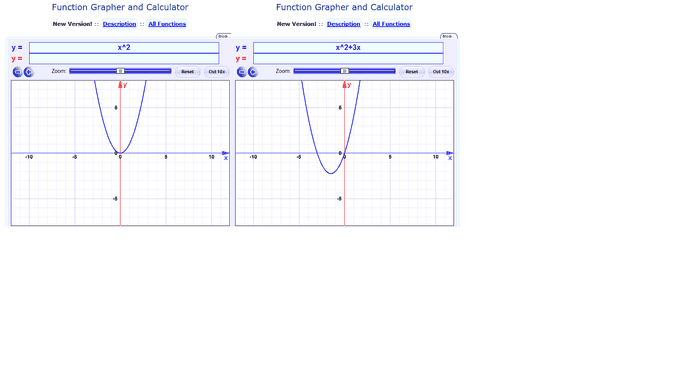
I get why it's a parabola because of the x^2 (for every value of x, y is the square of that number), but why does it shift to the left (and down as well) when I add x?
6PRDsmA.png
 
Physics news on Phys.org
Try factoring x^2 + 3x. You get x(x+3). This means that the equation now has two distinct roots as opposed to the same roots. So, it intersects the x-axis at two points (0 and -3) instead of only at 0.
 
JohnnyIngrim said:
I get why it's a parabola because of the x^2 (for every value of x, y is the square of that number), but why does it shift to the left (and down as well) when I add x?

6PRDsmA.png

x^2+3x=(x+3/2)^2-9/4. Does that form tell you why it shifts like it does? It's called 'completing the square'.
 
erisedk said:
Try factoring x^2 + 3x. You get x(x+3). This means that the equation now has two distinct roots as opposed to the same roots. So, it intersects the x-axis at two points (0 and -3) instead of only at 0.
I don't get how it got to this and don't fully get what you mean.
Dick said:
x^2+3x=(x+3/2)^2-9/4. Does that form tell you why it shifts like it does? It's called 'completing the square'.
No, it doesn't.
 
erisedk said:
Try factoring x^2 + 3x. You get x(x+3). This means that the equation now has two distinct roots as opposed to the same roots. So, it intersects the x-axis at two points (0 and -3) instead of only at 0.
JohnnyIngrim said:
I don't get how it got to this and don't fully get what you mean.
To find the x intercepts (roots) in the equation y = x2, you set y = 0, which means that x2 = 0. The only solution of this equation is x = 0. This means that the graph of y = x2 goes through the point (0, 0).

To find the x intercepts of the equation y = x2 + 3x, you again set y = 0, and solve the equation x2 + 3x = 0. The left side can be factored to give x(x + 3) = 0, which means that x = 0 or x = -3. This graph crosses the x-axis at (-3, 0) and (0, 0).
Dick said:
x^2+3x=(x+3/2)^2-9/4. Does that form tell you why it shifts like it does? It's called 'completing the square'.
JohnnyIngrim said:
No, it doesn't.
The graphs of y = x2 and y = (x - a)2 have the same shape, but there vertices are in different places. The vertex (lowest point) of the first graph is at the origin (the point (0, 0)), and the vertex of the second graph is at the point (a, 0). What Dick did was use the completing the square technique to write x2 + 3x in the form (x - a)2, so he could identify the location of the vertex.
 
Last edited:
Mark44 said:
To find the x intercepts (roots) in the equation y = x2, you set y = 0, which means that x2 = 0. The only solution of this equation is x = 0. This means that the graph of y = x2 goes through the point (0, 0).

To find the x intercepts of the equation y = x2 + 3x, you again set y = 0, and solve the equation x2 + 3x = 0. The left side can be factored to give x(x + 3) = 0, which means that x = 0 or x = -3/2. This graph crosses the x-axis at (-3/2, 0) and (0, 0).The graphs of y = x2 and y = (x - a)2 have the same shape, but there vertices are in different places. The vertex (lowest point) of the first graph is at the origin (the point (0, 0)), and the vertex of the second graph is at the point (a, 0). What Dick did was use the completing the square technique to write x2 + 3x in the form (x - a)2, so he could identify the location of the vertex.
So you're saying that in order to understand how the equation makes the graph I have to factor it each time? I can't look at the graph and equation and understand how the 3x causes it to shift that way, right?
 
Mark44, you're wrong about the graph crossing at -3/2. It's supposed to be -3.

JohnnyIngrim said:
So you're saying that in order to understand how the equation makes the graph I have to factor it each time? I can't look at the graph and equation and understand how the 3x causes it to shift that way, right?

Yup, you've got to factor every time to see how is shifts. And to figure out the vertex or how low/high it goes, you can either complete the square or differentiate the parabola.
 
JohnnyIngrim said:
So you're saying that in order to understand how the equation makes the graph I have to factor it each time? I can't look at the graph and equation and understand how the 3x causes it to shift that way, right?
Pretty much. Different equations cause different behaviors in the graphs, though. Here are a few examples.
1. y = x2 + 2 -- shift the graph of y = x2 up by two units. There is no need to factor the right side.
2. y = (x - 3)2 -- shift the graph of y = x2 right by three units. Vertex will be at (3, 0). The right side is already factored.
3. y = -x2 + 2x -- Can't tell until it's factored
For x-intercepts, set -x2 + 2x = 0, so -x(x - 2) = 0, so x = 0 or x = 2
To find vertex, complete the square on the right side
-x2 + 2x = -(x2 - 2x) = -(x2 - 2x + 1) + 1 = (x - 1)2 + 1
This represents a shift to the right by one unit, and a shift up by one unit, so the vertext is at (1, 1).
 
erisedk said:
Mark44, you're wrong about the graph crossing at -3/2. It's supposed to be -3.
Yes and thanks. I absent-mindedly was looking at Dick's work to find the vertex. Obviously if x(x + 3) = 0, the solutions are x = 0 and x = -3. I edited my earlier post to fix what I wrote.
 
  • #10
JohnnyIngrim said:
I get why it's a parabola because of the x^2 (for every value of x, y is the square of that number), but why does it shift to the left (and down as well) when I add x?

6PRDsmA.png
In this particular case, you can analyze the situation graphically, but in general, you need to do as the others have advised you and factor the resulting polynomial.

If you look at the graphs of ##x^2## and ##3x##, you can see that near the origin, the ##3x## term is bigger in magnitude than the ##x^2## term, so it "pulls" the parabola down below the x-axis on the left side. The vertex therefore shifts leftward, and the parabola as a whole gets shifted down. Away from the origin, the ##x^2## term dominates, and the graph turns upward.
 

Attachments

  • #11
vela said:
If you look at the graphs of ##x^2## and ##3x##, you can see that near the origin, the ##3x## term is bigger in magnitude than the ##x^2## term
I don't get what you mean by this.
 
  • #12
Magnitude of 3x = |3x|
Magnitude of x2 = |x2|
Near x=0, |3x| > |x2|.
 

Similar threads

  • · Replies 5 ·
Replies
5
Views
2K
  • · Replies 6 ·
Replies
6
Views
2K
  • · Replies 2 ·
Replies
2
Views
3K
  • · Replies 18 ·
Replies
18
Views
2K
  • · Replies 8 ·
Replies
8
Views
2K
  • · Replies 14 ·
Replies
14
Views
2K
  • · Replies 12 ·
Replies
12
Views
3K
  • · Replies 11 ·
Replies
11
Views
2K
  • · Replies 19 ·
Replies
19
Views
2K
Replies
4
Views
2K