Finding resultant force of three vectors with one on an axis

Join the discussion
Registration is free. Ask a follow-up in this thread, or start your own.
5 replies · 2K views
mishelhad
Messages
3
Reaction score
0
Homework Statement
Resultant force
Relevant Equations
Resultant forcd
Hello all
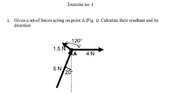
Trying to solve this one, faced a dilemma if i should trasfer the 5N vector from third to first quadrat because it head is on the 0 axis ass opposed to the two other vectors.
If it remains in third quadrant its components eouls be both negative, if transferred to first quadrant both components will be positive.

Please help
 
Attachments
  • Screenshot_20210525-011315_Samsung Notes.jpg
    Screenshot_20210525-011315_Samsung Notes.jpg
    12.5 KB · Views: 209
Physics news on Phys.org
mishelhad said:
Homework Statement:: Resultant force
Relevant Equations:: Resultant forcd

Hello all
Trying to solve this one, faced a dilemma if i should trasfer the 5N vector from third to first quadrat because it head is on the 0 axis ass opposed to the two other vectors.
If it remains in third quadrant its components eouls be both negative, if transferred to first quadrant both components will be positive.

Please help
Welcome to PF.

Are you familiar with how to express those vectors in x-y rectangular vector form? It's a lot easier to work with this kind of problem in rectangular coordinates.
 
berkeman said:
Welcome to PF.

Are you familiar with how to express those vectors in x-y rectangular vector form? It's a lot easier to work with this kind of problem in rectangular coordinates.
Yes i do, i tried doint this, my question is should all vectors start at the same origin, having all tails at the same point? Then starting to find components of x and y for each?
My problem is with the 5N force vector.
Its confusing me.
 
Put the origin at the point A, with the x-axis to the right and y-axis up. Then it is easier to visualize if you move the 5N force vector along its axis until its tail is at A. Then draw the vertical and horizontal lines for all 3 vectors to give you their x-y components and add those up to get the resultant vector.

If a force vector is pushing the point up and to the right with its point/tip, that's the same as if it were slid up along its force line to be shown pulling on the point with its tail. As you start working with Free Body Diagrams (FBDs) for objects that are larger than just a point, you will still consider the force vectors acting along their axis line at whatever point of application is shown in those problems.

Can you show us the components of the 3 vectors in rectangular coordinates and say what you get for the total resultant force?

1622248493677.png
 
Last edited:
I'll chip in if I may.
mishelhad said:
If [the 5N force] remains in third quadrant its components eouls [?] be both negative,
No. That's wrong and is the source of your confusion.

The x and y components will be positive. They will only be negative for a vector in the 3rd quadrant pointing outwards from the origin.

Think of the 5N vector alone, without the other two vectors and with no origin. Then ask yourself: what are its x and y components?
 
  • Like
Likes   Reactions: Delta2 and berkeman
Me too. You add the vectors head to tail. To do this I recommend a sketch additional to the free body diagram: draw the vectors head to tail, in any order, but keep the orientation and size. It will save you from dumb mistakes
 
  • Like
Likes   Reactions: Steve4Physics and berkeman