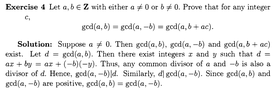
Question about problem involving gcd
- Context: MHB
- Thread starter issacnewton
- Start date
-
- Tags
- Gcd
Click For Summary
SUMMARY
The discussion centers on the mathematical property that if \( d = \gcd(a, b) \), then it follows that \( d | \gcd(a, -b) \). This conclusion is derived from the fundamental definition of the greatest common divisor (gcd), which remains unchanged when one of the arguments is negated. Participants confirm this property as a standard result in number theory, emphasizing its importance in understanding gcd relationships.
PREREQUISITES- Understanding of the greatest common divisor (gcd)
- Basic knowledge of number theory
- Familiarity with mathematical notation and properties
- Concept of divisibility in integers
- Study the properties of gcd in detail, including proofs and examples
- Explore the Euclidean algorithm for calculating gcd
- Learn about the implications of gcd in modular arithmetic
- Investigate applications of gcd in solving Diophantine equations
Students of mathematics, educators teaching number theory, and anyone interested in the properties of divisibility and gcd in integer arithmetic.
Similar threads
- · Replies 23 ·
Undergrad
Understanding the Results of gcd(x,n)
- · Replies 8 ·
- · Replies 3 ·
- · Replies 2 ·
- · Replies 1 ·
- · Replies 12 ·
- · Replies 1 ·
- · Replies 2 ·
- · Replies 2 ·