Question about roots/synthetic division

  • Context:
  • Thread starter Thread starter Madds
  • Start date Start date
  • Tags Tags
    Division
Join the discussion
Ask a follow-up here, or get your own question answered by working scientists, mathematicians and engineers — people, not an autocomplete.
Real named experts · corrections over time · the nuance an AI answer skips
2 replies · 2K views
Madds
Messages
2
Reaction score
0
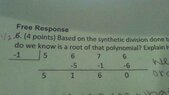
View attachment 7376
According to the synthetic division done below, what was the original polynomial and what number do we know is a root of that polynomial? Explain how you know to receive full points.

I know what the polynomial is, but I thought the root of this polynomial would be 1 but it's actually -1 could somebody explain why?
 

Attachments

  • 20171014_164749-min.jpg
    20171014_164749-min.jpg
    37.2 KB · Views: 129
Mathematics news on Phys.org
When doing synthetic division, the actual root $r$ or zero of the polynomial is put out to the left. Thus we know:

$$f(r)=0$$

And the polynomial function will contain the factor $(x-r)$. This might be why you felt the number needed to be negated?
 
Your question is puzzling. Are you clear on what "synthetic division" is? It is a quick way of dividing a polynomial by x- a for some value of a. Specifically, we write just the coefficients of the polynomial (here that is "5 6 7 6" which tells us that the original polynomial was [math]5x^3+ 6x^2+ 7x+ 6[/math]. The number we are "dividing" by is a= -1. In general, if we divide a polynomial, P(x), by x- a, the remainder is P(a).

The synthetic division here, shows that when x, in this polynomial, is set to -1, the value of the polynomial. is 0. That means that x= -1 is a root.