Deriving the 1-D Linear Convection Equation

Click For Summary
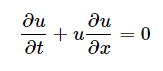
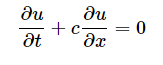
In the discussion on deriving the 1-D linear convection equation, participants clarify the transition from the 1-D nonlinear convection equation under the assumptions of inviscid flow, no pressure gradient, and no body forces. The key question raised is why only one instance of the velocity term 'u' is replaced with a constant 'c' during the derivation, while others remain unchanged. The correct approach involves linearizing the equation by expressing 'u' as a sum of a constant velocity 'u0' and a small perturbation 'u''. This leads to the linearized equation that describes wave propagation. The conversation concludes with an acknowledgment of the need for further exploration into linearization techniques.
Mr_Acceleration
Messages
3
Reaction score
0
With the assumptions of Inviscid flow, no pressure gradient and no body force terms in 1-D Navier Stokes becomes 1-D nonlinear convection equation;
sadasd.png

And if we assume velocity of wave propagation is constant value c, equation becomes 1-D linear convection equation;
sadasd.png

This is online derivation and my question is why only the u value outside of partial derivatives is replaced with c? we have 3 u term there. I was thinking they were all same term. So why do we only replace one of them?
 
Engineering news on Phys.org
I don't think this is correct. Can you please provide the full derivation ?
 
dRic2 said:
I don't think this is correct. Can you please provide the full derivation ?
123.png

Here is the derivation.
 
This is correct so far. The problem is this:

Mr_Acceleration said:
And if we assume velocity of wave propagation is constant value c, equation becomes 1-D linear convection equation;

This is not. That's why I'd like a full derivation.

Anyway the reasoning is the following:
$$ \frac {\partial u} {\partial t} + u \frac {\partial u} {\partial x} = 0$$
is NON-linear. What you usually do is linearize it, by writing ##u = u_0 + u'## where ##u_0## is an unperturbed constant velocity and ##u'## is a small perturbation. If you substitute into the diff equation ##\frac {\partial u_0} {\partial t} = \frac {\partial u_0} {\partial x} = 0## because ##u_0## is a constant. You finally end up with
$$ \frac {\partial u'} {\partial t} + u_0 \frac {\partial u'} {\partial x} = 0$$
 
  • Like
Likes SCP and Mr_Acceleration
Thank you for your answer. I didn't know about this. Now i will search linearization with pertubation.
 
My idea is that I want to use immerse Whitetail Antlers in a fishtank to measure their volumetric displacement (the Boone and Crockett system is the current record measurement standard to place in a juxtaposition with) I would use some sight glass plumbed into the side of the tank to get the change in height so that I can multiply by the tank cross-section. Simple Idea. But... Is there a simple mechanical way to amplify the height in the sight glass to increase measurement precision...

Similar threads

  • · Replies 4 ·
Replies
4
Views
6K
  • · Replies 3 ·
Replies
3
Views
1K
Replies
33
Views
4K
  • · Replies 51 ·
2
Replies
51
Views
9K
  • · Replies 5 ·
Replies
5
Views
5K
  • · Replies 18 ·
Replies
18
Views
2K
  • · Replies 1 ·
Replies
1
Views
2K
  • · Replies 4 ·
Replies
4
Views
2K
  • · Replies 32 ·
2
Replies
32
Views
3K
  • · Replies 11 ·
Replies
11
Views
3K