Question about the Weiner-Khinchin theorem

  • Thread starter Thread starter mrMeister
  • Start date Start date
  • Tags Tags
    Theorem
Click For Summary

Homework Help Overview

The discussion revolves around the Wiener-Khinchin theorem, with participants exploring its application and the relationship to the Fourier transform of a delta function. The original poster shares their attempts to prove a specific equation related to the theorem.

Discussion Character

  • Exploratory, Assumption checking

Approaches and Questions Raised

  • The original poster attempts to manipulate decomposition coefficients and integral limits but expresses difficulty in connecting these to the Wiener-Khinchin theorem. They seek alternative perspectives on their approach. Other participants inquire about the original poster's work and where they encountered challenges, emphasizing the importance of sharing details for effective assistance.

Discussion Status

Some participants have noted that the original poster eventually solved the problem but without utilizing a specific relation, prompting questions about the assumptions made during their derivation. The conversation reflects a mix of exploration and clarification without a clear consensus on the assumptions involved.

Contextual Notes

There is mention of the original poster's reluctance to share their full derivation, which may be impacting the guidance they receive. This raises questions about the assumptions made in their approach to the theorem.

mrMeister
Messages
2
Reaction score
0
Homework Statement
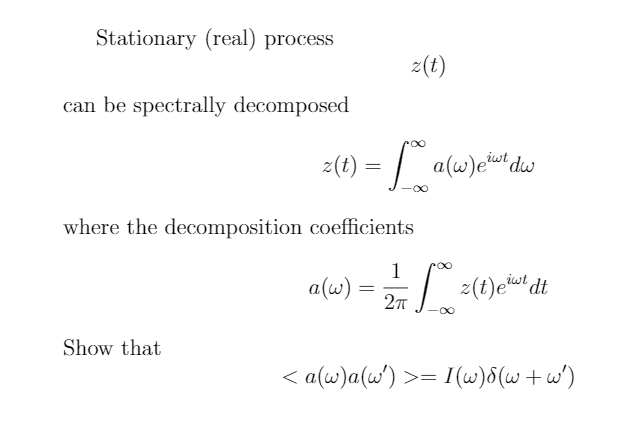
The question is attached below.
Relevant Equations
correlation equations
Wiener-Khinchin theorem
My try:

I tried to take the expression for the decomposition coefficients and put it into the equation that I had to prove.
Then, I tried to work with the integral limits in order to get into Wiener-Khinchin theorem or maybe Fourier transform of delta function but I didn't see any success in those tries.

It would be nice to get a new point of view.

Thank you.

EDIT: I did solve this problem eventually, but I did not use the relation for z(t) - how is that?
1584726208261.png
 
Last edited:
Physics news on Phys.org
Please shoe your work and also where you got stuck.
 
Watch my comment - I have solved this question but without the use of the relation for z(t).
I wanted to ask if it is hidden somewhere throughout the solution.
 
So you want someone to tell you if you assumed anything in a derivation that you refuse to share? I don’t think you understand how PF works.
 

Similar threads

  • · Replies 5 ·
Replies
5
Views
2K
  • · Replies 56 ·
2
Replies
56
Views
4K
  • · Replies 3 ·
Replies
3
Views
1K
  • · Replies 3 ·
Replies
3
Views
3K
  • · Replies 21 ·
Replies
21
Views
6K
  • · Replies 1 ·
Replies
1
Views
2K
  • · Replies 9 ·
Replies
9
Views
3K
Replies
1
Views
1K
  • · Replies 4 ·
Replies
4
Views
2K
  • · Replies 31 ·
2
Replies
31
Views
4K