Question: How do I calculate conditional probability in this scenario?

Join the discussion
Ask a follow-up here, or get your own question answered by working scientists, mathematicians and engineers — people, not an autocomplete.
Real named experts · corrections over time · the nuance an AI answer skips
5 replies · 3K views
Leanna
Messages
8
Reaction score
0
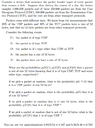
View attachment 6274
i am trying to push myself and learn these furTher exercises in my maths i would any appreciate any comments and help.

Question 1 what is probability u happens if n happens... P(U INTERSECTION N) / P(U)?

Question 2 probability of U or S happening in the sample space of UDP or 52 byte size packet? Let me think hmmm
450,000: UDP, 20% UDP 450,000 times 0.2 answr correct?? :)

Question 3 pick at random packet and packet of size 52. 1million packet so (0.2*450,000)+(0.9*500,000) correct again? :)

Question 4 probabalility u happens given s happens and is type of UDP ok P(U intersection S) / P(U)?

Question 5 not of size 52 bytes and is UDP so probability of U given N oh ok.
P(U intersection N) / P(N) = (450,000 INTERSECTION (450,000 * 0.8)) / (450000*0.8+500,000 * 0.1)?
Sample size of anything is equal to 1.

Nevertheless i am not quite sure i am appreciating insight and help, thanks.
 

Attachments
  • edd157664709d4f62651ca7cd733220d.png
    edd157664709d4f62651ca7cd733220d.png
    32.8 KB · Views: 160
Physics news on Phys.org
Leanna said:
i am trying to push myself and learn these furTher exercises in my maths i would any appreciate any comments and help.

Question 1 what is probability u happens if n happens... P(U INTERSECTION N) / P(U)?

Question 2 probability of U or S happening in the sample space of UDP or 52 byte size packet? Let me think hmmm
450,000: UDP, 20% UDP 450,000 times 0.2 answr correct?? :)

Question 3 pick at random packet and packet of size 52. 1million packet so (0.2*450,000)+(0.9*500,000) correct again? :)

Question 4 probabalility u happens given s happens and is type of UDP ok P(U intersection S) / P(U)?

Question 5 not of size 52 bytes and is UDP so probability of U given N oh ok.
P(U intersection N) / P(N) = (450,000 INTERSECTION (450,000 * 0.8)) / (450000*0.8+500,000 * 0.1)?
Sample size of anything is equal to 1.

Nevertheless i am not quite sure i am appreciating insight and help, thanks.

Hi Leanna, (Wave)

Welcome to MHB!

Let me see if I can try to help some...

Question 1 what is probability u happens if n happens... P(U INTERSECTION N) / P(U)?

Here is what you correctly stated : $$P(U|N) = \frac{P(U \cap N)}{P(N)}$$.

This is a question on Bayes' Theorem. Usually we can rewrite the above in an equivalent way:

$$P(U|N) = \frac{P(U \cap N)}{P(N)} = \frac{P(N|U)\cdot P(U)}{P(N)}$$

Looking at this it makes sense that the first question written on the page is $P(N|U)$. Do you have any idea what this probability is? :)
 
Answer to first q
P(n|u) = 0.8 right?
P(n|t) = 0.1 right ? and

Second question answer is 0.05?
 
Leanna said:
Answer to first q
P(n|u) = 0.8 right?
P(n|t) = 0.1 right ? and

Yes these both sound correct to me.

To finish answering your first question, what is $P(U)$ and what is $P(N)$ (this one is trickier)?
 
Jameson said:
Yes these both sound correct to me.

To finish answering your first question, what is $P(U)$ and what is $P(N)$ (this one is trickier)?

I worked that out but is the last question 0.667 (3d.p), the reason I'm not sure about this last question is because the approximations at the bottom is different.

And is the second to last question I think: $P(U|S)$ = (90,000/1,000,000) / (540,000/1,000,000)
Only these two I'm not completely sure it's right, what do you think? 😁
 
Leanna said:
I worked that out but is the last question 0.667 (3d.p), the reason I'm not sure about this last question is because the approximations at the bottom is different.

And is the second to last question I think: $P(U|S)$ = (90,000/1,000,000) / (540,000/1,000,000)
Only these two I'm not completely sure it's right, what do you think? 😁

$$P(U|S) = \frac{P(S|U)\cdot P(U)}{P(S)}$$

The numerator has two components to multiply and $P(S)$ can be expanded into two cases using the Law of Total Probability. $P(S)=P(S|U)\cdot P(U)+P(S|T)\cdot P(T)$.