Question on delta potential function

Click For Summary
To determine if a delta potential function's solution is even or odd, one should analyze the symmetry of the potential function. For the given example, V(x) = -alpha[delta(x+a) + delta(x-a)], the symmetry around the y-axis indicates that the function is even. It is established that delta functions can yield both even and odd solutions, with even solutions typically having lower energy due to the absence of nodes. The discussion emphasizes that for even potentials, energy eigenstates must be either even or odd, and the relationship between these states can be explored through their symmetry properties. Ultimately, solving the problem will clarify the nature of the solutions based on the strength of the delta functions.
Brown Arrow
Messages
101
Reaction score
0
NOT A HOME WORK QUESTION

how do i know if a delta potential function is given if its solution is even or odd? do i look for symettry or something

take this function for example:

V(x)= -alpha[delta(x+a) + delta(xa)]

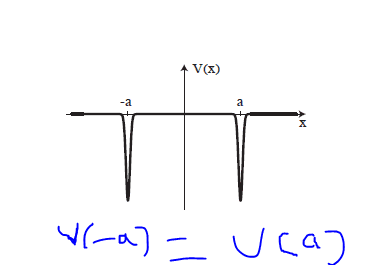
i skeched the following graph.
2hcngyg.png


since V(-a)=V(a)...
 
Physics news on Phys.org
Well, V(-a) = V(a) is the definition of an even function, so it's even. Graphically, this means the graph is symmetric around the y-axis, which is also the case.

Uneven functions: V(-a) = -V(a) & the graph is symmetric around the origin (like the sine function)
 
so we expect the solution to be even?
 
i just figured out that all delta function have both odd and even solution correct?...but how do we know that if it only has even or odd solution
 
For any even potential, you can argue that each energy eigenstate must be even or odd:

(1)If the potential is even, and psi(x) is an energy eigenstate, show that psi(-x) is an energy eigenstate with the same energy.
(2)Since there is no degeneracy of energy levels in one dimension, argue that psi(x) and psi(-x) must be linearly dependent
(3)Argue that the two possibilities are psi(x) = psi(-x) [an even solution] or psi(x) = -psi(-x) [an odd solution].
 
i can understand some of what your saying but not all b/c the course I am takeing is intro to modern physic... we don't talk interms of eigen
 
think of it like this...for even bound state there is a theorem alled the alternathing theorem. it states that if a function is even then you can do it seperately likr look for even then odd solution... there is no just even or odd solution...remember this is for even bounded ...function

hope this helps..
 
How many bound states does a single delta function have? How many do two have? Can you draw their wavefunctions?
 
only one bound state is possible no?
 
  • #10
Depending on the strength of these delta functions, you can have two solutions, even and odd. They are both valid solutions, but even solution has lower energy. You can usually tell that without solving the equation by the fact that odd solution has a node, and these generally have higher energy.

Best thing to do is just go ahead and solve the problem. You'll then see at which strengths you have two solutions, just the even solution, or no solutions.
 

Similar threads

  • · Replies 4 ·
Replies
4
Views
1K
  • · Replies 3 ·
Replies
3
Views
1K
Replies
1
Views
1K
  • · Replies 8 ·
Replies
8
Views
2K
  • · Replies 1 ·
Replies
1
Views
2K
Replies
3
Views
3K
Replies
0
Views
2K
  • · Replies 33 ·
2
Replies
33
Views
6K
  • · Replies 3 ·
Replies
3
Views
2K
  • · Replies 2 ·
Replies
2
Views
2K