Questions about speed and motion of a toy car on a conveyor belt

  • Thread starter Thread starter Tonyapplepan
  • Start date Start date
Click For Summary
SUMMARY

The discussion centers on the motion of a toy car on a conveyor belt, comparing the time taken for a round trip under two conditions: when the conveyor belt moves at a constant speed (t1) and when it remains stationary (t2). The participants conclude that t1 will always be greater than t2 due to the additional distance the car must travel relative to the moving belt. To analyze this, participants suggest using the speeds of the car and the belt, denoted as v and u respectively, and the distance d between points X and Y to derive equations for t1 and t2.

PREREQUISITES
  • Understanding of constant speed and relative motion
  • Familiarity with basic kinematics equations
  • Ability to manipulate algebraic expressions
  • Knowledge of distance, speed, and time relationships
NEXT STEPS
  • Derive the equations for t1 and t2 using the speeds v and u and the distance d
  • Explore the concept of relative velocity in moving reference frames
  • Investigate the implications of constant speed in different directions
  • Practice similar problems involving motion on conveyor belts or moving platforms
USEFUL FOR

Students studying physics, particularly those interested in kinematics and relative motion, as well as educators looking for practical examples to illustrate these concepts.

Tonyapplepan
Messages
4
Reaction score
0
New poster has been reminded to always show their work on schoolwork-type problems.
Homework Statement
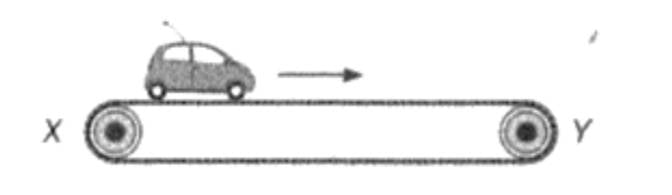
A toy car moves from X to Y and back to X at a constant speed. If the conveyor belt moves with a constant speed in the same direction throughout, the round trip of the toy car takes time t1. If the conveyor belt remains stationary throughout, the round trip of the toy car takes time t2. What is the conclusion drawn if you compare t1and t2? How can I prove it? :)
Relevant Equations
Average speed=total distance/total time
A toy car moves from X to Y and back to X at a constant speed. If the conveyor belt moves with a constant speed in the same direction throughout, the round trip of the toy car takes time t1. If the conveyor belt remains stationary throughout, the round trip of the toy car takes time t2. What is the conclusion drawn if you compare t1and t2? How can I prove it? :)
3F7EA893-AC11-41BD-BABC-0C44352C81FD.jpeg
 
Last edited:
Physics news on Phys.org
I assume X and Y are points fixed in the ground frame. (Perhaps there was a diagram?)
Per forum rules, please post an attempt.

"Relevant Equations" is for any standard equations you feel will be relevant, such as general equations for (constant) speed, time, and distance.
 
  • Like
Likes   Reactions: topsquark and PeroK
haruspex said:
I assume X and Y are points fixed in the ground frame. (Perhaps there was a diagram?)
Per forum rules, please post an attempt.

"Relevant Equations" is for any standard equations you feel will be relevant, such as general equations for (constant) speed, time, and distance.
Sorry that I didn’t gives a clear explanation,actually I think the diagram is quite misleading,as the motion of the car is from X to Y,and then from Y to X in straight line motion,but not moves in a circle
 
Tonyapplepan said:
Sorry that I didn’t gives a clear explanation,actually I think the diagram is quite misleading,as the motion of the car is from X to Y,and then from Y to X in straight line motion,but not moves in a circle
Okay, it should be clear enough. What are you saying about ##t_1## and ##t_2##?
 
PeroK said:
Okay, it should be clear enough. What are you saying about ##t_1## and ##t_2##?
t1 means the time travelled for car from X to Y then Y to X when the belt moves in uniform motion.t2 means the time travelled for car from X to Y then Y to X when the conveyor belt remains stationary throughout
 
Tonyapplepan said:
t1 means the time travelled for car from X to Y then Y to X when the belt moves in uniform motion.t2 means the time travelled for car from X to Y then Y to X when the conveyor belt remains stationary throughout
I mean what's the question?
 
PeroK said:
I mean what's the question?
The question is :A toy car moves from X to Y and back to X at a constant speed. If the conveyor belt moves with a constant speed in the same direction throughout, the round trip of the toy car takes time t1. If the conveyor belt remains stationary throughout, the round trip of the toy car takes time t2. What is the conclusion drawn if you compare t1and t2?
 
Tonyapplepan said:
The question is :A toy car moves from X to Y and back to X at a constant speed. If the conveyor belt moves with a constant speed in the same direction throughout, the round trip of the toy car takes time t1. If the conveyor belt remains stationary throughout, the round trip of the toy car takes time t2. What is the conclusion drawn if you compare t1and t2?
And your conclusion is ...?
 
Tonyapplepan said:
If the conveyor belt moves with a constant speed in the same direction throughout, the round trip of the toy car takes time t1.
Question 1: How can there be a "round trip" when the direction of the speed is "the same" throughout?
Question 2: Is this constant speed relative to the belt or relative to fixed points X and Y?
 
  • #10
kuruman said:
How can there be a "round trip" when the direction of the speed is "the same" throughout?
The conveyor belt moves always in the same direction, so presumably the car does not.
 
  • #11
This is a math problem as far as I can tell (sorry if I'm being captain obvious). The car travels speed ##v## relative to the belt, and when it gets to ##Y## it immediately reverses direction without changing speed and travels back to ##X##.
 
Last edited:
  • #12
Hi @Tonyapplepan. Welcome to PF.

If you haven't yet read the Forum guidelines (https://www.physicsforums.com/threads/homework-help-guidelines-for-students-and-helpers.686781/), note that you are required to show evidence of your own thinking/work. We don't simply give the answer; you'll get guidance to help you work out the answer for yourself.

If you are not yet clear, the question is asking you to say which one is bigger, t₁ or t₂ - or if they are equal (or, less likely, if there is insufficient information to decide). And to explain your reasoning.

So you need to make some initial attempt and post your work here. Hint: If you call the speed of the belt 'u', the speed of the car relative to the belt 'v', and the distance between X and Y 'd', can you work out formulae for t₁ and t₂?
 
  • Like
Likes   Reactions: PeroK and erobz

Similar threads

  • · Replies 7 ·
Replies
7
Views
3K
Replies
8
Views
2K
  • · Replies 4 ·
Replies
4
Views
2K
  • · Replies 1 ·
Replies
1
Views
2K
  • · Replies 1 ·
Replies
1
Views
2K
Replies
4
Views
2K
Replies
4
Views
3K
  • · Replies 3 ·
Replies
3
Views
11K
  • · Replies 2 ·
Replies
2
Views
9K
  • · Replies 4 ·
Replies
4
Views
4K