Questions about the learning curve

  • Context: Undergrad 
  • Thread starter Thread starter EvilKermit
  • Start date Start date
  • Tags Tags
    Curve
Click For Summary
SUMMARY

The discussion centers on the concept of learning curves and their implications for skill acquisition and intelligence. Participants argue that individuals exhibit varying learning curves, which directly affect their proficiency in acquiring skills. For instance, person A may achieve a higher level of proficiency in a shorter time compared to person B due to a steeper learning curve. Additionally, the conversation highlights that motivation and the perceived relevance of skills play crucial roles in the learning process, suggesting that the learning curve is not universally applicable across different types of knowledge.

PREREQUISITES
  • Understanding of learning curves and their impact on skill acquisition
  • Familiarity with concepts of motivation in learning
  • Knowledge of procedural memory and its relation to learning
  • Basic principles of cognitive psychology
NEXT STEPS
  • Research "Theories of Learning Curves" in cognitive psychology
  • Explore "Motivation and Learning" in educational psychology
  • Study "Procedural Memory" and its implications for skill learning
  • Investigate "Intelligence and Learning Styles" in psychological literature
USEFUL FOR

Students of psychology, educators, and anyone interested in understanding the dynamics of skill acquisition and the factors influencing learning efficiency.

EvilKermit
Messages
22
Reaction score
0
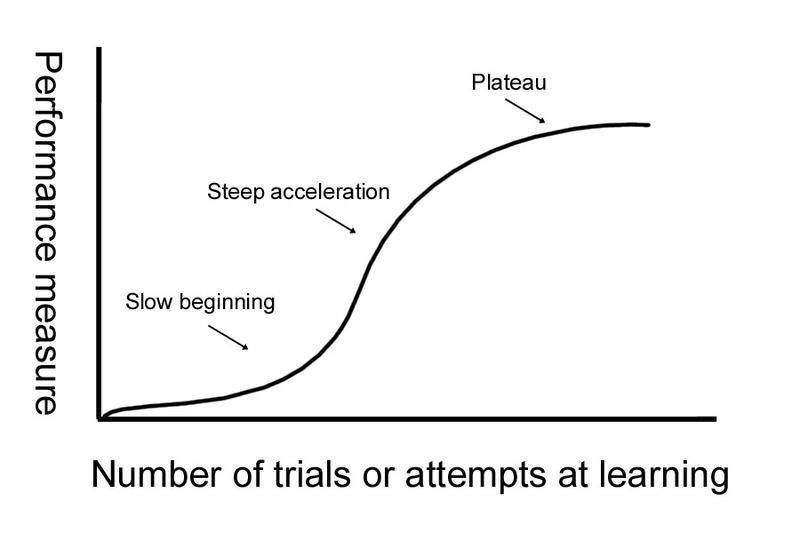
In case you don't know what I'm talking about or haven't seen it, here's the link:
07learningcurve.jpg


Does the learning curve imply that different people have different limits in learning a skill. For example let's say there's two people: person A and person B. If person A has a learning curve that is steeper, and lasts the same time or longer than person B, then he will become much more proficient then him, no matter how much person B tries. It will take person B years to become as proficient person A did in a couple of days, since person's B learning curve plateue out at a much lower performance than B.

Could this also explain the difference in intelligence of people. People who have mastered basic concepts at a better proficiency, can learn many different complex concepts at a faster rate (for example an understanding of Calculus can make one proficient in physics and engineering).
 
Mathematics news on Phys.org
Does the learning curve imply that different people have different limits in learning a skill? For example let's say there's two people: person A and person B. If person A has a learning curve that is steeper, and lasts the same time or longer than person B, then he will become much more proficient then him, no matter how much person B tries. It will take person B years to become as proficient person A did in a couple of days, since person's B learning curve plateue out at a much lower performance than B.

Could this also explain the difference in intelligence of people. People who have mastered basic concepts at a better proficiency, can learn many different complex concepts at a faster rate (for example an understanding of Calculus can make one proficient in physics and engineering).[/QUOTE]

I think you have to be careful overextending what is represented by this graph in terms of theoretical implications. The graph doesn't say how "performance" is measured or why learners would continue to make trials or attempts after reaching a plateau.

I think that learning is skill-specific and the reasons it is relatively easy or difficult for a certain learner to learn a certain skill has to do with a number of factors about how the learner perceives the skill, their attitude toward, their evaluation of what the use of it is, etc.

Some people can be easily motivated to learn skills or information that they perceive as arbitrary or functionless, if there are other social or material rewards involved. A rat can learn to navigate a maze, for example, after a certain number of tried provided there is a piece of cheese to be had as a reward for doing so. The same rat would probably not bother with the maze is there was no reward, but would probably learn other skills that are of immediate relevance, such as nest-building, without a different attitude.

Because this graph doesn't differentiate between different types of knowledge, skills, and reasons for learning, I don't think it is very useful for generalization - and since it probably is only derived from studying certain kids of knowledge-learning, it is vague for not specifying what those were/are.
 
EvilKermit said:
In case you don't know what I'm talking about or haven't seen it, here's the link:

www. psywww.com/intropsych/ch07_cognition/07learningcurve.jpg

Please tell me what section from Psychology: An Introduction by Russell A. Dewey, PhD did you find the link in Chapter 7: Cognition. Was it in Part One: Visual Information Processing, Part Two: Language, Part Three: Motor Activity, or Part Four: Thinking and Problem Solving.
http://www.intropsych.com/ch07_cognition/tofc_for_ch07_cognition.html or
www. intropsych.com/ch07_cognition/tofc_for_ch07_cognition.html (link)


Would you be so kind to also give me the previous page (via a link) prior to the image you presented?
 
Last edited:

Similar threads

  • · Replies 1 ·
Replies
1
Views
1K
Replies
16
Views
3K
  • · Replies 10 ·
Replies
10
Views
2K
Replies
5
Views
3K
  • · Replies 12 ·
Replies
12
Views
2K
  • · Replies 1 ·
Replies
1
Views
2K
  • · Replies 7 ·
Replies
7
Views
4K
  • · Replies 3 ·
Replies
3
Views
1K
  • · Replies 19 ·
Replies
19
Views
2K
  • · Replies 6 ·
Replies
6
Views
2K