Questions on Basic Axioms for Calculating Probabilities

  • Context:
  • Thread starter Thread starter nacho-man
  • Start date Start date
  • Tags Tags
    Axioms
Join the discussion
Registration is free. Ask a follow-up in this thread, or start your own.
4 replies · 2K views
nacho-man
Messages
166
Reaction score
0
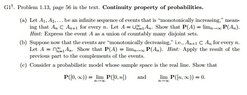
Please refer to the attached image.

for problem 1a)
i can see how this makes intuitive sense, however the hint confuses me.

When we are told that $A_n \subset A_{n+1}$ why would the hint say to attempt to express $A$ as as a union of countably many disjoint sets, when it is defined not to be disjoint in the question?

$P(A) = P(A_1) + ... + P(A_n)$ as $n$ approaches $\infty$
 

Attachments
  • Untitled.jpg
    Untitled.jpg
    27.8 KB · Views: 131
Physics news on Phys.org
nacho said:
Please refer to the attached image.

for problem 1a)
i can see how this makes intuitive sense, however the hint confuses me.

When we are told that $A_n \subset A_{n+1}$ why would the hint say to attempt to express $A$ as as a union of countably many disjoint sets, when it is defined not to be disjoint in the question?

$P(A) = P(A_1) + ... + P(A_n)$ as $n$ approaches $\infty$
If $A_n \subset A_{n+1}$ then $\cup_{n=1}^{N} A_{n} = A_{N}$ and that means that the sets $A_{n}$ aren't disjoint...

Kind regards

$\chi$ $\sigma$
 
yes, but the question says to "Express $A$ as a union of countably many disjoint sets".

i don't understand why though.
 
nacho said:
yes, but the question says to "Express $A$ as a union of countably many disjoint sets".

i don't understand why though.

I also don't understand (Emo) ...

Kind regards

$\chi$ $\sigma$
 
nacho said:
When we are told that $A_n \subset A_{n+1}$ why would the hint say to attempt to express $A$ as as a union of countably many disjoint sets, when it is defined not to be disjoint in the question?
The hint says so because for disjoint sets you can apply the axiom of σ-additivity. Yes,$A_n$ are not disjoint, so you have to define sets that are. Consider $B_n=A_n\setminus\bigcup_{k=1}^{n-1}A_k$. Then $B_n$ are mutually disjoint, $A_n=\bigcup_{k=1}^{n}B_k$ and $\bigcup_{n=1}^\infty A_n=\bigcup_{n=1}^\infty B_n$. Using these properties and σ-additivity, complete the following equality.

\[
P(A)=P(\bigcup_{n=1}^\infty A_n)= \dots=\lim_{n\to\infty}\sum_{k=1}^n P(B_k) =\dots=\lim_{n\to\infty}P(A_n)
\]