drzbigniew31
- 5
- 2
- TL;DR
- During an undergraduate physics course, are the basic axioms of thermodynamics demonstrated experimentally, or are only the theories taught?
I would like to propose a very simple experiment and ask: what is the official thermodynamic prediction for this specific setup?
And, are such basic experiments performed during physics training, or do courses move directly to more complex experiments while taking the foundational axioms for granted?
Proposed experiment:
Approximately 500 mL of tap water in a pan (glass or metallic).
Two thermometers immersed in the water: one at the bottom (touching the inner surface of the pan) and one just below the water surface.
Initial water temperature around 30 °C.
Add 5 ordinary ice cubes (which float at the surface).
Phase 1 – Ice floating on the surface (no flame, just ice melting):
What does standard thermodynamics predict regarding:
The temperature at the bottom versus at the surface?
Which region becomes colder, and which becomes hotter?
Phase 2 – After all ice has melted, turn on the flame (heating from below):
Same questions:
What is the predicted temperature behavior at the bottom versus at the surface?
During the heating process (before boiling), which region should be colder, and which should be hotter?
To be clear: I am not asking whether this exact experiment has been done. I am asking whether the most basic predictions of thermodynamics (e.g., cold water sinks, hot water rises, bottom is hottest under flame) are ever directly demonstrated in undergraduate lab courses, or if they are simply taught as axioms without empirical verification.
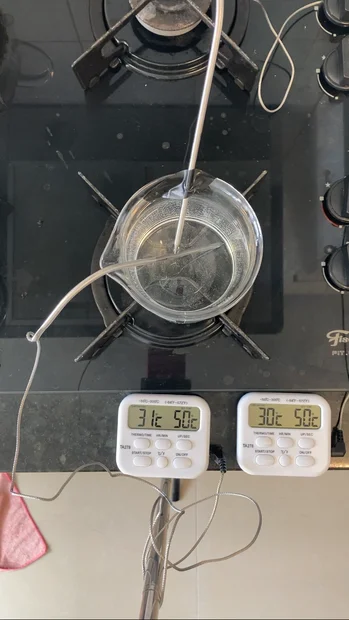
And, are such basic experiments performed during physics training, or do courses move directly to more complex experiments while taking the foundational axioms for granted?
Proposed experiment:
Approximately 500 mL of tap water in a pan (glass or metallic).
Two thermometers immersed in the water: one at the bottom (touching the inner surface of the pan) and one just below the water surface.
Initial water temperature around 30 °C.
Add 5 ordinary ice cubes (which float at the surface).
Phase 1 – Ice floating on the surface (no flame, just ice melting):
What does standard thermodynamics predict regarding:
The temperature at the bottom versus at the surface?
Which region becomes colder, and which becomes hotter?
Phase 2 – After all ice has melted, turn on the flame (heating from below):
Same questions:
What is the predicted temperature behavior at the bottom versus at the surface?
During the heating process (before boiling), which region should be colder, and which should be hotter?
To be clear: I am not asking whether this exact experiment has been done. I am asking whether the most basic predictions of thermodynamics (e.g., cold water sinks, hot water rises, bottom is hottest under flame) are ever directly demonstrated in undergraduate lab courses, or if they are simply taught as axioms without empirical verification.
Last edited:

