Discussion Overview
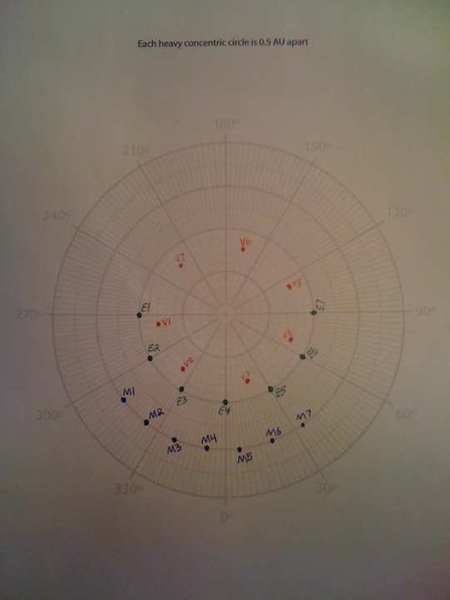
The discussion revolves around determining the visibility of Venus in the sky during specific times of day (dawn, dusk, noon, midnight) based on a polar graph representation of Earth and Venus. Participants explore the mechanics of Earth's rotation and its implications for observing Venus, as well as comparisons to Mars.
Discussion Character
- Exploratory
- Technical explanation
- Conceptual clarification
- Debate/contested
- Homework-related
Main Points Raised
- One participant asks how to determine when Venus is visible based on a polar graph, noting that Venus appears red and Earth green.
- Another participant questions the possibility of Venus being visible at midnight.
- Some participants suggest that understanding Earth's rotation direction (counter-clockwise) is crucial for determining visibility times.
- There is a suggestion to visualize Earth as a larger circle to better understand day and night regions.
- Multiple participants agree that Venus is visible in the morning and evening, but there is uncertainty about its visibility at night.
- One participant indicates that Venus comes into view before sunrise for specific positions of Earth.
- Discussion includes the visibility of Mars, with participants encouraged to analyze its position relative to the Sun and Earth.
- Some participants clarify that Venus can be visible in the morning or evening, but not both at the same time, depending on various factors.
- There is a contention regarding the visibility of Venus based on geographical location and night length, with some arguing that the statement about visibility is too strong without considering seasonal changes.
Areas of Agreement / Disagreement
Participants generally agree that Venus is visible in the morning and evening, but there is disagreement regarding its visibility at night and the conditions under which it may be visible. The discussion remains unresolved regarding the specifics of visibility based on location and time of year.
Contextual Notes
Participants note limitations in the discussion, such as the lack of data to account for seasonal changes and the implications of night length on visibility. There is also mention of edge conditions in real life that may affect visibility, which are not addressed in the current scenario.