Quick return mechanism stress analysis

Click For Summary
SUMMARY

The discussion focuses on the stress analysis of quick return mechanisms used in shaper machines, specifically addressing the moments of maximum load and simplification for analytical calculations. It is established that the maximum load occurs during the tool's maximum extension, and a simplified model treating the red arm as a beam supported at two points is proposed. However, it is crucial to consider the acceleration forces on the slide and tool holder, which exceed the cutting forces. A comprehensive analysis should evaluate stresses across various crankshaft positions, not just peak acceleration points.

PREREQUISITES
  • Understanding of quick return mechanisms in shaper machines
  • Familiarity with stress analysis techniques
  • Knowledge of Finite Element Analysis (FEA) principles
  • Basic concepts of kinematics in mechanical systems
NEXT STEPS
  • Research methods for calculating cutting forces based on yield strength and cutting area
  • Explore kinematic analysis of quick return mechanisms to identify peak stress points
  • Learn about the impact of bearing loads and sliding velocities on stress calculations
  • Study the design evolution of shaper mechanisms and their structural profiles
USEFUL FOR

Mechanical engineers, design engineers, and students involved in machine design and stress analysis, particularly those focusing on shaper machines and quick return mechanisms.

FEAnalyst
Messages
348
Reaction score
149
TL;DR
How to perform analytical stress analysis of a quick return mechanism?
Hi,

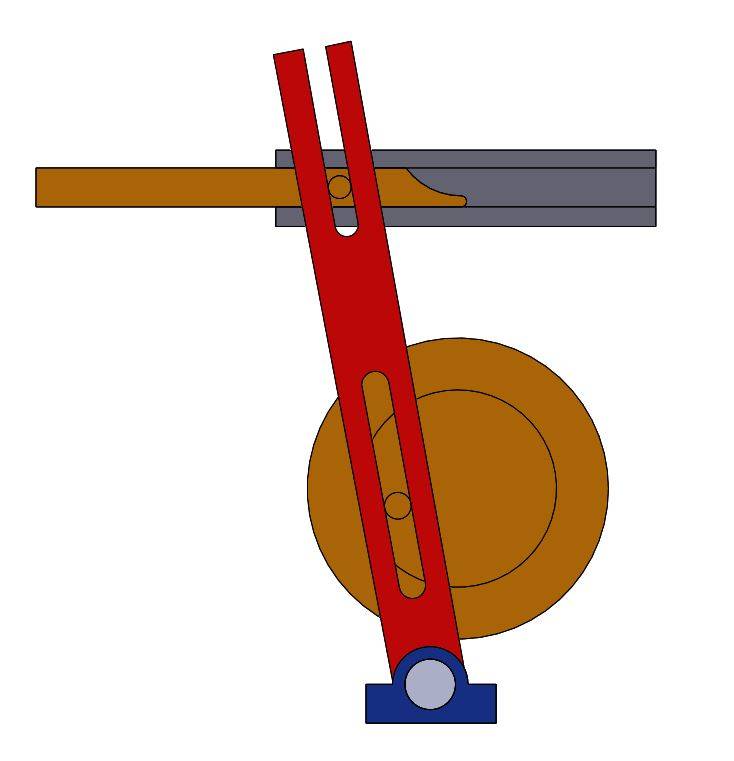
I wonder how to approach stress analysis of quick return mechanism used in shaper machines (see the diagram below):
mechanizm strugarki.JPG


The first issue is: which moment in the working process of this mechanism should be used for analysis (when will the mechanism experience largest loads)? So far I assumed that it will happen with maximum extension of the tool (like in the picture above).

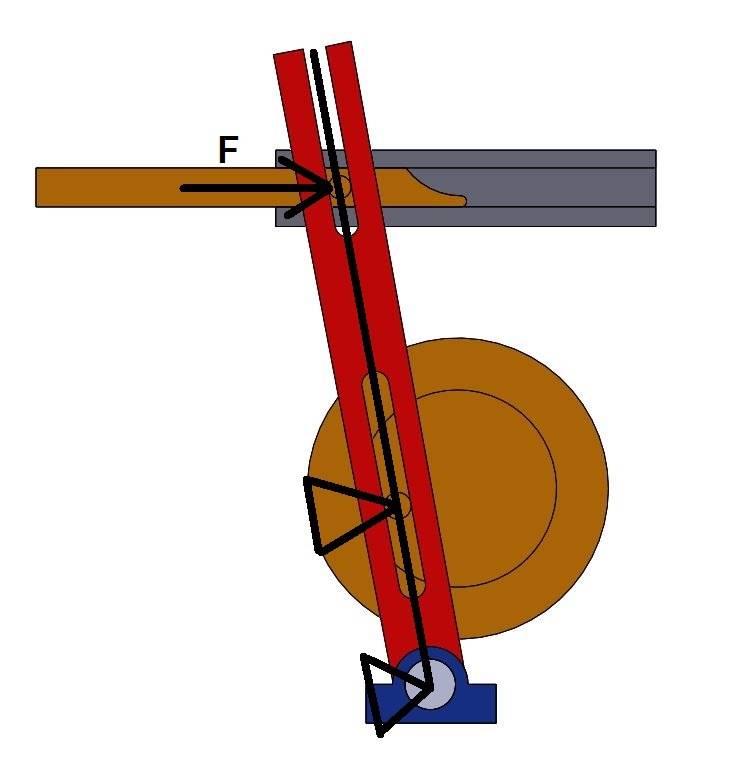
The second issue is: how to simplify this mechanism for analytical stress calculations (I can use FEA but it's not what I want to achieve now)? My current idea is to treat this red arm as a beam supported at two points and assume that the mechanism is subjected only to reaction force from the tool that presses on the workpiece:
mechanizm strugarki 2.jpg


Is this approach correct? Or should I do it differently - if yes then how? And what about the remaining parts of the mechanism - how to analyze them in terms of strength?

I've searched the literature but I've only found kinematic studies of such mechanisms. Nothing about stress analyses.

Thanks in advance for your help.
 
Engineering news on Phys.org
This approach is incomplete. The acceleration force on the slide and tool holder is most likely much larger than the cutting force. A rough estimate of the cutting force is the cutting area times the yield strength of the material. The cutting area is ##t_0## times the cut width (distance into the screen) in the figure below.

The kinematics calculations will give the slide acceleration vs crankshaft position. The point of peak acceleration is not necessarily the point of peak stress in the red arm, so do some checking there. A full analysis will check the stresses in the entire red arm over a range of crankshaft positions because the point of peak stress is not obvious. Also bearing loads, stresses, and sliding velocity (for PV calculations).
Cutting.jpg

The figure is from Manufacturing Processes for Engineering Materials by Serope Kalpakjian, first edition. This book is currently in its sixth edition: https://www.amazon.com/dp/0134290550/?tag=pfamazon01-20. Highly recommended for usability and readability.
 
  • Like
Likes FEAnalyst and Lnewqban
FEAnalyst said:
I wonder how to approach stress analysis of quick return mechanism used in shaper machines (see the diagram below):
Machines such as a shaper or planer that move a single cutting tool over a fixed work piece, have insignificant tool forces compared to the force required to accelerate and travel the tool holder along the tight ways lubricated with slideway oil. Most of those machines were replaced half a century ago by rotating multi-tooth cutters in milling machines.

The original shapers employed a linkage that survived. It was not a simple beam, but it evolved to a profile that did not fail when in use. Take a look at the profile of a real beam and the way it is coupled at the three reference points.
 
  • Like
Likes FEAnalyst

Similar threads

  • · Replies 1 ·
Replies
1
Views
2K
  • · Replies 9 ·
Replies
9
Views
3K
  • · Replies 7 ·
Replies
7
Views
4K
Replies
3
Views
2K
Replies
6
Views
3K
  • · Replies 2 ·
Replies
2
Views
2K
  • · Replies 5 ·
Replies
5
Views
2K
  • · Replies 2 ·
Replies
2
Views
2K
  • · Replies 1 ·
Replies
1
Views
6K
  • · Replies 4 ·
Replies
4
Views
3K