Undergrad R-Linear and C-Linear Mappings.... Another Question ....

  • Thread starter Thread starter Math Amateur
  • Start date Start date
Click For Summary
The discussion centers on understanding R-linear and C-linear mappings of complex numbers as presented in Reinhold Remmert's "Theory of Complex Functions." Key points include the conditions for a mapping to be R-linear or C-linear, specifically focusing on the implications of the condition T(i) = i T(1) for R-linear mappings. Participants clarify that if T is R-linear under this condition, it can be shown to also be C-linear, leading to the conclusion that T(z) takes the form T(z) = T(1)z. The conversation emphasizes the importance of additivity and homogeneity in establishing linearity in both contexts. Overall, the thread provides a detailed exploration of the relationships between these types of mappings in complex analysis.
Math Amateur
Gold Member
MHB
Messages
3,920
Reaction score
48
I am reading Reinhold Remmert's book "Theory of Complex Functions" ...

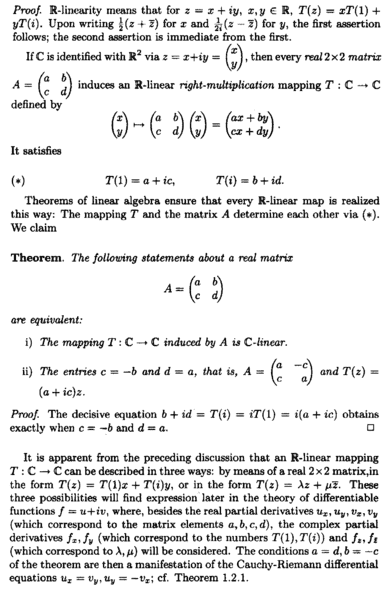
I am focused on Chapter 0: Complex Numbers and Continuous Functions ... and in particular on Section 1.2:##\mathbb{R}##-linear and ##\mathbb{C}##]-linear mappings of ##\mathbb{C}## into ##\mathbb{C}## ... ...

I need help in order to fully understand one of Remmert's results regarding ##\mathbb{C}##-linear mappings of ##\mathbb{C}## into ##\mathbb{C}## ... ...

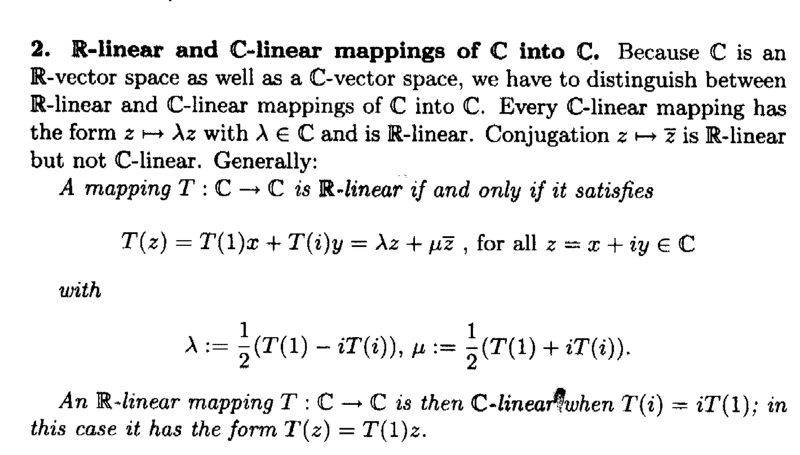
Remmert's section on ##\mathbb{R}##-linear and ##\mathbb{C}##-linear mappings of ##\mathbb{C}## into ##\mathbb{C}## reads as follows:
?temp_hash=b6a727075f8621b3dfa52509c2b5c764.png

?temp_hash=b6a727075f8621b3dfa52509c2b5c764.png

In the above text by Remmert we read the following: (... fairly near the start of the text ...)

" ... ... An ## \mathbb{R}##-linear mapping ##T : \mathbb{C} \to \mathbb{C}## is then ##\mathbb{C}##-linear when ##T(i) = i T(1)##; in this case it has the form ##T(z) = T(1) z##. ... ... "My questions are as follows:Question 1

How/why exactly is an ## \mathbb{R}##-linear mapping ##T : \mathbb{C} \to \mathbb{C}## also ##\mathbb{C}##-linear when ##T(i) = i T(1)## ... ... ?
Question 2

Why/how exactly does a ##\mathbb{C}##-linear mapping have the form ##T(z) = T(1) z## ... ...
Hope someone can help ...

Peter
 

Attachments

  • Remmert - 1 - R-linear and C-linear Mappings, Ch. 0, Section 1.2 ... PART 1 .png
    Remmert - 1 - R-linear and C-linear Mappings, Ch. 0, Section 1.2 ... PART 1 .png
    32.2 KB · Views: 402
  • Remmert - 2 - R-linear and C-linear Mappings, Ch. 0, Section 1.2 ... PART 2 .png
    Remmert - 2 - R-linear and C-linear Mappings, Ch. 0, Section 1.2 ... PART 2 .png
    32.7 KB · Views: 406
  • ?temp_hash=b6a727075f8621b3dfa52509c2b5c764.png
    ?temp_hash=b6a727075f8621b3dfa52509c2b5c764.png
    32.2 KB · Views: 633
  • ?temp_hash=b6a727075f8621b3dfa52509c2b5c764.png
    ?temp_hash=b6a727075f8621b3dfa52509c2b5c764.png
    32.7 KB · Views: 584
Physics news on Phys.org
Hi Peter!

What does linearity mean? Can you write down the two conditions for a function ##T## to be, say ##\mathbb{F}-##linear?

If so, can you apply it in the case ##\mathbb{F}=\mathbb{C}## on ##T(z\cdot 1)\,?##
This should answer your second question.
Next apply the case ##\mathbb{F}=\mathbb{R}## on ##T(a\cdot 1 + b \cdot i)\,.##
This should answer your first question.
 
  • Like
Likes Math Amateur
The condition for a function ##T : \mathbb{C} \to \mathbb{C}## to be ##\mathbb{F}##]-linear are as follows:

Additivity

##T(w + z) = T(w) + T(z)## for all ##w,z \in \mathbb{C}## ... ... ... (1)

Homogeneity

##T( \lambda w ) = \lambda T(w)## for all ##\lambda \in \mathbb{F}## and ##w \in \mathbb{C}## ... ... ... (2)Now apply the above to ##\mathbb{F} = \mathbb{C}## on ##T( z \cdot 1 )##

Then ... we have ... ##T( z \cdot 1 ) = z T(1)##

But ... ##T( z \cdot 1 ) = T(z)## ...

So ... ##T(z) = z T(1) = T(1) z## ... so, question 2 above is answered ... ...Now try to get answer to question 1 ...

Let ##z = a + b i## ... and ##\mathbb{F} = \mathbb{R}## ...

Then ##T(z) = T(a \cdot 1) = a T(1) + b T(i)## ... ...

BUT ... where to from here ...?Can you help further ...

Peter
 
Math Amateur said:
The condition for a function ##T : \mathbb{C} \to \mathbb{C}## to be ##\mathbb{F}##]-linear are as follows:

Additivity

##T(w + z) = T(w) + T(z)## for all ##w,z \in \mathbb{C}## ... ... ... (1)

Homogeneity

##T( \lambda w ) = \lambda T(w)## for all ##\lambda \in \mathbb{F}## and ##w \in \mathbb{C}## ... ... ... (2)

Now try to get answer to question 1 ...

Let ##z = a + b i## ... and ##\mathbb{F} = \mathbb{R}## ...

Then ##T(z) = T(a \cdot 1) = a T(1) + b T(i)## ... ...
Firstly, here is a typo: ##T(z) = T(z \cdot 1)## but this isn't of interest in the first step.

We have for ##z=a+ib \in \mathbb{C}## that ##a,b\in \mathbb{R}##. Now ##T## is ##\mathbb{R}-##linear, so we apply first additivity and get ##T(z)=T(a+ib)=T(a)+T(ib)##. This might be confusing, as one of the summands isn't real. However, we have the ##\mathbb{R}-##linearity on the vector space ##\mathbb{R}^2\cong \mathbb{C}##, that is ##T((a,b))=T((a,0))+T((0,b))## and the difference between ##(a,b)## and ##a+ib## is merely a notation one.

Next we apply homogeneity which is allowed, because ##a,b \in \mathbb{R}##. Thus we get ##T(z)=\ldots = T(a \cdot 1)+ T(b \cdot i)=a\cdot T(1) + b\cdot T(i)##. Here we are stuck, but we have an additional condition from question 1
Question 1

How/why exactly is an ## \mathbb{R}##-linear mapping ##T : \mathbb{C} \to \mathbb{C}## also ##\mathbb{C}##-linear when ##T(i) = i T(1)## ... ... ?
With that, we have ##T(z)=\ldots =a\cdot T(1) + b\cdot T(i) = a \cdot T(1) + b\cdot i\cdot T(1)= (a+bi)\cdot T(1)= z\cdot T(1)## which is ##\mathbb{C}-##homogeneity. From this we also get ##T(z_1+z_2)=T(z_1)+T(z_2)## since the complex addition goes componentwise: the ##a_j## add and the ##b_j## do, and we can proceed in the same way.

Both together is ##\mathbb{C}-##linearity.

And from the answer to question 1 we see, that it also holds in the opposite direction: If ##T## is ##\mathbb{C}-##linear, then ##T(i)=i \cdot T(1)##, simply use ##z=i\,.##
 
  • Like
Likes Math Amateur
Thanks fresh_42 ...

I appreciate your help ...

Peter
 
We all know the definition of n-dimensional topological manifold uses open sets and homeomorphisms onto the image as open set in ##\mathbb R^n##. It should be possible to reformulate the definition of n-dimensional topological manifold using closed sets on the manifold's topology and on ##\mathbb R^n## ? I'm positive for this. Perhaps the definition of smooth manifold would be problematic, though.

Similar threads

  • · Replies 1 ·
Replies
1
Views
1K
  • · Replies 3 ·
Replies
3
Views
2K
  • · Replies 4 ·
Replies
4
Views
3K
Replies
1
Views
1K
  • · Replies 2 ·
Replies
2
Views
2K
  • · Replies 12 ·
Replies
12
Views
3K
  • · Replies 0 ·
Replies
0
Views
2K
  • · Replies 1 ·
Replies
1
Views
1K
  • · Replies 11 ·
Replies
11
Views
3K
  • · Replies 4 ·
Replies
4
Views
2K