Real Experiment-MCBEND Simulation

Click For Summary
SUMMARY

The discussion centers on the necessity of applying normalization to compare experimental results with MCBEND simulation outputs. Users emphasize that normalization can help align the graphs, but the specific method depends on the analysis goals, such as matching integrals or peak values. The conversation also highlights the importance of ensuring that the simulation data is appropriately scaled to reflect expected experimental results. Participants suggest that the inherent differences in graph shapes may still pose challenges in achieving a perfect match.

PREREQUISITES
  • Understanding of data normalization techniques
  • Familiarity with MCBEND simulation software
  • Knowledge of experimental data analysis
  • Basic principles of graph interpretation
NEXT STEPS
  • Research normalization methods for experimental data comparison
  • Explore MCBEND simulation settings for scaling outputs
  • Learn about integral matching techniques in data analysis
  • Investigate graph shape analysis for simulation accuracy
USEFUL FOR

Researchers, nuclear engineers, and data analysts involved in simulation and experimental comparisons, particularly those working with MCBEND and similar tools.

gxa
Messages
24
Reaction score
3
TL;DR
Normalization for simulation results
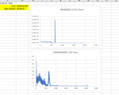
Do I need to apply normalization these two graphs to make them similar to each other and if so, how can I do this? I would be very grateful if you can help me if these results are consistent. I compared the results of the experiment and the results of the mcbend simulation.
 

Attachments
Engineering news on Phys.org
gxa said:
TL;DR Summary: Normalization for simulation results

Do I need to apply normalization these two graphs to make them similar to each other and if so, how can I do this? I would be very grateful if you can help me if these results are consistent. I compared the results of the experiment and the results of the mcbend simulation.
It's best not to post documents that can contain macros, like Word or Excel documents. It's better to upload a PDF or JPEG image of your work to help folks understand your question.

Is this for MCNP work? If so, I can move the thread to the Nuclear Engineering forum, where such questions usually go. Finally, is this for schoolwork? What is the context of the question? Thanks.
 
Got it, thanks. Can you move my question to nuclear engineering section and this is not a homework. Also, I added the necessary graphics for my question as a picture again.
 

Attachments

  • graph.PNG
    graph.PNG
    6.6 KB · Views: 136
  • Like
Likes   Reactions: berkeman
What do you want to learn from your data? Where does it come from?

It's possible the simulation hasn't been scaled to match the expected experimental result. In that case a normalization is useful. If you want to normalize to the same integral, or same integral of a peak, or something else, will depend on your experiment and your data analysis goal.
 
yes, I did not scale the data. what I want to do is to make the graphs similar. But I don't know exactly how to make normalization
 
gxa said:
what I want to do is to make the graphs similar.
Similar in what way, for what purpose?

Your experimental graph doesn't have the same shape as the theoretical one so they won't match up nicely no matter what you do.
 
I think my code is the same as the environment I have set up. I am investigating the accuracy of the simulation. These are the measurements of my detector and I added my code
1692791605783.png
 

Attachments

Similar threads

  • · Replies 0 ·
Replies
0
Views
2K
  • · Replies 1 ·
Replies
1
Views
3K
  • · Replies 17 ·
Replies
17
Views
4K
Replies
4
Views
2K
  • · Replies 7 ·
Replies
7
Views
3K
  • · Replies 61 ·
3
Replies
61
Views
4K
Replies
1
Views
3K
  • · Replies 8 ·
Replies
8
Views
2K
  • · Replies 3 ·
Replies
3
Views
3K