Really hard Volume Question.

  • Thread starter Thread starter DANIELLYMA
  • Start date Start date
  • Tags Tags
    Hard Volume
Join the discussion
Registration is free. Ask a follow-up in this thread, or start your own.
10 replies · 6K views
DANIELLYMA
Messages
16
Reaction score
0
Really hard Volume Question. URGENT!

Can someone help me with this question? I don't know where to begin. I don't want the answers, just hints in the right direction
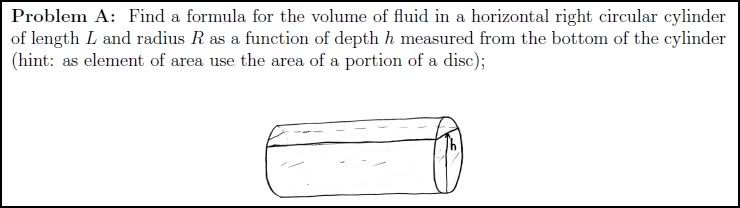
2i6gnif.jpg


*edit* can a mod please fix the topic title? It's supposed to read 'Really hard Volume Question. URGENT!' << Done. >>

Thanks
 
Last edited by a moderator:
Physics news on Phys.org


I can suggest:
http://img101.imageshack.us/img101/1570/49965064rf9.jpg And Volume = area*length
 
Last edited by a moderator:


Call z the axis which h belongs to. You have to find an expression for the area of the rectangle obtained by intersecting the cylinder with an horizontal plane as a function of z and integrate this area from 0 to h.


The area of the disc (what's inside the circle) from -r to h, where h is between -r and r can be figured out by doing half a circle at a time. The function is sqrt (r^2-x^2). Since a disc is symmetrical just find the area above the x-axis and multiply by 2. So the fun part here is finding out what the integral is.


think simple ...
I think it can be solved without integration using bunch of trigonometry and sector, triangle area formulas


Sure area 2 is a fraction of pi r^2. I bet the fraction formula as a function of h is not simple. Area 1 is + when h is above the center of the circle and - when h is below the center. I think I'll stick with my integral since I've already solve a related problem: The probability of intersection between a tossed square and a target disc.


This kind of integral is simple...
What you actually need is the length of the segment obtained by intersecting the circle [tex]x^2 + z^2 = R^2 [\tex] with a straight line z = const. And this is given by <br /> <br /> [tex] b(z) = 2 \sqrt{R^2 - z^2}<br /> [\tex] <br /> <br /> Thus, let L be the height of the cylinder, the area of the rectangle is given by<br /> <br /> [tex] A(z) = L b(z) = L 2 \sqrt{R^2 - z^2}<br /> [\tex] <br /> <br /> And then the volume of the water<br /> <br /> [tex] V(h) = \int_{-R}^{h} A(z) dz<br /> [\tex][/tex][/tex][/tex][/tex]


I don't know why but latex command doesn't work...


hokie1 said:
Sure area 2 is a fraction of pi r^2. I bet the fraction formula as a function of h is not simple. Area 1 is + when h is above the center of the circle and - when h is below the center..

I see.
I failed to consider the other case.


(1/2(pi r^2) + 1/2(pi (r-h)^2 ) * l

would that work?