Reasons for Increasing the Inductive Effect

  • Context: Chemistry 
  • Thread starter Thread starter Crystal037
  • Start date Start date
  • Tags Tags
    Increasing
Join the discussion
Registration is free. Ask a follow-up in this thread, or start your own.
16 replies · 4K views
Crystal037
Messages
167
Reaction score
7
Homework Statement
I have been given order of - I effect of different groups. But I don't know why these groups follow these order.
Relevant Equations
I effect is directly proportional to the electron affinity of the group
Here it has been given that NR3+ has more - I effect than NH3+ but according to my knowledge R group has more +I effect that H. So NR3+ will be stabilised by R groups' +I effect and hence NH3+ should have more - I effect.
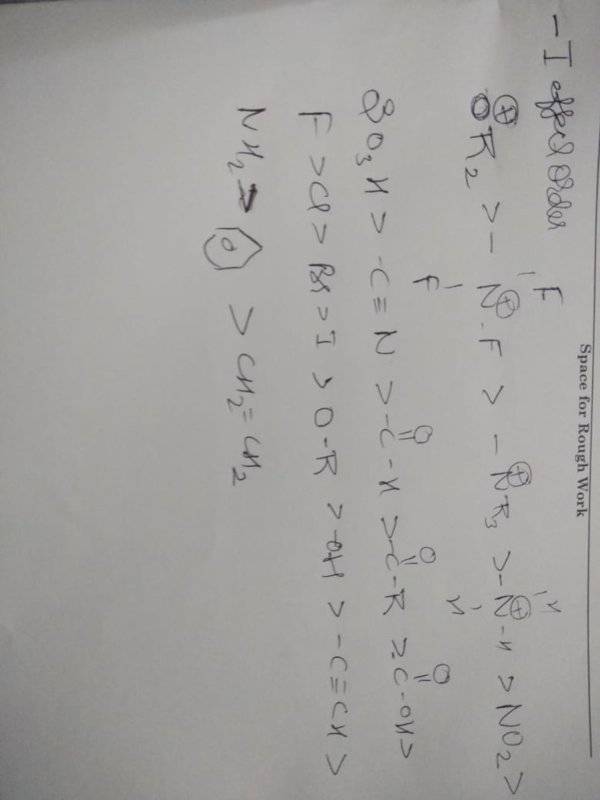
IMG-20191206-WA0005.jpg
 
Physics news on Phys.org
+I effect is positive inductive effect and - I effect is negative inductive effect
 
Can someone please answer me
 
Crystal037 said:
Here it has been given
Where? The inductive effect manifests itself in a few different places (acidity, regioselectivity, etc.). Different applications sometimes give different results. At any rate, I doubt that the inductive effects from NH3 and NR3 really differ substantially.
 
What do you mean by they don't differ substantially
 
Here’s an example. Compare the pKa’s of NH4+ and Et3NH+. Now compare the pKa’s of glycine (at the carboxyl) and trimethylglycine (aka betaine). Notice anything?
 
TeethWhitener said:
Here’s an example. Compare the pKa’s of NH4+ and Et3NH+. Now compare the pKa’s of glycine (at the carboxyl) and trimethylglycine (aka betaine). Notice anything?
pKa of nh3+ is 9.2 while while pka of et3nh+ is 10.75 and pka of glycine 2.34(carboxyl) and 9.6(amino) and pka of trimethylglycine is 1.84. What am I supposed to notice?
 
I was hoping you’d notice there’s not a pattern, thus corroborating my earlier statement:
TeethWhitener said:
I doubt that the inductive effects from NH3 and NR3 really differ substantially.
 
TeethWhitener said:
I was hoping you’d notice there’s not a pattern, thus corroborating my earlier statement:
But pKa of glycine was given in terms of pKa of carboxyl and amino while pKa of trimethylglycine was given in a single term. I don't understand why?
 
TeethWhitener said:
Where? The inductive effect manifests itself in a few different places (acidity, regioselectivity, etc.). Different applications sometimes give different results. At any rate, I doubt that the inductive effects from NH3 and NR3 really differ substantially.
This order has been given in my textbook
IMG_20200413_174423.jpg
of organic chemistry
 
Crystal037 said:
But pKa of glycine was given in terms of pKa of carboxyl and amino while pKa of trimethylglycine was given in a single term. I don't understand why?
For betaine (trimethylglycine) the only acidic proton is the carbonyl. In glycine, you have the carbonyl as well as the ammonium proton. That’s why I asked you to compare the carboxyls (apples to apples).

I don’t know what organic chemistry book you’re using, but I’ve noticed in some organic chemistry books a tendency to overapply a loose rule of thumb. In this case, my general point was that the inductive effects from NR3 and NH3 likely won’t be very different in practice; moreover, they’re likely to be swamped by other, more relevant, considerations in most situations.
 
  • Like
Likes   Reactions: jim mcnamara
Then methyl group shows +I effect more than hydrogen even if hydrogen is more electropositive than carbon
 
No, the trialkylammonium group (-NR3+) is more electron withdrawing than the ammonium group (-NH3+) due to steric effects. Those bulky alkyl groups try harder to achieve a planar structure which makes the bond attached to, whatever, have more ‘p’ character... a shorter bond closer to the positively-charged nitrogen. And closer to the fire usually means warmer!
 
  • Like
Likes   Reactions: TeethWhitener
chemisttree said:
No, the trialkylammonium group (-NR3+) is more electron withdrawing than the ammonium group (-NH3+) due to steric effects. Those bulky alkyl groups try harder to achieve a planar structure which makes the bond attached to, whatever, have more ‘p’ character... a shorter bond closer to the positively-charged nitrogen. And closer to the fire usually means warmer!
The structure of nr3+ would be tetrahedral why would it want to achieve a planar structure
 
The alkyl groups are big enough to bump into each other. They try to get away from each other. The only way to space out is to move more towards a planar structure (they don’t actually achieve planarity). The bond angles (R-N-R) get a little larger. One way to think of it is that the hybridization of the attached N bond changes slightly from sp3 to sp2.?.
Kind of like a VSEPR approach coupled with a bit of quantum mechanics.
 
chemisttree said:
The alkyl groups are big enough to bump into each other. They try to get away from each other. The only way to space out is to move more towards a planar structure (they don’t actually achieve planarity). The bond angles (R-N-R) get a little larger. One way to think of it is that the hybridization of the attached N bond changes slightly from sp3 to sp2.?.
Kind of like a VSEPR approach coupled with a bit of quantum mechanics.
Wouldn't they get more space in a 3 d structure than a 2d planar structure. How come hybridisation of the molecule change it depends on the no if atoms attached to the central atom which doesn't vary in this case.