Recommendaton for Clarifying Special Relativity

Click For Summary
SUMMARY

This discussion focuses on the need for a comprehensive Fact Sheet or FAQ to clarify the foundational elements of Special Relativity (SR) as established by Albert Einstein. Contributors PAllen and Fredrik emphasize the confusion stemming from varying interpretations of SR, particularly regarding Einstein's evolving presentations and the historical context of spacetime diagrams. The conversation highlights the necessity for a unified understanding to prevent misinterpretations and misguided discussions among forum visitors, many of whom may lack formal exposure to the complexities of SR.

PREREQUISITES
  • Understanding of Einstein's Special Relativity (SR)
  • Familiarity with spacetime concepts and diagrams
  • Knowledge of Lorentz Ether Theory (LET) and its implications
  • Basic grasp of the historical evolution of physics theories
NEXT STEPS
  • Research the historical context of Einstein's Special Relativity presentations
  • Study Minkowski spacetime diagrams and their significance in SR
  • Explore the distinctions between Einstein's SR and Lorentz Ether Theory (LET)
  • Investigate effective methods for creating educational FAQs in physics
USEFUL FOR

Physics educators, students in undergraduate and graduate programs, and anyone interested in clarifying their understanding of Special Relativity and its foundational concepts.

bobc2
Messages
842
Reaction score
7
This thread is intended to replace the previous thread that I established (and was closed), because the img link was inadvertently corrupted.

I was hoping to generate interest among the mentors (and the more prominent contributors to this subject) in preparing something like a Fact Sheet or FAQ clarifying the elements of Special Relativity Theory. PAllen and Fredrik have made very useful contributions to the subject and have identified the root source of the problem we have had in the past in discussing foundational issues of special relativity. They have pointed out that some of us have been operating on different basic conceptions of what elements of Einstein’s SR discussions actually constitute The Theory of Special Relativity as it is should be understood.

Perhaps an august team representing the PF stance on this subject could develop a summary of the situation in order to avoid future confusion of the type that has precipitated the kinds of misguided discussions that have taken place in the past.

The diagram below is not offered as a form to be adapted—it is intended merely as a stimulus to motivate a team of seasoned PF mentors and established authoritative PF contributors to come up with some sort of presentation that clarifies the relationships among the various theories and interpretations.
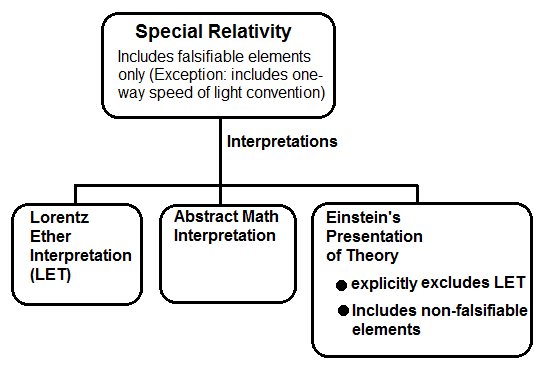
LETvsSR_Diagram_zps3a197c8d.png
 
Last edited:
Physics news on Phys.org
One issue from the get go is that 'Einstein's presentation' of SR evolved through discussion and contribution of others. Initially, it did not emphasize the metric or spacetime; later it did. Spacetime diagrams were little used in SR treatments until circa 1950s (after Einstein died). Einstein never used lines of simultaneity for non-inertial observers. Einstein never enunciated any concept resembling a 'simultaneous space' carried by a general observer, in any presentation I've seen. (Personally, I like some of these innovations [space time diagrames], but not others [treating lines of simultaneity as if they had any objective significance]).

Thus, I don't think focusing on Einstein's presentation is important for a physics forum. We would get bogged down in history, relative emphasis of different documents, and even which translations to give weight to (since almost all of his scientific writings were in German). I suspect there would also be a tendency to read our own pedagogical biases into Einstein's writings.
 
PAllen said:
One issue from the get go is that 'Einstein's presentation' of SR evolved through discussion and contribution of others. Initially, it did not emphasize the metric or spacetime; later it did. Spacetime diagrams were little used in SR treatments until circa 1950s (after Einstein died). Einstein never used lines of simultaneity for non-inertial observers. Einstein never enunciated any concept resembling a 'simultaneous space' carried by a general observer, in any presentation I've seen. (Personally, I like some of these innovations [space time diagrames], but not others [treating lines of simultaneity as if they had any objective significance]).

Thus, I don't think focusing on Einstein's presentation is important for a physics forum. We would get bogged down in history, relative emphasis of different documents, and even which translations to give weight to (since almost all of his scientific writings were in German). I suspect there would also be a tendency to read our own pedagogical biases into Einstein's writings.


PAllen, it seems to me that what you have just described illustrates all the more the benefit of some kind of PF clarification of the relationships among the various concepts you allude to. In four years of an Undergraduate physics program followed by two years of physics Master’s program, then three years of the physics Doctorate program, I don’t recall being exposed to any distinction between Einstein’s presentation of special relativity and what would be considered on this PF as a valid characterization of The Special Theory of Relativity (of course I may not have been paying attention). And in looking back in my old Rindler textbook through the foundational discussions of Einstein’s concepts, I don’t find those distinctions (other than Rindler’s pointed remarks about the explicit exclusion of LET from Einstein’s theory). Now, if after all of my exposure to special relativity, I can be confused throughout extended series of posts here, I just imagine that there must be many other visitors to the forum, who have not had extensive formal exposure to SR, who might well be even more confused than I.
 
bobc2 said:
In four years of an Undergraduate physics program followed by two years of physics Master’s program, then three years of the physics Doctorate program, I don’t recall being exposed to any distinction between Einstein’s presentation of special relativity and what would be considered on this PF as a valid characterization of The Special Theory of Relativity
Perhaps your lack of exposure to these distinctions is an indication of their relative importance.
 
Bill_K said:
Perhaps your lack of exposure to these distinctions is an indication of their relative importance.
Subtle, and if you're saying what I think you're saying, I agree.
Does SR need 'clarifying' ?
No doubt some people find this stuff edifying but for me the words 'dancing, 'angels' and 'pin' come to mind.
 
bobc2 said:
Now, if after all of my exposure to special relativity, I can be confused throughout extended series of posts here, I just imagine that there must be many other visitors to the forum, who have not had extensive formal exposure to SR, who might well be even more confused than I.

Are you really confused? Or do you just not like the answer you have repeatedly gotten, which basically amounts to: the only block on your chart that we talk about here on PF is the one that says "falsifiable elements only"?
 
PeterDonis said:
Are you really confused?

I'm certainly not confused now. The situation has been made quite clear. But, although it is clear to you PF SR experts, it will not necessarily be clear to visitors to the forum.

PeterDonis said:
Or do you just not like the answer you have repeatedly gotten,...

The point of this thread has nothing to do with whether I like or dislike the views of others on the subject of foundational physics. The comments offered have not always been consistent, and, as an example, I'm not the one who presented the confusing narrative that LET is an interpretation of Einstein's special relativity. I understand the context now (as shown in the block diagram of my initial post). It should not be assumed that any visitor to the forum should understand this. It would be more natural, in this example, to assume that Einstein's SR excludes LET, since Einstein's writings and textbooks like Rindler's are so explicit about this.

PeterDonis said:
which basically amounts to: the only block on your chart that we talk about here on PF is the one that says "falsifiable elements only"?

Hopefully, the chart makes the relationships in this regard quite clear now. But, This has not been obvious throughout many of the discussions.

But, the point of this thread is not to rehash old arguments and I have no interest in pursuing the subject further. If it is felt that my suggestion has no merit--fine. It was only a recommendation.
 
bobc2 said:
...some of us have been operating on different basic conceptions of what elements of Einstein’s SR discussions actually constitute The Theory of Special Relativity as it is should be understood.

I think there are several problems with your diagram. First, Einstein's 1905 presentation did not "explicitly exclude" a Lorentzian ether interpretation. It simply said that the identification of a unique frame as the "rest frame of an ether" will prove superfluous. There's a difference between saying something is superfluous and saying it is explicitly excluded. Second, Einstein's presentation did not include any non-falsifiable elements. He was remarkably careful to give operational meanings to all his statements (which is not to say his presentation couldn't have been improved). Third, the one-way speed of light in terms of coordinates in which "the equations of Newtonian mechanics hold good" is an empirical fact, and this is all that special relativity claims, so you shouldn't say this is a non-falsifiable feature of special relativity. Fourth, the expression "Abstract Math Interpretation" doesn't make any sense. A physical theory isn't just math, it requires a correspondence with sense impressions and operational measures (at the very least).
 
bobc2 said:
it will not necessarily be clear to visitors to the forum.

What percentage of forum visitors have raised questions similar to yours? My sense is that it's a very small percentage, but I may be wrong.
 
  • #10
One thing I learned from writing FAQ's or fact based articles is that there are several challenges to consider.

1) What types of questions is the FAQ designed to answer, (a sequential list like a flow chart helps)
2) Where to draw the line on alternate model/proposals/interpretations as opposed to concordance/textbook views (this part is sometimes tricky to control)
3) images and supportive links reliability on a long term basis (broken links are frustrating to a reader)
4) keeping the article as short and as informative as possible (lol personal experience taught me just how tricky that is)
5)level of understanding suitable to a large body of readers ( its easy to get too technical, but a good article needs the technical details, so its a juggling act)

just some things to consider in your writing,
 
  • #11
Never Mind

Never mind.
 
  • #12
bobc2 said:
[..] some of us have been operating on different basic conceptions of what elements of Einstein’s SR discussions actually constitute The Theory of Special Relativity as it is should be understood.
[..]
LETvsSR_Diagram_zps3a197c8d.png
Good start! As already mentioned, Einstein's presentations evolved in the course of time. His early presentations corresponded somewhat with your middle presentation, similar to his other "annus mirabiis papers": the mathematical consequences of a combination of observations. In fact he stuck to discussing falsifiable elements (top balloon). Of course he did give "physical interpretations" of the result, but those were again limited to measurement predictions. Your presentation on the right was perhaps first given by Minkowski. I suggest to replace "Einstein" by "Minkowski", which will steer the reader in the direction of Minkowski Spacetime diagrams etc.

PS. while it is impossible to please everyone, the first balloon could be improved as follows: Includes falsifiable assumptions only (the speed of light is isotropic by definition).
- http://www.fourmilab.ch/etexts/einstein/specrel/www/
 
Last edited:
  • #13
harrylin said:
Good start! As already mentioned, Einstein's presentations evolved in the course of time. His early presentations corresponded somewhat with your middle presentation, similar to his other "annus mirabiis papers": the mathematical consequences of a combination of observations. In fact he stuck to discussing falsifiable elements (top balloon). Of course he did give "physical interpretations" of the result, but those were again limited to measurement predictions. Your presentation on the right was perhaps first given by Minkowski. I suggest to replace "Einstein" by "Minkowski", which will steer the reader in the direction of Minkowski Spacetime diagrams etc.

PS. while it is impossible to please everyone, the first balloon could be improved as follows: Includes falsifiable assumptions only (the speed of light is isotropic by definition).
- http://www.fourmilab.ch/etexts/einstein/specrel/www/

Thanks for the comment, harrylin (especially your polite but accurate tone). I must concur in your observations. You are of course correct to point out that ideas about his own theory evolved over time (as also immediately pointed out by PAllen), so that my characterization was inaccurate in that respect. I actually had not consciously passed over this fact—out of habit, when characterizing Einstein's ideas, I just normally include those expressed from the early ‘20s on (and certainly the late ‘40s and early ‘50s). I probably should not have presented them in that context, at least without qualification. And again you correctly attribute one of the most significant ideas coming out of the special theory to Minkowski, where I, again out of habit, lump Minkowski’s in with Einstein (from Einstein’s book: “…These inadequate remarks can give the reader only a vague notion of the important idea contributed by Minkowski. Without it the general theory of relativity, of which the fundamental ideas are developed in the following pages, would perhaps have got no further than its long clothes.”). And it apparently took Einstein a while to endear himself to Minkowski’s idea.

It kind of reminds me of a recent visit I had with my old relativity advisor. He was a new PhD graduate himself, fresh out of the University of Texas (perhaps a Wheeler student--although Wheeler may not have taken on students at UT), when I entered the PhD program. He commented that as he gets older he is beginning to think more and more about ideas underlying physics. And I think that is what many look for when they come to this forum. But of course that does not mean we should cater at the expense of watering down the theory to the point of presenting inaccurate representations.
 
Last edited:
  • #14
Just to bring the diagram into closer agreement with Harrylin's suggestions. Again, this is not a recommendation to use this diagram. It is only to motivate interest in creating a FAQ

.
LETvsSR_Diagram2_zpse69a2099.png
 
Last edited:
  • #15
harrylin said:
...PS. while it is impossible to please everyone, the first balloon could be improved as follows: Includes falsifiable assumptions only (the speed of light is isotropic by definition).
- http://www.fourmilab.ch/etexts/einstein/specrel/www/

I have a question about this. I think numerous experiments have been conducted that support isotropy for space with very high precision (I believe those tests were all conducted for light traveling one way). However, do those results guarantee the one-way speed of light has been shown to be falsifiable?
 
  • #16
bobc2 said:
I have a question about this. I think numerous experiments have been conducted that support isotropy for space with very high precision (I believe those tests were all conducted for light traveling one way). However, do those results guarantee the one-way speed of light has been shown to be falsifiable?
First a few comments:
- I should not have omitted "one-way" there, sorry for that. MMX happened to be about speed of light isotropy as well, the two-way kind.
- with "Einstein's later presentation" you apparently mean after 1922, as his opinion swayed in all directions until at least then (for example, 1920: "The ether of the general theory of relativity is transmuted conceptually into the ether of Lorentz if we substitute constants for the functions of space which describe the former, disregarding the causes which condition its state."). Minkowski's opinion was certainly more straightforward and constant.
- perhaps your middle interpretation could be called the "shut up and calculate" (non-)interpretation.

Concerning the measurement of one-way light speed isotropy we had many discussions here and there is also an overview article in Wikipedia with many references:
http://en.wikipedia.org/wiki/One-way_speed_of_light

Einstein was very sharp when in 1905 he made the one-way speed of light isotropic "by definition". Two years later he reformulated it even better, IMHO:

"We [...] assume that the clocks can be adjusted in such a way that
the propagation velocity of every light ray in vacuum - measured by
means of these clocks - becomes everywhere equal to a universal
constant c, provided that the coordinate system is not accelerated." (translation by A.Beck)
- original here: http://www.soso.ch/wissen/hist/SRT/E-1907.pdf

For SR to work, it must be possible to define an isotropic one-way speed of light wrt any inertial reference system of choice -because the two-way speed is isotropic. It is the free choice of the operator to set the clocks such that the subsequently measured one-way speed of light in all directions becomes isotropic wrt to that system.
 
Last edited:
  • #17
PAllen said:
Thus, I don't think focusing on Einstein's presentation is important for a physics forum.

Shame.
 
  • #18
TheBC said:
Shame.

Why? Such discussion is great for 'history of science' and philosophy. How often do discussions of electromagnetism as physics focus on textual analysis of Maxwell's papers? Or Schrödinger's, Heisenberg's, etc. for QM? For learning and understanding current understanding of science, current textbooks and papers are the relevant material- they define what current understanding is.

In the case of Einstein, a several of his papers have stood the test of time as still being relevant learning materials (especially SR, less for GR). However, in a science forum they stand on their merits as relevant explanatory papers, not primarily because Einstein wrote them.
 
  • #19
TheBC said:
PAllen said:
Thus, I don't think focusing on Einstein's presentation is important for a physics forum.
Shame.
Here's one of my favorite quotes on relativity (bold emphasis by me)...
To understand a subject, one must tear it apart and reconstruct it in a form intellectually satisfying to oneself, and that (in the view of the differences between individual minds) is likely to be different from the original form. This new synthesis is of course not an individual effort; it is the result of much reading and of countless informal discussions, but for it one must in the end take individual responsibility. Therefore, I apologise, if apology is necessary, for departing from certain traditional approaches which seemed to me unclear, and for insisting that the time has come in relativity to abandon an historical order and to present the subject as a completed whole, completed, that is, in its essentials. In this age of specialisation, history is best left to the historians.
- J.L. Synge in Relativity: The Special Theory (1956), p. vii
(my previous uses of this quote)
https://www.physicsforums.com/showpost.php?p=596099&postcount=16
https://www.physicsforums.com/showpost.php?p=1722297&postcount=7

Similarly, we don't focus on Bohr's presentation when we talk about Quantum Mechanics, or Newton's presentation for Mechanics, or Maxwell's presentation of Electromagnetism.

(Note... it's "focus" not "ignore"... some historical and philosophical motivation is important... but clarity of what the final [or at least current] viewpoint is more important... and should be the target of the "focus".)

[PAllen was quicker to respond.]
 
  • #20
Bobc2,

I think that on this forum it should look like this:
(I'm not sure about the LET part, nor how that should or can work, but I do know that anything below 'Lorentz Trantsformations' is on this forum considered philosophy.)
LETvsSRdiagram_zpsca30c628.jpg
 
  • #21
TheBC said:
anything below 'Lorentz Trantsformations' is on this forum considered philosophy.)

Huh? Even if we restrict discussion purely to the machinery that makes testable predictions (labeling everything else as "philosophy"--which is indeed the position I would take), there's a lot more to that than the Lorentz transformations.

In fact, the Lorentz transformations themselves are not necessary; they are calculational conveniences that help to make the prediction process easier. So are frames of reference. The predictions can be stated entirely in terms of invariant quantities; all you have to do is specify which particular invariant quantities in the math correspond to which particular observable numbers. You can do that without ever doing a Lorentz transformation or defining a reference frame.
 
  • #22
Mathematics is the language of physics. Philosophical BS and historical indulgences are not the language of physics. If you have a problem with that then take it up with mother nature.
 
  • #23
bobc2 said:
I was hoping to generate interest among the mentors (and the more prominent contributors to this subject) in preparing something like a Fact Sheet or FAQ clarifying the elements of Special Relativity Theory. PAllen and Fredrik have made very useful contributions to the subject and have identified the root source of the problem we have had in the past in discussing foundational issues of special relativity. They have pointed out that some of us have been operating on different basic conceptions of what elements of Einstein’s SR discussions actually constitute The Theory of Special Relativity as it is should be understood.

In my opinion it is more pedagogical to include some of general relativity also... It is not really possible to separate between them in a meaningful way... I vote for starting with the experiments and the predictions and from them go into details about the theory after... A list of things to include would be:

1. Some equation explaining how relativity makes it impossible to accelerate stuff to superluminal velocity in an accelerator...
2. Some equation describing how fast a clock will tick in a spherical symmetric gravitational field, including both the effect due to gravitational potential and the effect due to high velocity... Pound and Rebka and the gps-satellites could be examples.
3. Gravitational redshift of light, Mössbauer effect, could be useful.
4. Shapiro Delay, how light slows down (appers to slow down to an external observer) in a gravitational field.

Then you have the more most interesting effects concerning electromagnetic radiation and relativity. Some information on perihelion-precession could of course be interesting, but has less to do with electromagnetism and could perhaps be left out if electromagnetism is the major concern...

The four things listed above is the four basic things I think people should learn. Then you can decide about how much of the theoretical underpinnings to include.
 
  • #24
If this task were to be done,
I would agree with Agerhell to include General Relativity
since it is a continuation of the story of our understanding of physics.

In some sense, it may be interesting to ponder that:

1. At some point in history, there were several competing theories to explain some set of phenomena.

2. Then, later, an extension of one of those theories successfully explained additional phenomena.
In light of this development, some of the other competing theories then may have lose their usefulness if they cannot successfully explain the phenomena. As a family tree, maybe only one branch continues on.
 
  • #25
TheBC said:
Shame.

Not really.

The PF guidelines are

Our mission is to provide a place for people (whether students, professional scientists, or others interested in science) to learn and discuss science as it is currently generally understood and practiced by the professional scientific community.

So, when we discuss relativity, we discuss it as it is currently practiced. The historical elements may be interesting, but they are a sidenote, not the main focus.

Thus, for example, we mostly discuss Maxwell's equations using the modern vector formalism rather than formalism Maxwell originally used in "On Physical Lines of Force". (Which I"ve only glanced at , for whatever it's worth.)

I believe that the general attitude here is that science has made progress over the last 100 years, and that our focus here is on modern physics, not how it was done 100 years ago. This is helpful to students who are trying to learn as well - it would be confusing to a student who was trying to learn Maxwell's equations if someone were to constantly refer to criticize all modern treatments of Maxwell's equations as being misguided because Maxwell originally wrote them differently.

Similar remarks apply for a student learning relativity. It's not helpful to students trying to learn and apply relativity in the real world to focus exclusively on what Einstein said, and totally ignore what's written in their textbooks.

Rather, we focus on what their textbooks say, and we may mention in passing how Einstein originally presented the material.
 
  • #26
TheBC said:
Bobc2,

I think that on this forum it should look like this:
(I'm not sure about the LET part, nor how that should or can work, but I do know that anything below 'Lorentz Trantsformations' is on this forum considered philosophy.)
LETvsSRdiagram_zpsca30c628.jpg

TheBC, I appreciate your attitude about what is relevant in considering the scope of special relativity. While there are lots of side bars that don't need to always come into the SR discussion, relativity of simultaneity and the Einstein-Minkowski space-time concept is certainly not something to push aside as irrelevent.

However, I think we've been able to crystallize out the distinctions that most of the members here would like to establish from among the concepts associated with special relativity. They wish to identify a clear line between what is confirmed directly by observations (experiments) and what might be interpreted from those observations.

There's kind of a catch-22 here in a way. For example, Einstein's postulates and the resulting Lorentz transformations clearly imply relativity of simultaneity and a 4-dimensional space-time. (I have never seen an argument that suggests an ether is implied from Einstein's postulate regarding equivalence of all frames). Notwithstanding the issue of falsifiability, this places the space-time concept in a unique position in that respect.

But now, we can see very clearly that the majority opinion here maintains the space-time concept is only an interpretation, because the concept has no prediction value--it is not falsifiable. On the one hand, the underlying explanatory character of the space-time concept, taken as a priori, leads to the prediction of all of those experimental observations that have been made, confirming the space-time concept. Yet, those resenting any significance attached to the space-time concept can assert that those predictions don't count because they come after the fact, and besides, those predictions have already been made by the Lorentz transformations.

Having said all of that, my friend, I think you can conclude that there will be no winning of this argument for you here.

And I had no intention of this thread extending the argument, because I felt that the majority position (and official PF position) had finally become sufficiently clarified in an earlier thread. I simply wanted to see a FAQ or something that would establish the PF position on this up front for visitors to the forum.

It is easy for the more experienced physicists here to take what is to be understood as Einstein's theory of special relativity for granted. But, when others come here with questions about simultaneity and different cross-section views of the universe (Brian Greene's loaf of bread slices) it can be confusing when told that all of that stuff is irrelevant and has nothing to do with physics.
 
Last edited:
  • #27
bobc2 said:
There's kind of a catch-22 here in a way. For example, Einstein's postulates and the resulting Lorentz transformations clearly imply relativity of simultaneity and a 4-dimensional space-time. (I have never seen an argument that suggests an ether is implied from Einstein's postulate regarding equivalence of all frames). Notwithstanding the issue of falsifiability, this places the space-time concept in a unique position in that respect.

As an example of further nuances, I strongly prefer to think in these terms, yet have significant disagreements with you about things you believe are bundled with these, that I do not think are bundled. For example:

- Relativity of simultaneity: To me (and I believe Einstein) this means different inertial frames disagree about simultaneity; and (for inertial frames only) there is a unique preferred simultaneity that allows the simplest expression and interpretation of physical laws. When non-inertial observers are considered, there is no preferred simultaneity, and no preferred global coordinates. To me, this suggests that there is no objective, non-conventional meaning to simultaneity. The situation is completely analogous to coordinates on a flat plane: flatness means it is possible to introduce cartesian coordinates with a plethora of nice properties; if you chose a curved axis [non inertial observer], there is no longer any uniquely preferred way complete a coordinate system using this curved axis; lines you draw on the plane (simultaneity convention) have no more intrinsic meaning to the geometry of the flat plane than simultaneity conventions have to do with physics of spacetime.

- 4-dimensional spactime: You bundle with this a number of non-geometric notions that I would consider equivalent to giving objective meaning to coordinates rather than geometry. Also, we disagree on whether using a 4-d spacetime model mandates (rather than allows) a deterministic block universe interpretation. To me, it allows it but does not mandate it.
 
  • #28
bobc2 said:
the majority opinion here maintains the space-time concept is only an interpretation, because the concept has no prediction value--it is not falsifiable.

You're kidding, right? Spacetime is part of the mathematical machinery we use to make predictions, as you yourself point out in your very next sentence. If you're going to talk about "the majority opinion here", please get it right.

bobc2 said:
those resenting any significance attached to the space-time concept can assert that those predictions don't count because they come after the fact, and besides, those predictions have already been made by the Lorentz transformations.

Please read my previous post in this thread where I said, as I have said before, that the Lorentz transformations are not fundamental; you can describe all the physics without ever doing a Lorentz transformation (or defining a reference frame).

As for predictions not counting because they come after the fact, I haven't asserted that either. I have, repeatedly, pointed out that making a prediction is not the same as knowing that the prediction is correct; knowing that a prediction is correct is what comes after the fact. And at any given instant on your (or anyone's) worldline, it's important to keep a clear distinction between what you actually know and what you are extrapolating or predicting from what you know. That's not at all the same as saying that predictions "don't count".

I realize that others on PF may have said things that amount to what you are asserting above; but it is simply not correct to represent those things as "the majority opinion here". I am not the only one who has repeatedly said things such as I pointed out above, nor am I the only one who has repeatedly pointed out that you are not correctly representing what we are saying.

bobc2 said:
when others come here with questions about simultaneity and different cross-section views of the universe (Brian Greene's loaf of bread slices) it can be confusing when told that all of that stuff is irrelevant and has nothing to do with physics.

I'm sorry that it's confusing, but I prefer a confusing truth to intuitively plausible sound bites like Greene's loaf of bread slices that cause more problems than they solve (if they actually solve any).
 
  • #29
PAllen said:
Relativity of simultaneity: To me (and I believe Einstein) this means different inertial frames disagree about simultaneity

I would say that the current understanding of relativity puts it somewhat differently:

First, you can talk about relativity of simultaneity without talking about or defining reference frames at all. The Einstein simultaneity convention can be applied purely in terms of the behavior of light signals and observations of them. The term "frame" is often used when what is really meant is "observer", i.e., we mean to be talking about the observations of someone following a particular worldline. Normally this causes no confusion, but in a discussion about fundamentals it's important to make these fine distinctions.

Also, I would say that the main lesson of relativity of simultaneity is that simultaneity is a convention and has no real physical meaning at all. A true relativity purist would expunge words like "simultaneity" and "now" from his vocabulary altogether, and instead talk about what's actually important physically: causal structure--light cones. Saying that a pair of events are "simultaneous" is just a convention, but saying they are spacelike separated (or null or timelike separated, for that matter) is a physical invariant. You can make all the physical predictions you need without ever using the concept of simultaneity.
 
  • #30
PeterDonis said:
You're kidding, right? Spacetime is part of the mathematical machinery we use to make predictions, as you yourself point out in your very next sentence. If you're going to talk about "the majority opinion here", please get it right.

Quote by bobc2 View Post

"the majority opinion here maintains the space-time concept is only an interpretation, because the concept has no prediction value--it is not falsifiable."

It didn't occur to me that the context would not have made the statement clear. So, we'll say: The majority opinion here maintains the Einstein-Minkowski space-time concept is only an interpretation...

But it is refreshing to see your comment emphasizing at least the importance of space-time as mathematical machinery. Of course Einstein saw much more than that in it.


PeterDonis said:
Please read my previous post in this thread where I said, as I have said before, that the Lorentz transformations are not fundamental; you can describe all the physics without ever doing a Lorentz transformation (or defining a reference frame).

Good to hear that as well. I think I've made the same point.

PeterDonis said:
As for predictions not counting because they come after the fact, I haven't asserted that either. I have, repeatedly, pointed out that making a prediction is not the same as knowing that the prediction is correct; knowing that a prediction is correct is what comes after the fact. And at any given instant on your (or anyone's) worldline, it's important to keep a clear distinction between what you actually know and what you are extrapolating or predicting from what you know. That's not at all the same as saying that predictions "don't count".

I don't think we need to rehash that.

PeterDonis said:
I realize that others on PF may have said things that amount to what you are asserting above; but it is simply not correct to represent those things as "the majority opinion here". I am not the only one who has repeatedly said things such as I pointed out above, nor am I the only one who has repeatedly pointed out that you are not correctly representing what we are saying.

Fair enough. I should be more careful about all inclusive comments. But I was really trying to motivate a clarification that could represent the position among the authoritative experts on this PF (such as yourself and the mentors).

PeterDonis said:
I'm sorry that it's confusing, but I prefer a confusing truth to intuitively plausible sound bites like Greene's loaf of bread slices that cause more problems than they solve (if they actually solve any).

But then again, Briane is quite a reputable physicist. And there are others such as Paul Davies who try informing using similar pedagogical tools.
 

Similar threads

  • · Replies 8 ·
Replies
8
Views
1K
  • · Replies 8 ·
Replies
8
Views
3K
  • · Replies 33 ·
2
Replies
33
Views
4K
  • · Replies 1 ·
Replies
1
Views
1K
Replies
90
Views
10K
  • · Replies 17 ·
Replies
17
Views
2K
  • · Replies 32 ·
2
Replies
32
Views
7K
  • · Replies 29 ·
Replies
29
Views
5K
  • · Replies 37 ·
2
Replies
37
Views
7K
  • · Replies 1 ·
Replies
1
Views
3K