MHB Recursive Function for Virus Spread: Finding the General Solution

Click For Summary
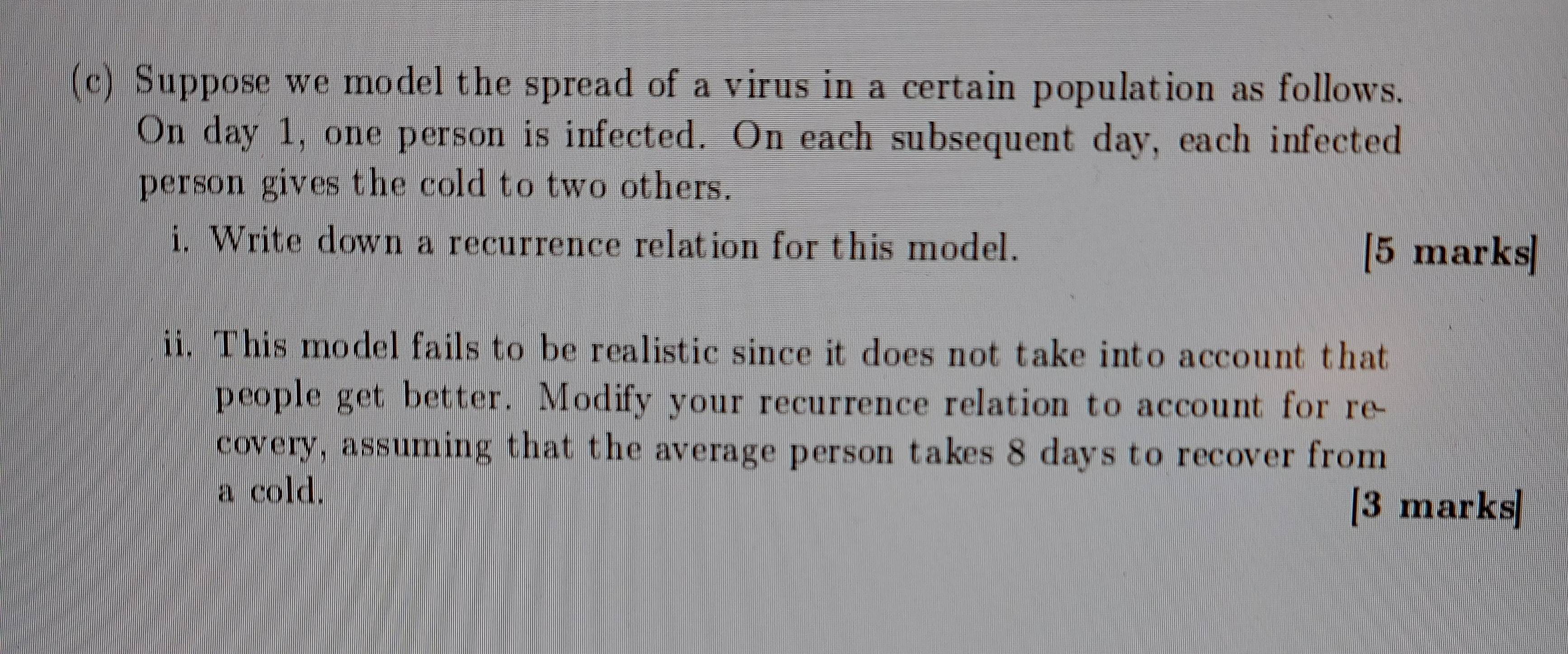
The discussion focuses on modeling the spread of a virus using a recursive function. Initially, one person spreads the virus, leading to a geometric progression where the total number of infected individuals each day can be expressed as powers of 3. The formula derived for the number of sick people on the nth day is x_n = 3^(n-1), which satisfies the recurrence relation x_{n+1} = 3x_n. The mathematical reasoning confirms that the pattern holds true and provides a general solution for the spread of the virus. This approach effectively illustrates the exponential growth of the virus transmission over time.
Tekilou
Messages
1
Reaction score
0
Could anyone please help me I am especially stuck on the second part of the question. Thanks very much I really appreciate it.
20220219_235603.jpg
 
Physics news on Phys.org
What did you have for part (i)?
 
Did you try writing a few numbers to see if you can see a pattern?

On the first day 1 person has the virus and he gives it to 2 other people.

On the second day 1+ 2= 3 people have the virus.
Each of the 3 give the virus to 2 people, a total of 6 new people.

On the third day, 3+ 6= 9 people have the virus.
Each of the 9 people give the virus to 2 people, a total of 18 new people.

On the fourth day a total of 9+ 18= 27 people have the virus.
Each of the 27 people give the virus to 2 people, a total of 54 new people.

On the fifth day a total of 27+ 54= 81 people have the virus.
Each of the 81 people give the virus to 2 people, a total of 162 new people.

On the sixth day a total of 81+ 162= 243 people have the virus.So far we have 1, 3, 9, 27, 81, 243. I see that those are all powers of 3!
$1= 3^0$, $3= 3^1$, $9= 3^2$, $27= 3^3$, $81= 3^4$, $243=3^5$.

I would conjecture that the number of sick people on the nth day is $3^{n-1}$.

Let $x_n$ be the number of sick people on the nth day. Those $x_n$ people each give the virus to 2 people for a total of $2x_n$ new people so on the n+1 day, $x_{n+1}= x_n+ 2x_n= 3x_n$. Does $x_n= 3^{n-1}$ satisfy that? $x_{n+1}= 3^{n+ 1-1}= 3^n= 3^n+ 2(3^n)= 3(3^n)= 3^{n+1}$. Yes, $x_n= 3^{n-1}$ satisfies this "recurrance relation". Further, $x_1= 3^{1- 1}= 3^0= 1$ as required.
 
IF we were a little more "mathematically sophisticated" we could have started from the "recurrence relation". If, on the nth day, $x_n$ people have the virus, each person gives the virus to two new people so a total of $2x_n$ new people. On the n+1 day, $x_{n+ 1}= x_n+ 2x_n= 3x_n$. Since we are repeatedly multiplying by 3, it is easy to see that the general solution to $x_{n+ 1}= 3x_n$ is $x_n= C3^n$ for some constant, C. We have $x_1= 1$ so must have $1= C(3^1)= 3C$ so $C=\frac{1}{3}$. $x_n= \left(\frac{1}{3}\right)3^{n}= 3^{n- 1}$.
 
We all know the definition of n-dimensional topological manifold uses open sets and homeomorphisms onto the image as open set in ##\mathbb R^n##. It should be possible to reformulate the definition of n-dimensional topological manifold using closed sets on the manifold's topology and on ##\mathbb R^n## ? I'm positive for this. Perhaps the definition of smooth manifold would be problematic, though.

Similar threads

  • · Replies 11 ·
Replies
11
Views
1K
  • · Replies 11 ·
Replies
11
Views
2K
Replies
4
Views
3K
  • · Replies 3 ·
Replies
3
Views
2K
  • · Replies 3 ·
Replies
3
Views
3K
  • · Replies 14 ·
Replies
14
Views
3K
  • · Replies 5 ·
Replies
5
Views
3K
  • · Replies 3 ·
Replies
3
Views
658
  • · Replies 1 ·
Replies
1
Views
1K
  • · Replies 5 ·
Replies
5
Views
3K