Redox reactions oxidation number method

Click For Summary

Discussion Overview

The discussion revolves around the application of the oxidation number method in redox reactions, specifically focusing on a scenario where the same molecule, iodine, undergoes both oxidation and reduction. Participants are exploring how to determine the changes in oxidation numbers and how to proceed with calculations based on these changes.

Discussion Character

  • Homework-related
  • Technical explanation

Main Points Raised

  • One participant notes that in the given problem, iodine is both oxidized and reduced, leading to two different changes in oxidation numbers (7 and 1).
  • Another participant confirms the existence of these two different changes in oxidation numbers.
  • A subsequent participant asks how to proceed after identifying the changes in oxidation numbers.
  • One participant suggests that the approach is similar to other redox reactions, indicating that one half-reaction is for reduction and the other for oxidation, and they propose combining them.
  • Another participant attempts to clarify the calculation process, suggesting a multiplication of coefficients to arrive at a final value.
  • One participant expresses confusion about the explanation provided and requests further clarification.
  • A later reply indicates that the participant has gained understanding after the discussion.

Areas of Agreement / Disagreement

Participants appear to agree on the method of using half-reactions for oxidation and reduction, but there is some confusion regarding the specific calculations and explanations. The discussion remains somewhat unresolved as participants seek clarity on the steps involved.

Contextual Notes

There are limitations in the clarity of the problem statement and the assumptions made about the oxidation states. The discussion does not fully resolve the mathematical steps involved in the calculations.

Coco12
Messages
272
Reaction score
0
1) Problem Statement
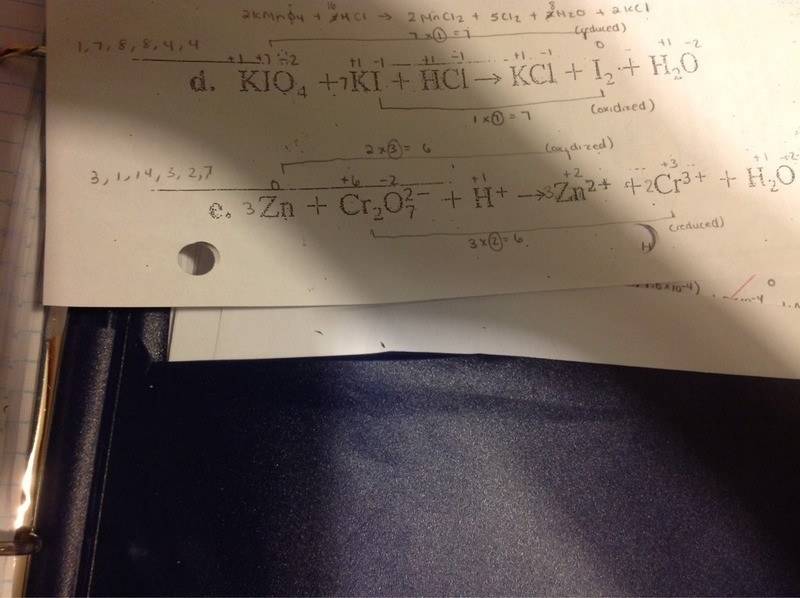
ImageUploadedByPhysics Forums1389217019.130425.jpg
2) Relevant Equations3) Attempt at Solution
For question d, I realize in this case that the substance that is oxidized and reduced is the same molecule : iodine.
How do I proceed then as the next step would ask for you to find the change in oxidation numbers and multiplying by coefficients?
You would have 2 different changes number ( 7 and 1)?
 
Physics news on Phys.org
Coco12 said:
You would have 2 different changes number ( 7 and 1)?

Yes.
 
Borek said:
Yes.
Where do you go from there?
 
Last edited:
Same thing you do with other reactions - one half reaction is for reduction, other is for oxidation, just combine them.
 
Borek said:
Same thing you do with other reactions - one half reaction is for reduction, other is for oxidation, just combine them.

So it would be 7/2 * 1/2 to give you 7/4 , then you multiply everything by 4?
 
I am not going to try to guess what you mean, if you want us to help it is up to you to explain what is what of what.
 
Borek said:
I am not going to try to guess what you mean, if you want us to help it is up to you to explain what is what of what.
Thank you. I understand now.
 

Similar threads

Replies
7
Views
3K
  • · Replies 9 ·
Replies
9
Views
4K
Replies
1
Views
3K
  • · Replies 3 ·
Replies
3
Views
3K
  • · Replies 2 ·
Replies
2
Views
2K
  • · Replies 5 ·
Replies
5
Views
3K
  • · Replies 2 ·
Replies
2
Views
4K
  • · Replies 4 ·
Replies
4
Views
2K
  • · Replies 3 ·
Replies
3
Views
2K
  • · Replies 1 ·
Replies
1
Views
4K