Relation between spectral radiance and density of cavity

Click For Summary

Discussion Overview

The discussion revolves around the relationship between spectral radiance and the density of energy within a blackbody cavity, particularly focusing on the integration of angles to determine the energy emitted from the cavity. Participants explore the implications of integrating over specific angular limits and the physical reasoning behind these choices.

Discussion Character

  • Technical explanation
  • Conceptual clarification
  • Debate/contested

Main Points Raised

  • One participant presents an equation for energy coming from defined directions and questions the integration limits for angles θ and Φ, suggesting that integrating θ from 0 to π/2 yields half the energy density.
  • Another participant challenges the choice of integrating θ from 0 to π/2, arguing that to account for the entire radiation from the blackbody cavity, integration should extend to π.
  • Some participants express confusion regarding the distinction between the entire blackbody and the cavity, seeking clarification on whether integrating only to π/2 is appropriate for considering radiation from inside the cavity.
  • There is a discussion about the implications of the hole in the cavity and whether radiation from outside the cavity should be considered, with some suggesting that if only the emission from the blackbody is of interest, external radiation is irrelevant.
  • One participant emphasizes that the energy density, ρ(ν), is assumed to be uniform within the cavity, and the integration should focus on how much radiation reaches the hole from the cavity's interior.
  • Another participant describes the process of calculating the energy contained in a small element of the cavity and how to determine the radiation that reaches the hole, reiterating the need for integration over a hemisphere.

Areas of Agreement / Disagreement

Participants express differing views on the appropriate limits for integration and the relevance of external radiation, indicating that multiple competing views remain without a consensus on the correct approach.

Contextual Notes

Participants highlight potential confusion regarding the integration limits and the assumptions about the uniformity of energy density within the cavity, which may affect the interpretation of the results.

Jhordan
Messages
5
Reaction score
0
Hi, my teacher showed us how we can derive de relation between spectral radiance and density of cavity (of a black hole), but I have a doubt.
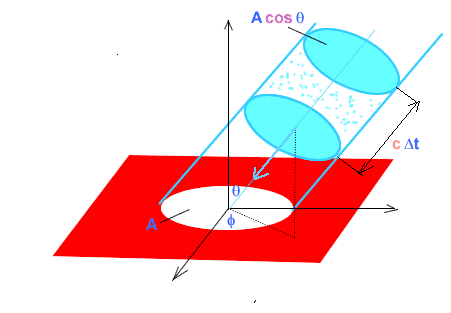
This is the equation of the energy that are coming from definited directions by the intervals of angles θ and Φ with frequency in a determined interval:
relR_rho.png

$$
\left[\rho\left(\nu\right)d\nu\right]\cdot\left[\frac{\sin\left(\theta\right)d\theta d\phi}{4\pi}\right]
$$

But if we integrade θ from 0 to π/2 and Φ from 0 to 2π so we has:
$$
\frac{\rho\left(\nu\right)d\nu}{2}
$$

I think that this are because if the body are in thermal equilibriu, same quantity energy that are coming to in are coming out from, so how we onlye need want the nergy that are being irradiated by the black body, we have half of this total of density of energy. I am correct?

Thank you

Link for complete derivation [in portuguese]: https://www.if.ufrgs.br/~betz/iq_XX_A/radTerm/aRadTermAd_1.htm
 

Attachments

  • relR_rho.png
    relR_rho.png
    6.6 KB · Views: 1,018
Physics news on Phys.org
Jhordan said:
But if we integrade θ from 0 to π/2 and Φ from 0 to 2π so we has:
$$
\frac{\rho\left(\nu\right)d\nu}{2}
$$
Why are you integrating ##\theta## from 0 to ##\pi/2##? If you want to consider the entire radiation from a piece of the blackbody cavity, you need to integrate up to ##\pi##.

The reason why the limit is ##\pi/2## in the derivation is that a hole in the cavity will only get radiation from one side, the inside of the cavity.
 
  • Like
Likes   Reactions: Jhordan
Well, this is exact the fact that i am trying confirm, maybe i made some confusion betweem the entire black body and this cavity. So, i am correct when I say that i integrate θ only up to π/2 π, because I only want get radiation from inside of the cavity?

The other half are radiation coming from external of the cavity?

Thanks again.
 
Jhordan said:
Well, this is exact the fact that i am trying confirm, maybe i made some confusion betweem the entire black body and this cavity. So, i am correct when I say that i integrate θ only up to π/2 π, because I only want get radiation from inside of the cavity?
The point of the calculation is to figure out the emission of a blackbody by considering a blackbody cavity with a hole in it, and calculating the radiation that leaks out, which will be the same as the radiation from the blackbody itself.

Jhordan said:
The other half are radiation coming from external of the cavity?
It depends on the situation you are considering. If you just want the emission from the blackbody, then there is nothing on the other side of the hole.
 
So, we have the equation of the energy that are coming from definited directions by the intervals of angles θ and Φ with frequency in a determined interval, that are:
$$\left[\rho\left(\nu\right)d\nu\right]\cdot\left[\frac{\sin\left(\theta\right)d\theta d\phi}{4\pi}\right]$$
And at this moment, don't matter if the energy are coming from black body or infinite, or whatever. If we integrate over a sphere, we have the radiation coming from all directions to our element of volume.

But more later, in the derivation, we want only the energy that are coming from inside of the cavity, the emission of blackbody. Thus we integrate over the half of the sphere, that is, the outer directions to our infinite plane - the black body - of the hole.
 
Jhordan said:
And at this moment, don't matter if the energy are coming from black body or infinite, or whatever. If we integrate over a sphere, we have the radiation coming from all directions to our element of volume.
Well, I don't like the way you put it. What bothers me is that the ##\rho(\nu)## in the equation is the energy density inside a blackbody cavity. It is true that ##\rho(\nu)## doesn't have to be specified at that point, but it is assumed to be uniform.

I am used to the presentation of the problem being the reverse of the way you present it here. Looking again at the link you provided (my Portuguese is limited), it appears to be also presented in the way I know: you start by considering a little element of the cavity, and see how much of the radiation contained therein reaches the hole. Then, you integrate over all elements inside the cavity that reach the hole at a given time. This is the reason why the integration is over only a hemisphere.
 
So, the cylinder are the little element, and then this equation multiplied by the volume of this element give me the energy contained in this element of the cavity. The next step are see how much of this radiation reaches the hole, then we integrate over all elements inside the cavity that reach the hole, and here that we want only a hemisphere.
 
I think that I understand now. Thanks, if you want close the topic, it's okay for me.

Thank you again.
 

Similar threads

  • · Replies 18 ·
Replies
18
Views
2K
  • · Replies 4 ·
Replies
4
Views
3K
  • · Replies 1 ·
Replies
1
Views
2K
  • · Replies 9 ·
Replies
9
Views
4K
  • · Replies 1 ·
Replies
1
Views
3K
  • · Replies 2 ·
Replies
2
Views
3K
  • · Replies 15 ·
Replies
15
Views
4K
  • · Replies 4 ·
Replies
4
Views
2K
  • · Replies 2 ·
Replies
2
Views
9K
  • · Replies 11 ·
Replies
11
Views
2K